Post by : Avinab Raana
Photo : X / AeroTime
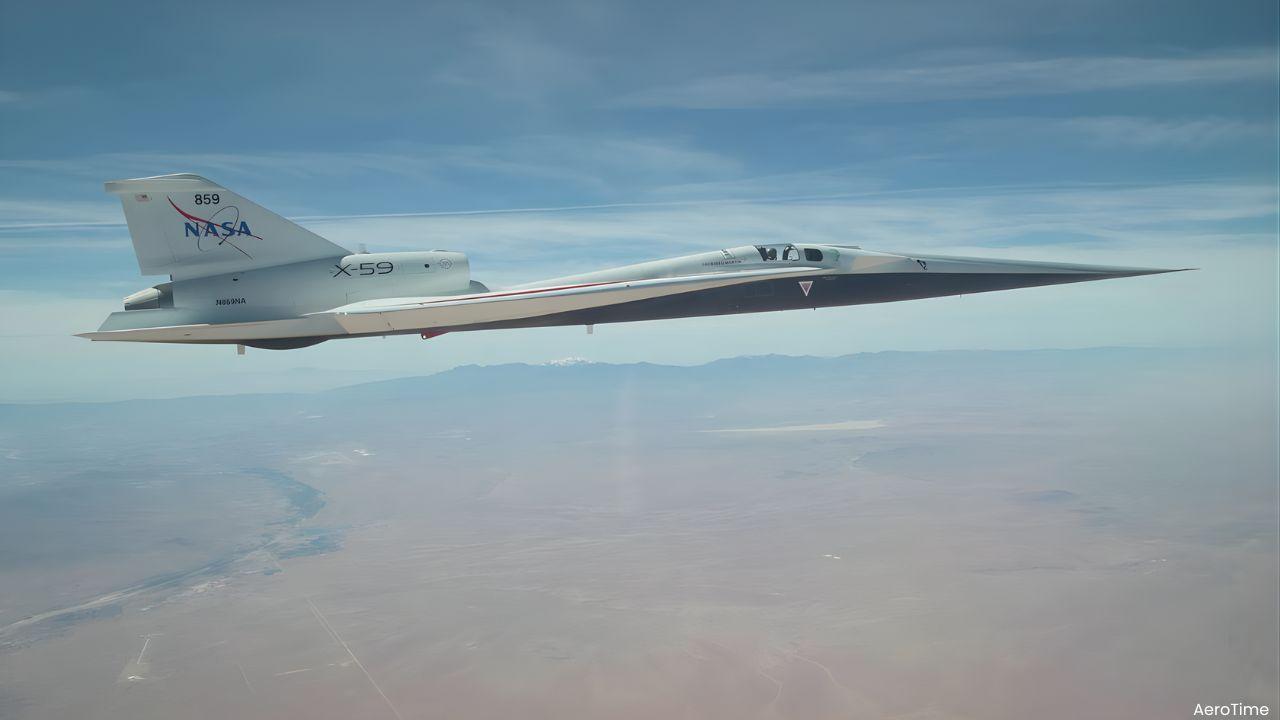
The future of aviation is edging closer to a historic transformation as NASA’s X-59 prepares for its next critical phase demonstrating how supersonic flight can finally overcome one of its greatest barriers: the sonic boom. Designed under NASA’s Quesst mission, the experimental aircraft is not just another high-speed jet; it represents a fundamental rethinking of how aircraft interact with the atmosphere. As global demand for faster travel intensifies, the X-59’s mission could unlock a new era where flying faster than sound is no longer restricted by noise limitations, potentially reshaping long-haul aviation forever.
At the heart of the X-59’s innovation lies its ability to dramatically reduce the disruptive sonic boom into what engineers describe as a softer “sonic thump.” Traditional supersonic aircraft, such as the Concorde, generated powerful shockwaves that produced thunder-like booms, leading to strict bans on supersonic flight over land in many countries. The X-59 addresses this issue through its unique elongated fuselage and carefully engineered airframe, which spreads shockwaves into smaller, less intense pulses.This breakthrough is not just about noise reduction, it is about redefining the economics and feasibility of supersonic travel. By minimizing ground-level disturbance, the X-59 could pave the way for regulatory changes that allow commercial supersonic flights over populated areas, a possibility that has remained out of reach for decades.
The aircraft has already completed its initial flight tests, marking the beginning of an extensive evaluation campaign that will span multiple phases. These early “wheels-up” flights are designed to validate the aircraft’s safety, system integration, and baseline performance before advancing to full supersonic testing. As the program progresses, NASA will gradually push the X-59 to higher altitudes and faster speeds, eventually exceeding the speed of sound while collecting crucial acoustic data. These tests will play a central role in proving that the aircraft can consistently deliver reduced-noise supersonic performance, setting the stage for broader adoption across the aviation industry.
Unlike traditional experimental aircraft programs, the X-59 is not just about technological demonstration—it is about influencing policy. NASA plans to conduct community overflight tests, gathering real-world feedback on how people perceive the quieter sonic “thump.” This data will then be shared with regulators worldwide to establish new noise standards for supersonic travel.This approach reflects a shift toward data-driven policymaking in aviation, where technological capability and public acceptance must align. If successful, the X-59 could directly contribute to lifting long-standing restrictions on supersonic travel over land, opening up faster travel routes across continents and significantly reducing journey times.
Built in collaboration with Lockheed Martin, the X-59 is powered by a modified engine mounted above the fuselage, an unconventional design choice aimed at minimizing the number of shockwaves reaching the ground. This configuration, combined with its needle-like nose and advanced aerodynamics, highlights the level of engineering precision required to achieve quiet supersonic flight. Beyond its technical achievements, the aircraft represents a major step toward commercial viability. The ability to fly supersonically without disruptive noise could revive interest in high-speed passenger travel, enabling airlines to offer significantly shorter flight times without compromising environmental or regulatory constraints.
The X-59 is more than an experimental jet, it is a vision of what the future of aviation could look like. As airlines, manufacturers, and regulators watch closely, the success of this program could redefine how we think about speed, efficiency, and connectivity in air travel. If NASA’s quiet supersonic technology delivers on its promise, the skies of the future may no longer be defined by limitations, but by possibilities where crossing continents in half the time becomes a practical, everyday reality. The question now is not whether supersonic travel will return, but how soon it will reshape the global aviation landscape.
#trending #latest#NASAX59 #SupersonicFlight #QuietBoom #AerospaceInnovation #FutureAviation





Advances in Aerospace Technology and Commercial Aviation Recovery
Insights into breakthrough aerospace technologies and commercial aviation’s recovery amid 2025 chall

Defense Modernization and Strategic Spending Trends
Explore key trends in global defense modernization and strategic military spending shaping 2025 secu

Tens of Thousands Protest in Serbia on Anniversary of Deadly Roof Collapse
Tens of thousands in Novi Sad mark a year since a deadly station roof collapse that killed 16, prote

Canada PM Carney Apologizes to Trump Over Controversial Reagan Anti-Tariff Ad
Canadian PM Mark Carney apologized to President Trump over an Ontario anti-tariff ad quoting Reagan,

The ad that stirred a hornets nest, and made Canadian PM Carney say sorry to Trump
Canadian PM Mark Carney apologizes to US President Trump after a tariff-related ad causes diplomatic

Bengaluru-Mumbai Superfast Train Approved After 30-Year Wait
Railways approves new superfast train connecting Bengaluru and Mumbai, ending a 30-year demand, easi



