Post by : Avinab Raana
Photo : X / @vargasmoni
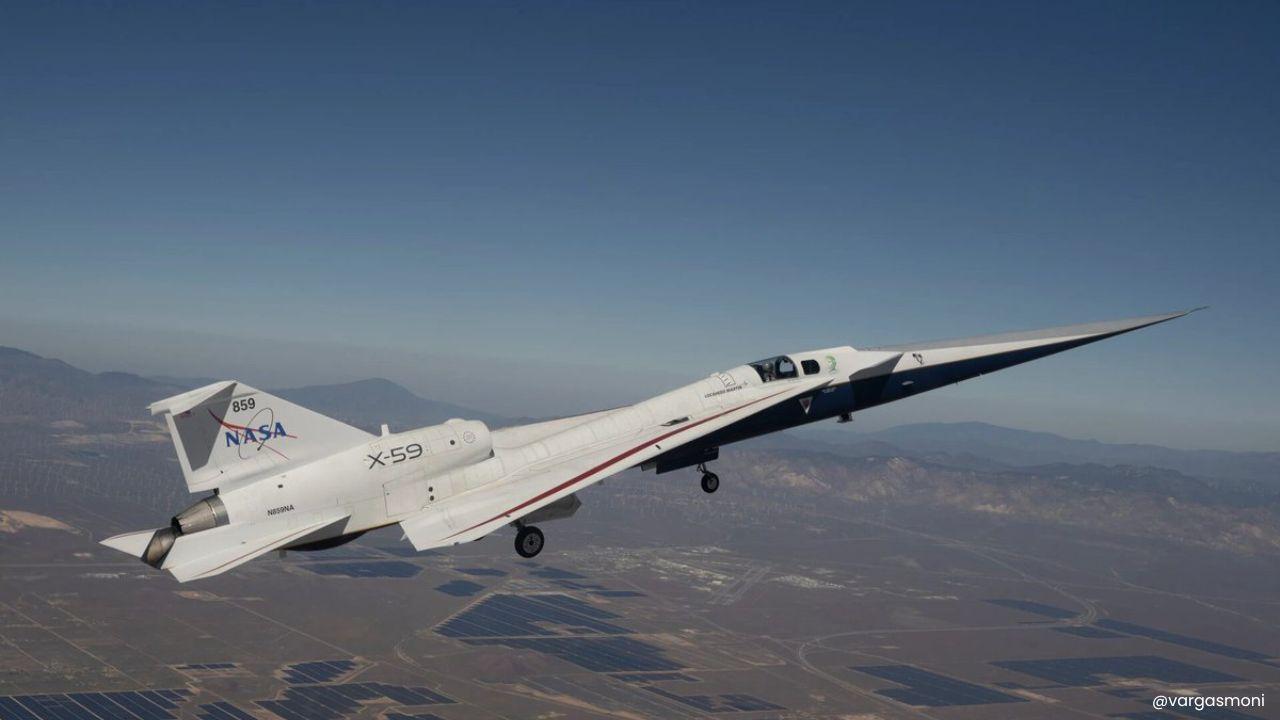
In a development that could redefine the future of aviation, NASA’s X-59 Quesst aircraft is steadily progressing through critical ground and pre-flight testing phases, bringing the dream of quiet supersonic travel closer to reality. Unlike the supersonic jets of the past that were grounded by disruptive sonic booms, the X-59 is designed to dramatically reduce that noise into a soft “thump,” potentially unlocking overland supersonic flight for the first time in decades. As the aviation industry searches for faster yet sustainable travel solutions, this project stands at the intersection of innovation, regulation, and global transportation transformation.
At the heart of the X-59’s mission is a revolutionary aerodynamic design that reshapes how shockwaves are generated and perceived. The aircraft’s long, slender fuselage and carefully engineered nose structure are intended to prevent the traditional explosive sonic boom, instead dispersing shockwaves in a controlled manner. This design innovation is not just a technical milestone, it directly addresses the regulatory barrier that has restricted supersonic travel over land since the era of the Concorde. By solving the noise problem, NASA is effectively reopening a chapter in aviation that has remained closed for over 50 years.
The X-59 program has now entered an advanced phase of system integration and ground testing, including engine runs, avionics validation, and structural evaluations. These tests are crucial in ensuring that the aircraft performs reliably under real-world conditions. The aircraft, developed in collaboration with Lockheed Martin, is undergoing rigorous checks at its Skunk Works facility, where cutting-edge aerospace technologies are brought to life. Each successful milestone moves the program closer to its highly anticipated first flight, expected to pave the way for a new category of commercial aviation.
Beyond engineering, the X-59 mission is deeply tied to shaping future aviation policy. Once flight tests begin, NASA plans to conduct community overflights to collect real-world data on how people perceive the reduced sonic signature. This data will be shared with regulators worldwide, including agencies like Federal Aviation Administration, to potentially revise existing restrictions on supersonic travel over land. If successful, this could open vast new corridors for faster air travel, reducing long-haul flight times and transforming global connectivity.
The success of the X-59 could trigger a new wave of innovation across the aerospace industry. Aircraft manufacturers and airlines are closely watching the program, as it holds the potential to create an entirely new market for commercial supersonic travel. Faster travel times, combined with reduced noise pollution, could redefine passenger expectations and operational models. Moreover, advancements from the X-59 program are likely to influence next-generation aircraft designs, including those focused on fuel efficiency and sustainability.
If quiet supersonic flight becomes a commercial reality, the implications for global transportation are profound. Flights that currently take 10–12 hours could be reduced to nearly half, reshaping business travel, tourism, and international trade. Major global corridors such as North America to Europe or Asia could see unprecedented improvements in travel efficiency, strengthening economic ties and accelerating global mobility.
NASA’s X-59 is more than just an experimental aircraft, it is a bold step toward redefining the boundaries of aviation. As testing progresses and the possibility of quiet supersonic travel becomes increasingly tangible, the industry stands on the brink of a transformation that could rival the introduction of jet engines decades ago. The question is no longer whether supersonic travel will return, but how soon it will reshape the skies and how the world will adapt to a faster, quieter future of flight.
#trending #latest,#NASAX59 #SupersonicFlight #QuesstMission #AviationInnovation #FutureOfFlight






Advances in Aerospace Technology and Commercial Aviation Recovery
Insights into breakthrough aerospace technologies and commercial aviation’s recovery amid 2025 chall

Defense Modernization and Strategic Spending Trends
Explore key trends in global defense modernization and strategic military spending shaping 2025 secu

Tens of Thousands Protest in Serbia on Anniversary of Deadly Roof Collapse
Tens of thousands in Novi Sad mark a year since a deadly station roof collapse that killed 16, prote

Canada PM Carney Apologizes to Trump Over Controversial Reagan Anti-Tariff Ad
Canadian PM Mark Carney apologized to President Trump over an Ontario anti-tariff ad quoting Reagan,

The ad that stirred a hornets nest, and made Canadian PM Carney say sorry to Trump
Canadian PM Mark Carney apologizes to US President Trump after a tariff-related ad causes diplomatic

Bengaluru-Mumbai Superfast Train Approved After 30-Year Wait
Railways approves new superfast train connecting Bengaluru and Mumbai, ending a 30-year demand, easi



