Post by : Avinab Raana
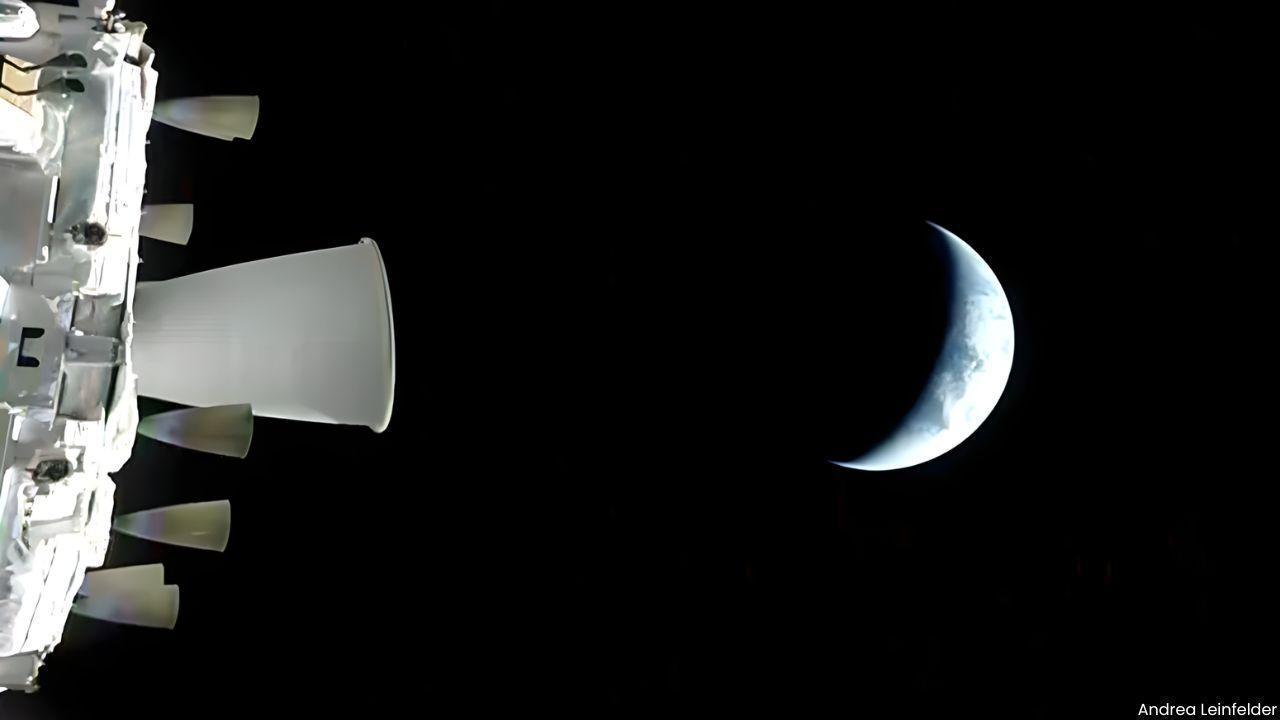
Photo : X / Andrea Leinfelder
In a defining moment for modern space exploration, NASA’s Artemis II mission has officially set course for the Moon after successfully completing a critical engine burn, marking the first crewed journey beyond Earth’s orbit in over five decades. This milestone not only revives humanity’s lunar ambitions but also signals a powerful shift toward deep-space exploration, positioning the Artemis program as the cornerstone of future interplanetary missions. As global attention turns skyward, this mission represents both a technological triumph and a symbolic return to the Moon after more than 50 years.
At the heart of this breakthrough lies the successful execution of the translunar injection (TLI) burn—a precisely timed engine ignition that propelled the Orion spacecraft out of Earth’s orbit and onto a lunar trajectory. Lasting nearly six minutes, the burn accelerated the spacecraft sufficiently to break free from Earth’s gravitational hold and begin its journey toward the Moon. This maneuver is widely regarded as the mission’s point of no return, committing the crew to a deep-space path that mirrors the historic Apollo missions while leveraging cutting-edge modern technology.
The Artemis II mission is designed as a 10-day test flight, carrying four astronauts aboard the Orion spacecraft on a free-return trajectory around the Moon. Unlike the Apollo landings, this mission will not touch down on the lunar surface but will instead focus on validating critical systems required for future crewed landings. The spacecraft will travel farther from Earth than any human mission since 1972, looping around the Moon before returning safely to Earth. This approach ensures that all systems from navigation to life support are rigorously tested in deep-space conditions.
Central to the mission is the Orion spacecraft, a next-generation crew vehicle engineered to withstand the harsh conditions of deep space. Equipped with advanced propulsion, navigation, and life-support systems, Orion is designed to support astronauts during long-duration missions beyond low Earth orbit. The success of the engine burn and subsequent trajectory alignment demonstrates the spacecraft’s capability to perform under extreme conditions, reinforcing confidence in its role as the backbone of NASA’s future lunar and Mars missions.
Artemis II is not just a standalone mission, it is a critical stepping stone in NASA’s broader Artemis program, which aims to establish a sustained human presence on the Moon and eventually pave the way for missions to Mars. By validating systems and operational procedures, Artemis II sets the stage for Artemis III, which is expected to include a crewed lunar landing. The data collected during this mission will be instrumental in shaping future exploration strategies, from spacecraft design to mission planning.
Beyond its scientific significance, Artemis II highlights the evolution of space transportation into a highly advanced and collaborative domain. The mission includes international participation, reflecting a growing trend toward global partnerships in space exploration. As space agencies and private players increasingly collaborate, missions like Artemis II are redefining the boundaries of transportation extending them far beyond Earth and into deep space.
The successful engine burn of Artemis II marks more than a technical milestone, it represents the beginning of a new era in human exploration. As the Orion spacecraft journeys toward the Moon, it carries with it the ambitions of a generation determined to push beyond known limits. The path ahead is filled with challenges, but also unprecedented opportunities. With Artemis II leading the way, humanity is not just returning to the Moon, it is preparing to go even further, redefining the future of transportation on a cosmic scale.
#trending #latest,#ArtemisII #MoonMission #NASA #SpaceExploration #OrionSpacecraft







Advances in Aerospace Technology and Commercial Aviation Recovery
Insights into breakthrough aerospace technologies and commercial aviation’s recovery amid 2025 chall

Defense Modernization and Strategic Spending Trends
Explore key trends in global defense modernization and strategic military spending shaping 2025 secu

Tens of Thousands Protest in Serbia on Anniversary of Deadly Roof Collapse
Tens of thousands in Novi Sad mark a year since a deadly station roof collapse that killed 16, prote

Canada PM Carney Apologizes to Trump Over Controversial Reagan Anti-Tariff Ad
Canadian PM Mark Carney apologized to President Trump over an Ontario anti-tariff ad quoting Reagan,

The ad that stirred a hornets nest, and made Canadian PM Carney say sorry to Trump
Canadian PM Mark Carney apologizes to US President Trump after a tariff-related ad causes diplomatic

Bengaluru-Mumbai Superfast Train Approved After 30-Year Wait
Railways approves new superfast train connecting Bengaluru and Mumbai, ending a 30-year demand, easi



