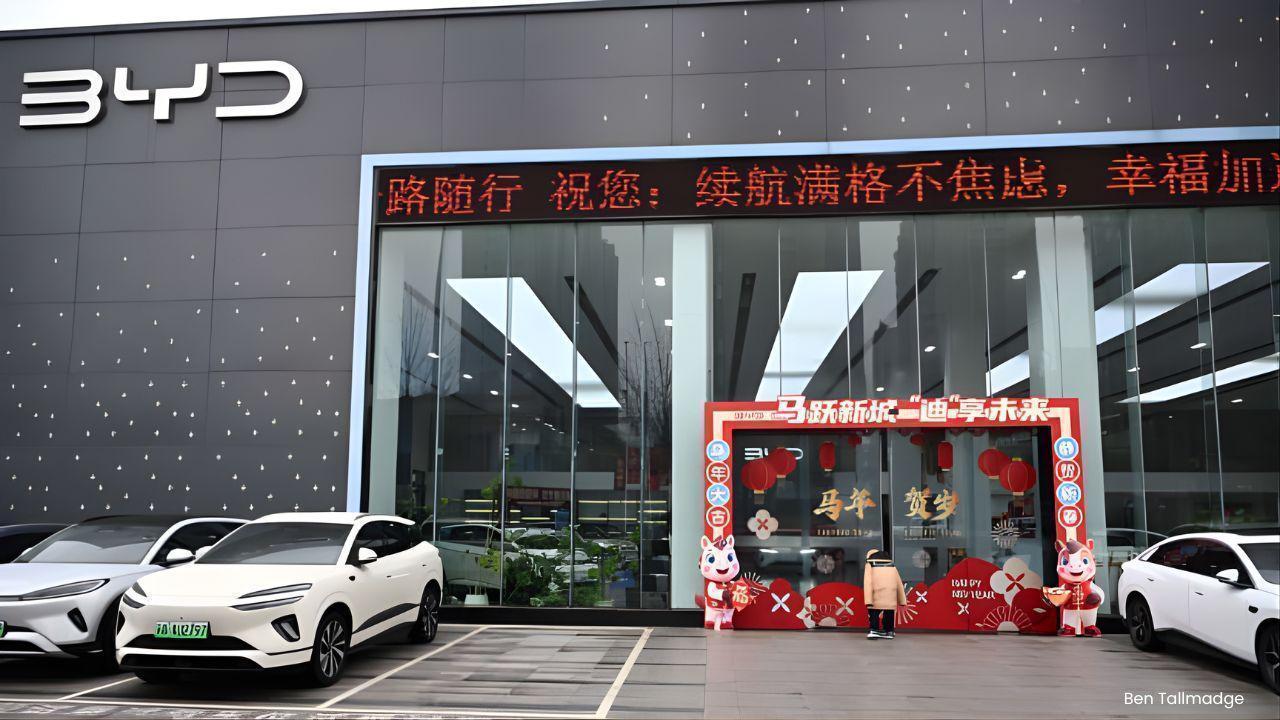
Post by : Avinab Raana
Photo : X / Ben Tallmadge
China’s electric vehicle giant is facing a temporary slowdown as BYD EV sales delivered mixed results during a seasonal holiday period that traditionally dampens consumer activity. The dip reflects the broader rhythm of the EV market in China, where major festivals and travel seasons often slow retail demand before sales bounce back in the following months.
Despite the short-term decline, industry observers say the slowdown appears more seasonal than structural. China remains the world’s largest market for electric vehicles China, and manufacturers like BYD continue to dominate domestic sales while expanding their presence globally.
The slowdown in BYD EV sales largely reflects the typical lull that occurs during China’s major holiday period, when consumer spending shifts toward travel and family activities rather than vehicle purchases. Dealerships across the country often experience lower showroom traffic during these weeks.
However, the EV market in China has shown remarkable resilience over the past few years. Even when temporary slowdowns occur, strong government policies, expanding charging infrastructure, and rising consumer awareness of electric mobility continue to drive long-term growth.
BYD has become one of the most influential players in electric vehicles China, competing aggressively across multiple segments including compact city cars, sedans, and premium electric models. The company’s strategy of offering a broad lineup at competitive prices has helped it capture significant market share.
The automaker’s integrated manufacturing approach—producing its own batteries and critical components also gives it a cost advantage in the increasingly competitive EV market. This vertical integration allows BYD to respond quickly to demand shifts and maintain strong production capacity even during industry fluctuations.
China’s electric vehicle landscape has grown fiercely competitive, with both domestic and international automakers fighting for market share. While BYD EV sales remain among the strongest in the industry, rivals are rapidly introducing new models designed to attract younger and tech-focused consumers.
At the same time, companies are expanding exports to Europe, Southeast Asia, and other global markets as the domestic EV market becomes more crowded. This international expansion strategy has become a key pillar for Chinese manufacturers looking to maintain rapid growth.
Despite the temporary slowdown, analysts remain optimistic about the long-term trajectory of electric vehicles China. Rising fuel costs, supportive policies, and advances in battery technology are expected to keep demand strong in the coming years.
For BYD, the recent dip in BYD EV sales may simply represent a pause in an otherwise rapid expansion story. As consumer activity returns to normal and new models enter showrooms, the company will be looking to regain momentum in one of the world’s most dynamic and competitive EV markets.
BYD EV sales, electric vehicles China, EV market








Advances in Aerospace Technology and Commercial Aviation Recovery
Insights into breakthrough aerospace technologies and commercial aviation’s recovery amid 2025 chall

Defense Modernization and Strategic Spending Trends
Explore key trends in global defense modernization and strategic military spending shaping 2025 secu

Tens of Thousands Protest in Serbia on Anniversary of Deadly Roof Collapse
Tens of thousands in Novi Sad mark a year since a deadly station roof collapse that killed 16, prote

Canada PM Carney Apologizes to Trump Over Controversial Reagan Anti-Tariff Ad
Canadian PM Mark Carney apologized to President Trump over an Ontario anti-tariff ad quoting Reagan,

The ad that stirred a hornets nest, and made Canadian PM Carney say sorry to Trump
Canadian PM Mark Carney apologizes to US President Trump after a tariff-related ad causes diplomatic

Bengaluru-Mumbai Superfast Train Approved After 30-Year Wait
Railways approves new superfast train connecting Bengaluru and Mumbai, ending a 30-year demand, easi



