Post by : Avinab Raana
photo : X / Harsh Kumar
India’s ambitious bullet train project linking Mumbai and Ahmedabad has once again drawn national attention as discussions around cost escalation intensify. The high-speed rail corridor, considered one of the country’s most transformative transport initiatives, is witnessing revised financial estimates as construction continues across several key segments.
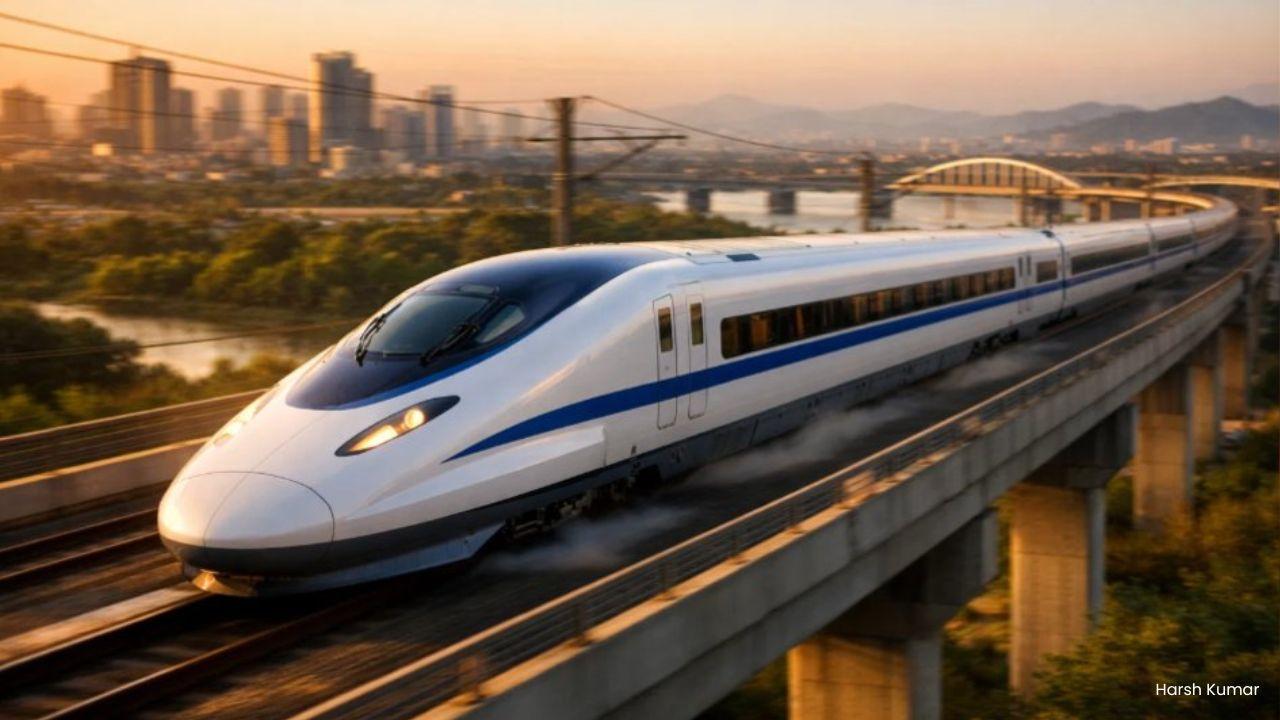
The Mumbai Ahmedabad bullet train corridor represents India’s first attempt at introducing true high-speed rail technology. Designed to significantly reduce travel time between the two economic hubs, the project aims to reshape long-distance transportation while offering passengers a faster and more efficient alternative to conventional rail travel.
Rising infrastructure costs have become a major talking point around the bullet train project, with estimates suggesting that the overall investment required for the corridor has increased compared with earlier projections. Large-scale transport projects often face cost adjustments due to factors such as land acquisition challenges, engineering complexities, and changes in construction timelines.
As India continues to build advanced transport infrastructure, such cost revisions are increasingly common in mega projects that involve complex engineering, international collaboration, and long development timelines.
Amid speculation over who will bear the increased costs, the National High Speed Rail Corporation Limited (NHSRCL) has clarified that Indian Railways will not shoulder the entire financial burden. According to project officials, the funding structure for the corridor was designed to distribute financial responsibilities across multiple stakeholders.
Authorities have emphasised that the financial model includes government backing and structured financing arrangements, ensuring the bullet train project remains financially viable even as construction costs evolve.
Despite the financial debates, the Mumbai Ahmedabad bullet train project continues to move forward as a landmark step in India’s transport modernization. The corridor is expected to introduce advanced train technology capable of operating at speeds exceeding 300 km per hour, dramatically reducing travel time between the two cities.
In addition to faster travel, the project is expected to stimulate industrial development, boost job creation, and strengthen domestic expertise in high-speed rail technology. Infrastructure experts believe the corridor could serve as a blueprint for future high-speed rail projects across the country.
The discussion around rising costs has not slowed the broader vision behind India’s high-speed rail ambitions. Policymakers view the bullet train project as a long-term investment aimed at transforming intercity mobility and supporting economic growth.
As construction continues and more sections move toward completion, the project remains a symbol of India’s commitment to building next-generation transport systems that match global standards.
bullet train project, Mumbai Ahmedabad bullet train, NHSRCL








Advances in Aerospace Technology and Commercial Aviation Recovery
Insights into breakthrough aerospace technologies and commercial aviation’s recovery amid 2025 chall

Defense Modernization and Strategic Spending Trends
Explore key trends in global defense modernization and strategic military spending shaping 2025 secu

Tens of Thousands Protest in Serbia on Anniversary of Deadly Roof Collapse
Tens of thousands in Novi Sad mark a year since a deadly station roof collapse that killed 16, prote

Canada PM Carney Apologizes to Trump Over Controversial Reagan Anti-Tariff Ad
Canadian PM Mark Carney apologized to President Trump over an Ontario anti-tariff ad quoting Reagan,

The ad that stirred a hornets nest, and made Canadian PM Carney say sorry to Trump
Canadian PM Mark Carney apologizes to US President Trump after a tariff-related ad causes diplomatic

Bengaluru-Mumbai Superfast Train Approved After 30-Year Wait
Railways approves new superfast train connecting Bengaluru and Mumbai, ending a 30-year demand, easi



