Post by : Avinab Raana
Photo : X / @max_otto4
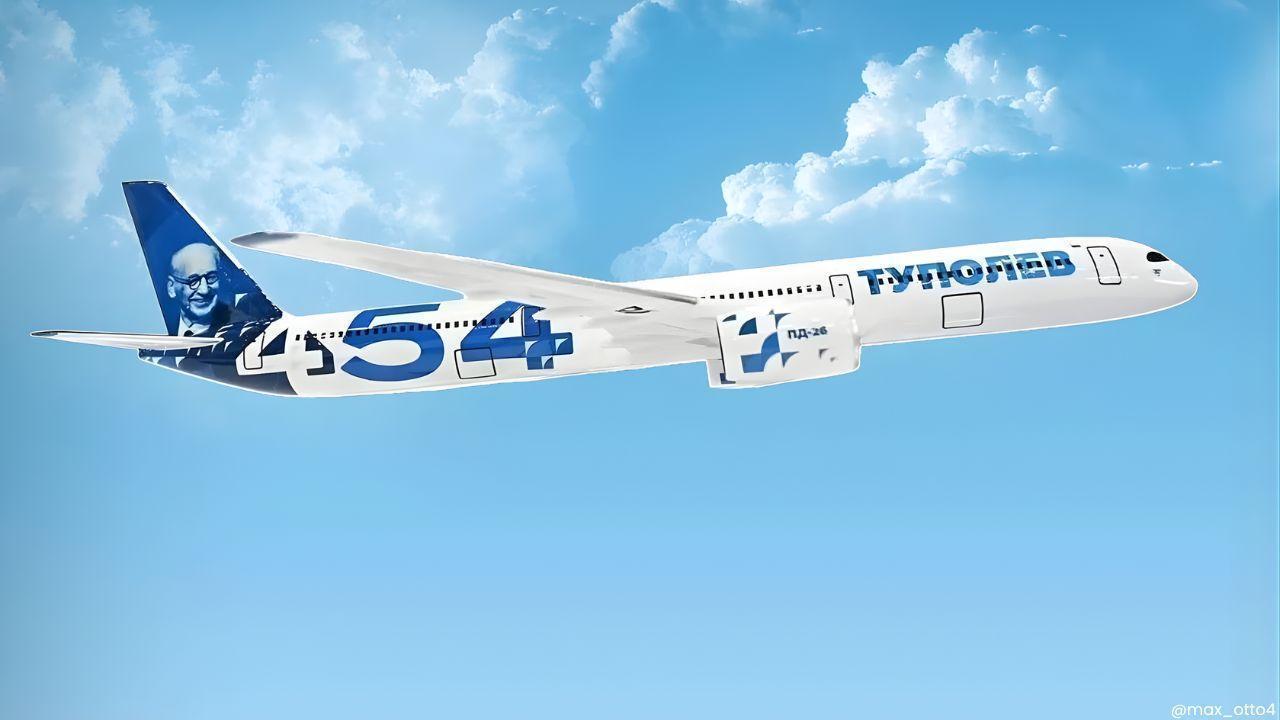
In a move that could reshape the dynamics of global aviation, Russia has unveiled the Tupolev Tu-454, a next-generation widebody aircraft concept designed to compete directly with industry leaders Boeing and Airbus. The announcement signals a strategic push by Russia to reclaim its position in the long-haul aviation segment, a market that has long been dominated by Western manufacturers. With increasing geopolitical pressures and restricted access to foreign aircraft, the Tu-454 represents not just an engineering ambition but a critical step toward aviation self-reliance and global competitiveness.
The Tu-454 is envisioned as a twin-engine, long-range widebody aircraft capable of carrying between 250 and 350 passengers over distances of approximately 15,000 kilometres, placing it squarely in the same category as the Boeing 787 Dreamliner and Airbus A350. Its design incorporates advanced composite materials and aerodynamic improvements aimed at enhancing fuel efficiency and operational performance, aligning with modern airline requirements. This positions the aircraft as a serious contender on paper, targeting the most competitive segment of the global aviation market.
A key highlight of the Tu-454 program is its reliance on domestically developed engines, particularly the PD-26 turbofan, which is currently under development. This move reflects Russia’s broader strategy to reduce dependence on Western technology and build a fully self-sufficient aerospace ecosystem. However, the development of such advanced engines remains a complex challenge, especially when compared to the maturity and efficiency of established Western counterparts. The success of the Tu-454 will heavily depend on how effectively these technological hurdles are addressed in the coming years.
The unveiling of the Tu-454 must be understood within the broader context of global geopolitics and sanctions that have significantly limited Russia’s access to Boeing and Airbus aircraft. With domestic airlines increasingly reliant on aging fleets and restricted supply chains, the need for an indigenous long-haul aircraft has become urgent. The Tu-454, therefore, is not just a commercial project, it is a strategic necessity aimed at sustaining Russia’s aviation network across its vast geography and international routes.
Despite its ambitious positioning, the Tu-454 faces substantial challenges in entering a market dominated by decades of innovation, global supply chains, and established customer trust. Boeing and Airbus benefit from extensive maintenance networks, certification systems, and long-standing airline partnerships—advantages that are difficult to replicate. Additionally, concerns around sanctions, certification approvals, and global acceptance may limit the aircraft’s reach beyond domestic and allied markets, even if its technical performance meets expectations.
If successfully developed, the Tu-454 could introduce a new competitive dimension to the aviation industry, particularly in regions seeking alternatives to Western aircraft manufacturers. It also reflects a broader trend of nations investing in domestic aerospace capabilities, similar to China’s push with COMAC. The emergence of new players in the widebody segment could eventually reshape pricing, supply chains, and airline procurement strategies across the globe.
The Tupolev Tu-454 stands as a bold statement of intent, a vision to challenge the dominance of Boeing and Airbus in the most demanding segment of commercial aviation. While the concept showcases promising specifications and strategic ambition, its success will ultimately depend on execution, technological maturity, and global acceptance. As the aviation industry watches closely, the Tu-454 could either become a breakthrough innovation or a reminder of how difficult it is to compete at the highest level of aerospace engineering.
#trending #latest#TupolevTu454 #AviationInnovation #WidebodyAircraft #AirbusA350 #Boeing787









Advances in Aerospace Technology and Commercial Aviation Recovery
Insights into breakthrough aerospace technologies and commercial aviation’s recovery amid 2025 chall

Defense Modernization and Strategic Spending Trends
Explore key trends in global defense modernization and strategic military spending shaping 2025 secu

Tens of Thousands Protest in Serbia on Anniversary of Deadly Roof Collapse
Tens of thousands in Novi Sad mark a year since a deadly station roof collapse that killed 16, prote

Canada PM Carney Apologizes to Trump Over Controversial Reagan Anti-Tariff Ad
Canadian PM Mark Carney apologized to President Trump over an Ontario anti-tariff ad quoting Reagan,

The ad that stirred a hornets nest, and made Canadian PM Carney say sorry to Trump
Canadian PM Mark Carney apologizes to US President Trump after a tariff-related ad causes diplomatic

Bengaluru-Mumbai Superfast Train Approved After 30-Year Wait
Railways approves new superfast train connecting Bengaluru and Mumbai, ending a 30-year demand, easi



