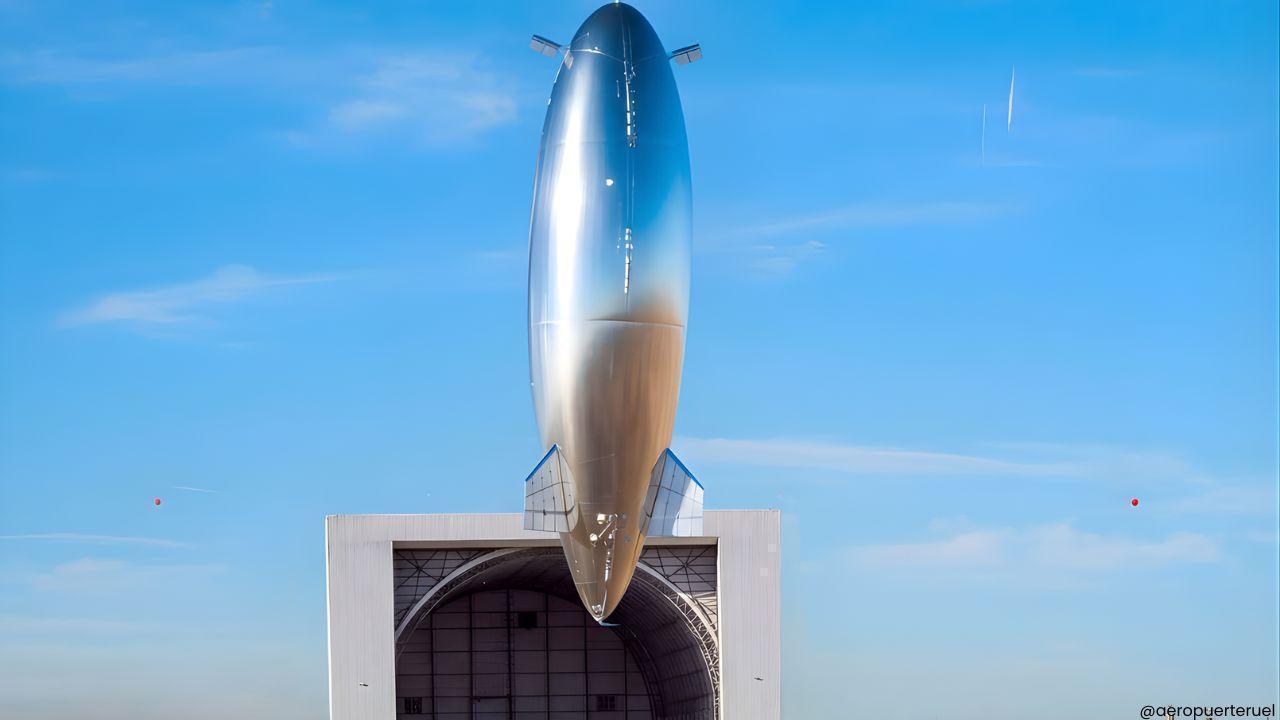
Post by : Avinab Raana
Photo : X / @aeropuerteruel
The boundaries of aviation and space are beginning to blur as Sceye successfully completes a groundbreaking 12-day high-altitude platform mission, marking a pivotal moment in aerospace innovation. Operating in the stratosphere far above commercial air traffic yet below satellites, this achievement introduces a new operational layer that could redefine global connectivity, environmental monitoring, and surveillance systems. More than just a flight milestone, this mission signals the arrival of a new category of infrastructure that sits between traditional aviation and space-based systems, opening up transformative possibilities for industries worldwide.
The mission saw Sceye’s solar-powered SE2 high-altitude platform system travel approximately 6,400 miles from New Mexico to the coast of Brazil, maintaining operations for over 12 consecutive days at altitudes exceeding 52,000 feet. What makes this achievement particularly significant is not just the distance covered, but the endurance demonstrated. The platform successfully maintained position over targeted areas for extended periods over 88 hours while sustaining stable operations across multiple day-night cycles.This level of persistence is critical for real-world applications, where continuous presence over a region can deliver capabilities that neither satellites nor conventional aircraft can easily provide.
At the core of this breakthrough lies a sophisticated combination of solar energy systems, battery storage, and advanced flight control technologies. The platform harnesses solar power during daylight hours to charge onboard batteries, enabling uninterrupted operation through the night, a key requirement for long-duration missions. Equally important is the platform’s ability to maintain altitude, pressure, and stability in the harsh conditions of the stratosphere. These technical achievements demonstrate a level of maturity that brings high-altitude platform systems (HAPS) closer to commercial deployment, moving beyond experimental phases into practical, scalable solutions.
The implications of this mission extend far beyond aerospace engineering. Sceye’s platforms are designed to function as “cell towers in the sky,” delivering broadband connectivity directly to regions where traditional infrastructure is limited or nonexistent.This capability has the potential to transform global communication networks, particularly in remote and underserved areas. By operating at fixed positions for extended periods, HAPS platforms can provide reliable, high-speed connectivity without the need for extensive ground infrastructure, significantly reducing costs and deployment time. In addition to telecommunications, these platforms can support real-time environmental monitoring, disaster response, and climate tracking applications that require persistent, high-resolution data collection over large geographic areas.
The success of this mission introduces a new dimension to the transportation and aerospace ecosystem. By occupying the stratospheric layer, HAPS platforms create a complementary system to both traditional aviation and satellite networks, enabling more efficient use of global airspace. For the transportation sector, this could lead to enhanced navigation systems, improved weather forecasting, and more efficient logistics planning. The integration of high-altitude platforms into existing infrastructure networks has the potential to improve operational efficiency across aviation, maritime, and land-based transport systems.This development also signals a shift in aerospace design philosophy, where endurance and persistence are becoming as important as speed and range.
The 12-day mission marks the culmination of Sceye’s Endurance Program, providing critical data and validation needed to move toward commercial operations. With pre-commercial telecom flights already planned, the company is positioning itself at the forefront of a rapidly emerging industry.This transition from testing to deployment is a key indicator of market readiness, suggesting that high-altitude platforms could soon become a standard component of global infrastructure. As industries seek more efficient and scalable solutions, the demand for such technologies is expected to grow significantly.
Sceye’s achievement comes at a time when multiple players are exploring high-altitude platforms as an alternative to satellite-based systems. This has sparked a new competitive landscape, where companies and governments are racing to establish dominance in the stratospheric domain.The advantages of HAPS lower latency, higher flexibility, and reduced costs make them an attractive option for a wide range of applications. As technology continues to advance, the stratosphere is emerging as a critical frontier in the global infrastructure ecosystem.
As the aerospace industry continues to evolve, the success of Sceye’s mission offers a glimpse into a future where connectivity, monitoring, and communication are no longer limited by ground infrastructure or orbital constraints.The ability to maintain long-duration operations in the stratosphere opens up new possibilities for industries ranging from telecommunications to transportation and environmental science.In the bigger picture, this achievement represents more than a technological milestone, it marks the beginning of a new era where the skies themselves become an integral part of global infrastructure. The question now is not whether this new layer will be integrated into our daily lives, but how quickly it will reshape the way we connect, move, and understand the world around us.
#trending #latest#Sceye #HAPS #StratosphericFlight #AerospaceInnovation #FutureConnectivity




Advances in Aerospace Technology and Commercial Aviation Recovery
Insights into breakthrough aerospace technologies and commercial aviation’s recovery amid 2025 chall

Defense Modernization and Strategic Spending Trends
Explore key trends in global defense modernization and strategic military spending shaping 2025 secu

Tens of Thousands Protest in Serbia on Anniversary of Deadly Roof Collapse
Tens of thousands in Novi Sad mark a year since a deadly station roof collapse that killed 16, prote

Canada PM Carney Apologizes to Trump Over Controversial Reagan Anti-Tariff Ad
Canadian PM Mark Carney apologized to President Trump over an Ontario anti-tariff ad quoting Reagan,

The ad that stirred a hornets nest, and made Canadian PM Carney say sorry to Trump
Canadian PM Mark Carney apologizes to US President Trump after a tariff-related ad causes diplomatic

Bengaluru-Mumbai Superfast Train Approved After 30-Year Wait
Railways approves new superfast train connecting Bengaluru and Mumbai, ending a 30-year demand, easi



