Post by : Avinab Raana
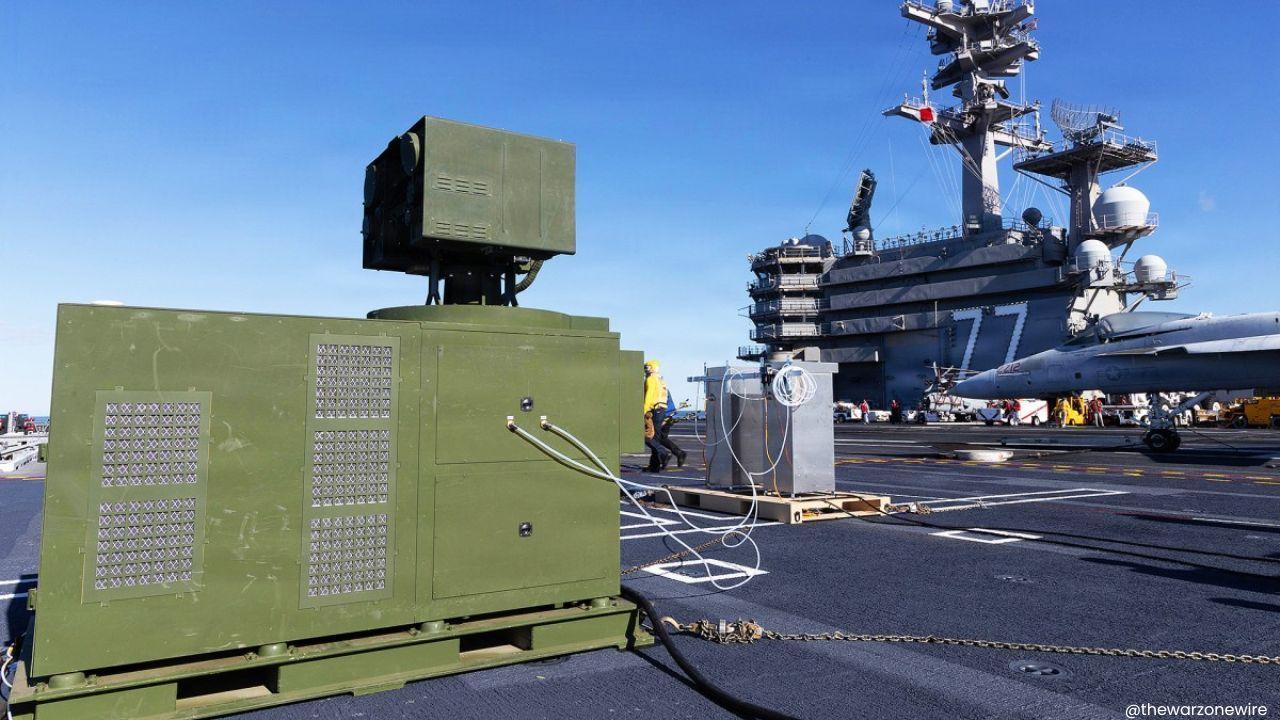
In a breakthrough that signals the arrival of next-generation naval combat systems, AeroVironment has taken its LOCUST directed-energy laser weapon to sea, marking a pivotal step toward redefining how modern warships defend themselves against increasingly sophisticated threats. As unmanned aerial systems and drone swarms become more accessible and harder to counter using traditional missiles, the demand for faster, more cost-effective defense solutions has reached a critical point. The deployment of a laser weapon in a maritime environment is not just a technological milestone, it represents a paradigm shift where defense systems operate at the speed of light, delivering precision strikes without the logistical constraints of conventional munitions. In a world where reaction time determines survival, the LOCUST system could become a cornerstone of future naval defense strategy.
AeroVironment’s move to test the LOCUST laser weapon at sea reflects a growing urgency within defense circles to operationalize directed-energy technologies. While land-based testing has demonstrated the system’s effectiveness, the maritime environment presents a far more complex challenge, requiring the system to perform under dynamic conditions such as motion, humidity, and varying atmospheric interference. By transitioning to sea trials, the company is taking a decisive step toward validating the system’s real-world applicability and readiness for deployment on naval platforms. This progression highlights the broader shift from experimental defense concepts to deployable solutions that can address evolving threats in real time.
At the core of the LOCUST system is its ability to neutralize threats using concentrated beams of energy rather than physical projectiles. Designed to counter drones and unmanned systems, the laser weapon offers several key advantages instantaneous engagement, pinpoint accuracy, and significantly lower operational costs compared to traditional missile-based systems. Unlike conventional interceptors that require continuous resupply, a laser weapon can engage multiple targets as long as power is available, making it particularly effective against swarm attacks. The system’s precision also minimizes collateral damage, allowing it to disable specific components of a target without causing widespread destruction. This capability is especially valuable in congested operational environments where distinguishing between threats and non-threats is critical.
The increasing use of drones in both military and asymmetric warfare scenarios has created new vulnerabilities for naval forces. Small, fast-moving, and often inexpensive, drones can overwhelm traditional defense systems, creating a pressing need for scalable and cost-efficient countermeasures. The LOCUST laser weapon is designed to address exactly this challenge, offering a solution that can engage multiple threats quickly and effectively. For naval commanders, this translates into enhanced situational control and the ability to respond to emerging threats without depleting valuable missile inventories. As drone technology continues to evolve, the importance of adaptable defense systems like LOCUST will only grow, making them a critical component of future naval strategies.
AeroVironment’s sea trials are part of a broader industry trend where directed-energy weapons are moving from research laboratories to operational deployment. Defense organizations worldwide are investing heavily in laser and high-energy systems, recognizing their potential to complement existing capabilities and provide a cost-effective alternative to traditional weapons. The success of LOCUST could accelerate this transition, encouraging further investment and development across the sector. It also positions AeroVironment as a key player in the rapidly evolving field of directed-energy defense, where innovation is driving the next wave of military capability.
One of the most significant advantages of laser weapons lies in their cost efficiency. Traditional missile interceptors can cost hundreds of thousands, if not millions, of dollars per shot, while a laser system can engage targets at a fraction of that cost. This economic advantage becomes critical in high-intensity scenarios where large numbers of threats must be neutralized quickly. By reducing the cost per engagement, systems like LOCUST enable naval forces to maintain a higher level of readiness and sustainability, even during prolonged operations. This shift has the potential to fundamentally change the economics of warfare, making advanced defense capabilities more accessible and scalable.
As AeroVironment’s LOCUST laser weapon moves from concept to real-world testing at sea, it marks the beginning of a new chapter in naval warfare one where speed, precision, and efficiency redefine the rules of engagement. This is not just an incremental upgrade; it is a transformative leap that could reshape how navies protect their fleets in an increasingly complex threat environment. With drones, missiles, and emerging technologies challenging traditional defense systems, the ability to respond instantly and cost-effectively will be the defining factor of future military success. And as the first beams of this new generation of weapons cut through the maritime sky, one thing becomes clear the future of defense may no longer rely on firepower alone, but on the power of light itself.
#trending #latest#LaserWeapon #LOCUST #NavalDefense #DroneDefense #DirectedEnergy









Advances in Aerospace Technology and Commercial Aviation Recovery
Insights into breakthrough aerospace technologies and commercial aviation’s recovery amid 2025 chall

Defense Modernization and Strategic Spending Trends
Explore key trends in global defense modernization and strategic military spending shaping 2025 secu

Tens of Thousands Protest in Serbia on Anniversary of Deadly Roof Collapse
Tens of thousands in Novi Sad mark a year since a deadly station roof collapse that killed 16, prote

Canada PM Carney Apologizes to Trump Over Controversial Reagan Anti-Tariff Ad
Canadian PM Mark Carney apologized to President Trump over an Ontario anti-tariff ad quoting Reagan,

The ad that stirred a hornets nest, and made Canadian PM Carney say sorry to Trump
Canadian PM Mark Carney apologizes to US President Trump after a tariff-related ad causes diplomatic

Bengaluru-Mumbai Superfast Train Approved After 30-Year Wait
Railways approves new superfast train connecting Bengaluru and Mumbai, ending a 30-year demand, easi



