Post by : Avinab Raana
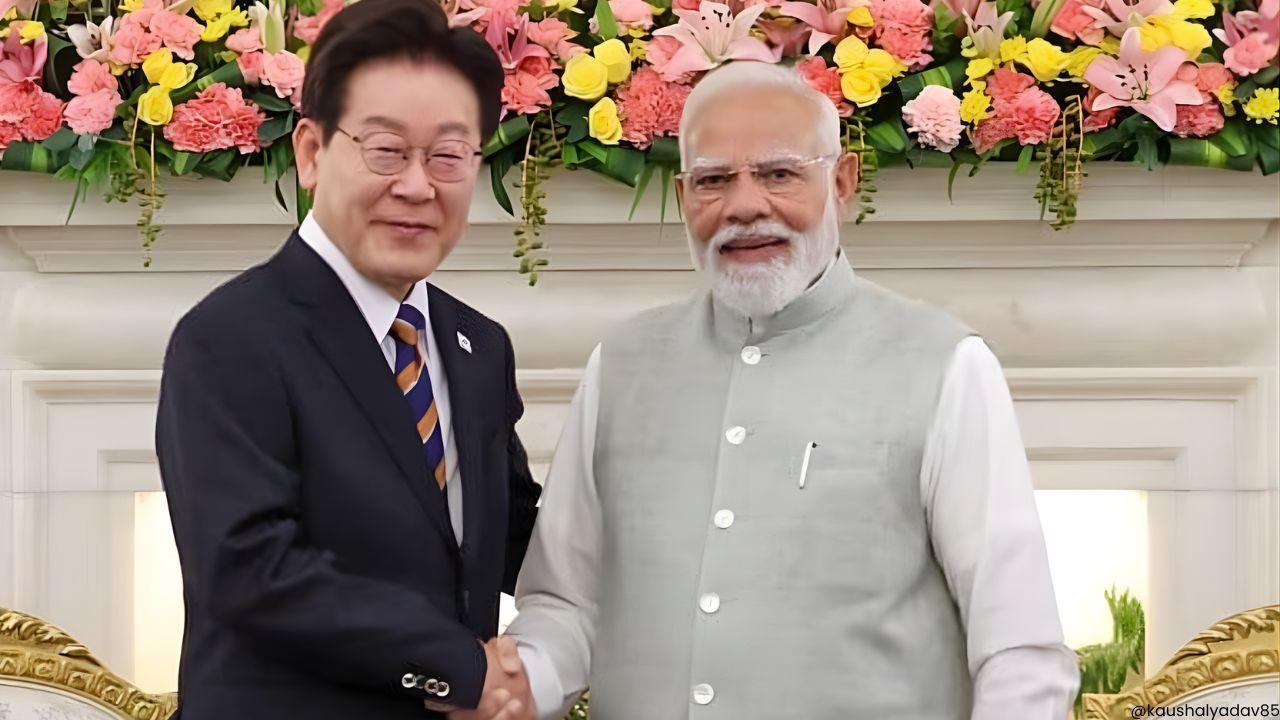
In one of the most ambitious maritime collaborations in recent years, India and South Korea have unveiled a sweeping partnership that aims to unlock a massive ₹2.2 lakh crore shipbuilding opportunity, an initiative that could fundamentally reshape India’s position in the global maritime economy. At a time when supply chains, trade routes, and industrial capabilities are being redefined worldwide, this pact signals a decisive push to transform India from a growing maritime player into a dominant shipbuilding and logistics hub. Anchored in a shared strategic vision, the agreement goes far beyond conventional cooperation, bringing together India’s scale and demand with South Korea’s technological expertise and decades of shipbuilding leadership. The implications are vast not just for the two nations, but for the entire global shipping and logistics ecosystem, where competition for capacity, efficiency, and resilience is intensifying.
The partnership is built under a comprehensive framework known as VOYAGES (Vision for Operation of Yard Assisted Growth with Efficiency and Scale), formalized during high-level talks between Indian and South Korean leadership. This framework is designed to create a structured pathway for collaboration across shipbuilding, shipping, and maritime logistics sectors that are increasingly seen as critical to economic growth, trade competitiveness, and national security.The approach reflects a clear alignment of strengths: India brings a rapidly expanding market and large-scale demand, while South Korea contributes advanced engineering capabilities, manufacturing systems, and global leadership in shipbuilding. Together, the two countries are attempting to build an industrial ecosystem that can compete with the world’s leading maritime nations.
At the heart of this collaboration lies India’s announcement of a 400+ vessel acquisition plan, valued at approximately ₹2.2 lakh crore (around $25 billion). This pipeline is expected to act as a catalyst for domestic shipbuilding, attracting global players and encouraging local manufacturing growth. This level of demand is not just significant, it is transformative. By channeling this requirement into domestic production supported by international partnerships, India aims to reduce reliance on foreign shipyards while building its own industrial capabilities. For South Korean companies, this represents a major opportunity to expand their footprint in one of the fastest-growing maritime markets in the world.
A key pillar of the agreement is the development of large-scale greenfield shipbuilding clusters in India, with South Korean shipbuilders invited to act as technical and strategic anchor partners. These clusters will focus on advanced manufacturing, design engineering, safety frameworks, and operational efficiency areas where Korean firms have established global leadership. In addition to new shipyards, the partnership also emphasizes upgrading existing facilities through brownfield expansion, ensuring that India’s current infrastructure can meet future demand. Simultaneously, the agreement extends to port development and logistics, opening the door for South Korean companies to participate in India’s multi-billion-dollar port infrastructure pipeline, estimated at over $13 billion in the coming years.
Beyond infrastructure, the pact places strong emphasis on technology transfer, skill development, and ecosystem building. Collaborative initiatives are expected to cover areas such as advanced manufacturing techniques, automation, maritime equipment production, and workforce training. India’s growing pool of over 300,000 seafarers and its expanding maritime workforce provide a strong foundation for scaling operations, while partnerships with South Korean institutions are expected to enhance technical expertise and training capabilities. This focus on human capital is critical, as the success of such a large-scale initiative will depend not only on infrastructure but also on the availability of skilled professionals capable of operating and sustaining complex maritime systems.
The India–South Korea maritime partnership carries significant geopolitical and economic implications. As global trade dynamics shift and countries seek to secure supply chains, building domestic shipbuilding capacity has become a strategic priority. For India, this initiative aligns with its broader vision of becoming a top global shipbuilding nation by 2030 and a leading maritime power by 2047. For South Korea, the partnership offers an opportunity to extend its industrial influence and tap into new markets, reinforcing its position as a global leader in shipbuilding technology. Together, the two countries are creating a model of collaboration that could redefine how maritime industries operate in an increasingly interconnected world.
As India and South Korea set the stage for what could become one of the largest shipbuilding collaborations in modern history, the real story lies in execution. The ₹2.2 lakh crore opportunity is not just about building ships, it is about building an ecosystem that can sustain long-term growth, drive innovation, and position India at the forefront of global maritime trade. If successfully implemented, this partnership could mark the beginning of a new era where India transitions from a participant in global shipping to a leader shaping its future. And in a world where the control of sea routes and shipping capacity defines economic power, this pact may well prove to be one of the most consequential moves in India’s industrial journey.
#trending #latest#IndiaKoreaPact #ShipbuildingIndia #MaritimeGrowth #PortDevelopment #GlobalLogistics








Advances in Aerospace Technology and Commercial Aviation Recovery
Insights into breakthrough aerospace technologies and commercial aviation’s recovery amid 2025 chall

Defense Modernization and Strategic Spending Trends
Explore key trends in global defense modernization and strategic military spending shaping 2025 secu

Tens of Thousands Protest in Serbia on Anniversary of Deadly Roof Collapse
Tens of thousands in Novi Sad mark a year since a deadly station roof collapse that killed 16, prote

Canada PM Carney Apologizes to Trump Over Controversial Reagan Anti-Tariff Ad
Canadian PM Mark Carney apologized to President Trump over an Ontario anti-tariff ad quoting Reagan,

The ad that stirred a hornets nest, and made Canadian PM Carney say sorry to Trump
Canadian PM Mark Carney apologizes to US President Trump after a tariff-related ad causes diplomatic

Bengaluru-Mumbai Superfast Train Approved After 30-Year Wait
Railways approves new superfast train connecting Bengaluru and Mumbai, ending a 30-year demand, easi



