Post by : Avinab Raana
Photo : X / New Atlas
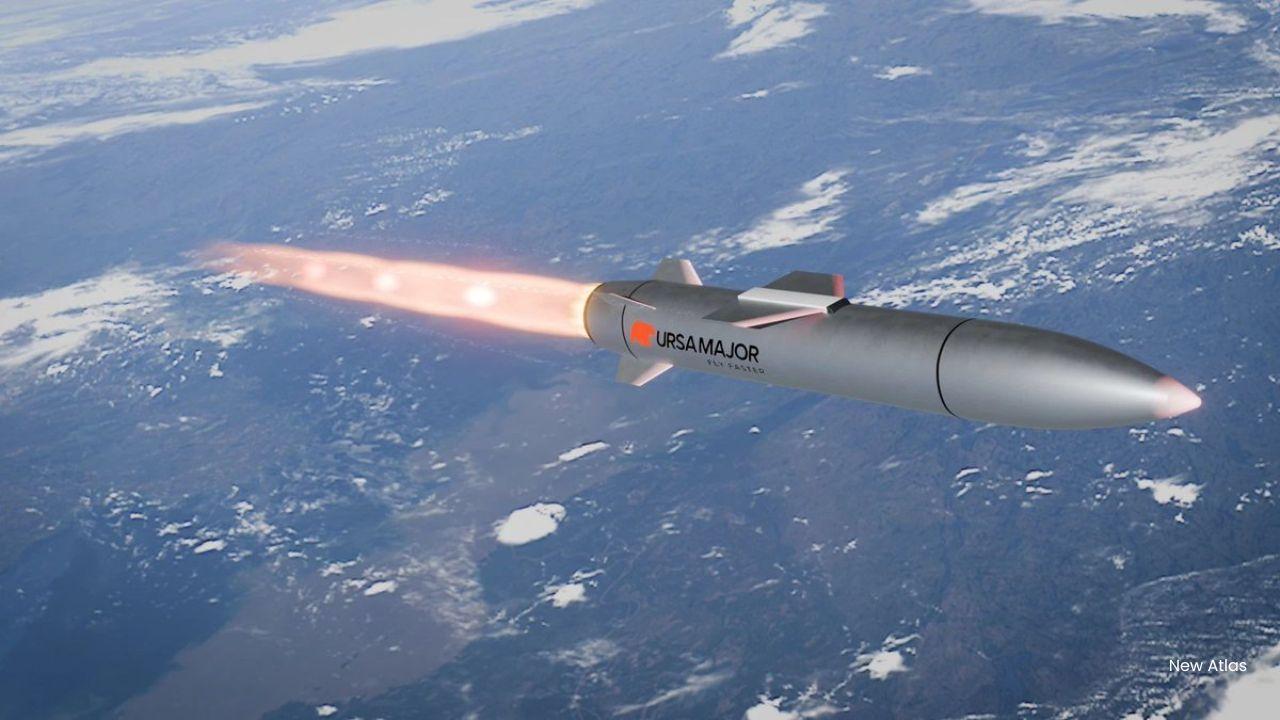
Ursa Major Defence Technologies has taken a major step forward in strategic weapons innovation with the public unveiling of its HAVOC hypersonic missile, a multi-domain strike platform designed to operate across air, sea and land environments. The announcement marks a significant development in hypersonic weapons innovation, positioning the missile as a potential game-changer in next-generation defence capability where speed, precision and adaptability are paramount.
Built to travel at speeds exceeding Mach 5, the HAVOC system is engineered to outpace modern air-defence systems and deliver critical strike power deep within contested territory. With global military interest in hypersonic technologies surging, Ursa Major’s unveiling underscores how private-sector defence firms are increasingly contributing advanced capabilities alongside government programmes.
The HAVOC hypersonic missile is reported to integrate cutting-edge propulsion, guidance and materials systems that enable sustained high-speed flight while maintaining exceptional manoeuvrability. Such characteristics are essential as defence planners seek weapons that can evade advanced surface-to-air defences and strike time-sensitive targets with minimal warning.
Unlike traditional cruise missiles, which typically operate at subsonic or supersonic speeds, hypersonic systems like the HAVOC are designed to reduce engagement timelines dramatically. The ability to reach distant objectives in minutes rather than hours reshapes strategic strike doctrine and offers commanders a rapid-response option across multiple theatres of operation.
Ursa Major’s approach emphasises modularity and multi-domain deployment, allowing the platform to be launched from diverse vectors including aircraft, ground vehicles and naval ships. This versatility reflects modern battlefield requirements where joint operations demand seamless integration across air, land and sea platforms.
The introduction of the HAVOC hypersonic missile comes at a time of intensified global interest in high-speed weapons systems. Several nations have poured investment into hypersonic research, seeking to field operational systems that provide decisive strategic advantage. For military analysts, the growing availability of hypersonic strike options alters deterrence postures and raises the bar for defensive countermeasures.
Ursa Major’s unveiling also highlights the expanding role of private defence firms in advancing technologies once exclusively developed by government laboratories. By accelerating innovation cycles and partnering with national defence agencies, companies like Ursa Major are shaping the future of military capabilities in an era where technological edge is critical.
While the HAVOC hypersonic missile’s introduction signals design maturity, next steps will involve rigorous flight testing, integration with existing command and control networks, and certification for field deployment. Successful demonstration of reliability, accuracy and safety will be key to progressing toward operational use.
Defence stakeholders will be watching closely as Ursa Major advances its development programme, with implications for procurement decisions and future force structure planning. As hypersonic technologies evolve, the HAVOC system could become a central element in strategic strike arsenals, supporting deterrence and rapid-response missions in contested environments.
Ursa Major’s multi-domain HAVOC hypersonic missile represents a bold leap in hypersonic weapons innovation, marrying extraordinary speed with flexible deployment potential. In a global defence landscape increasingly focused on rapid, precise strike capabilities, the HAVOC system underscores how next-generation technologies are redefining military strategy and operational effectiveness. As development progresses, this breakthrough could play a pivotal role in shaping airpower and deterrence for decades to come.
HAVOC hypersonic missile, Ursa Major defence, hypersonic weapons innovation










Advances in Aerospace Technology and Commercial Aviation Recovery
Insights into breakthrough aerospace technologies and commercial aviation’s recovery amid 2025 chall

Defense Modernization and Strategic Spending Trends
Explore key trends in global defense modernization and strategic military spending shaping 2025 secu

Tens of Thousands Protest in Serbia on Anniversary of Deadly Roof Collapse
Tens of thousands in Novi Sad mark a year since a deadly station roof collapse that killed 16, prote

Canada PM Carney Apologizes to Trump Over Controversial Reagan Anti-Tariff Ad
Canadian PM Mark Carney apologized to President Trump over an Ontario anti-tariff ad quoting Reagan,

The ad that stirred a hornets nest, and made Canadian PM Carney say sorry to Trump
Canadian PM Mark Carney apologizes to US President Trump after a tariff-related ad causes diplomatic

Bengaluru-Mumbai Superfast Train Approved After 30-Year Wait
Railways approves new superfast train connecting Bengaluru and Mumbai, ending a 30-year demand, easi



