Post by : Avinab Raana
Photo : X / UK Defence Journal
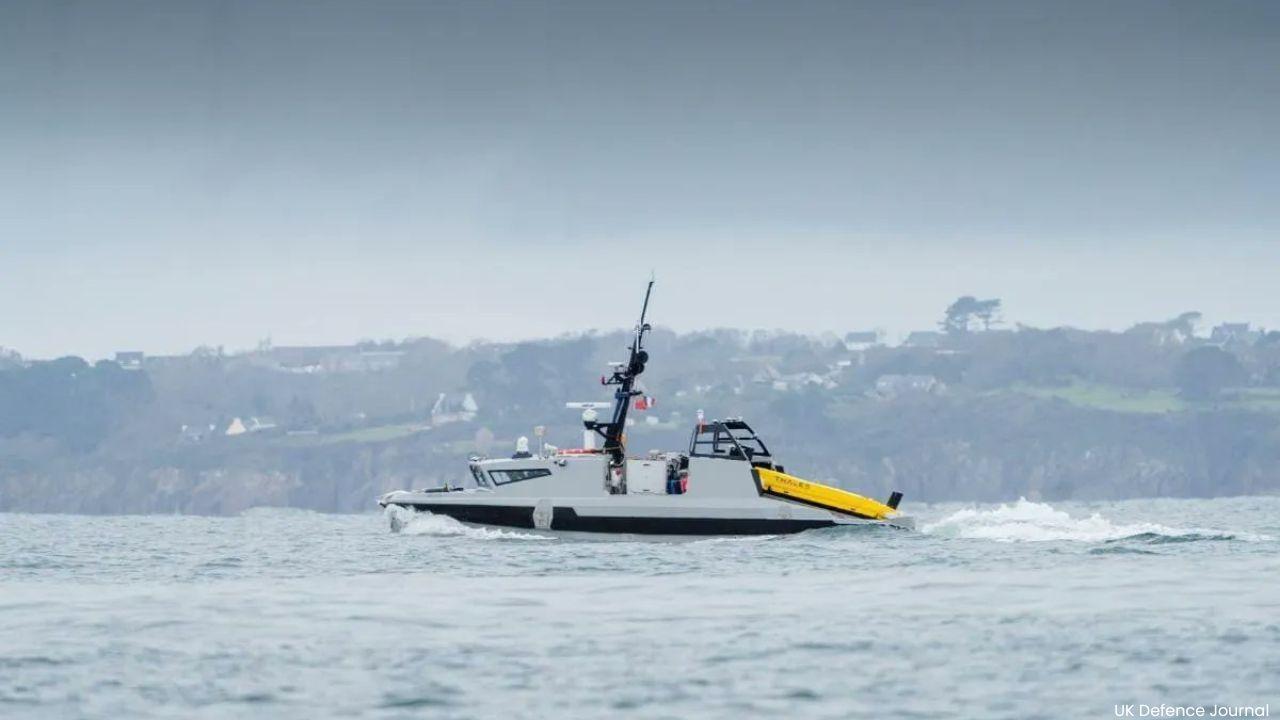
The future of naval defence has arrived with the Royal Navy deploying its £500 million autonomous minehunting system, “Adventure”, a move that marks a decisive shift away from traditional, crewed mine countermeasure vessels. In an era where maritime threats are becoming increasingly unpredictable, this cutting-edge system represents a bold transformation in how navies detect, track, and neutralise underwater dangers. More than just a technological upgrade, it signals a strategic evolution one that prioritises safety, speed, and precision while keeping personnel out of harm’s way.
Unlike conventional ships, Adventure is not a standalone platform, it is the central command node in a fully integrated mine warfare ecosystem. Built as a 12-metre uncrewed surface vessel, it carries and deploys a network of advanced off-board systems including sonar arrays, autonomous underwater vehicles, and remote-controlled mine neutralisation units. This layered capability allows operators to complete the entire mission cycle from detection to destruction remotely, ensuring operations are conducted from a safe distance rather than directly within dangerous minefields.
At the core of Adventure’s operational strength lies its sophisticated technology stack. Equipped with high-resolution synthetic aperture sonar, the system can scan vast seabed areas with remarkable clarity, identifying potential threats with precision. Artificial intelligence further accelerates this process by analysing sonar data in real time, enabling faster decision-making and reducing human workload. Once a threat is confirmed, remotely operated vehicles can be deployed to neutralise mines using targeted explosive charges delivering surgical precision without repeated risk exposure.
For decades, mine countermeasure operations relied heavily on specialised ships and onboard crews navigating hazardous waters. Adventure represents a clear departure from this model. By enabling remote operations from shore bases or support vessels, the Royal Navy is transitioning towards a distributed and modular defence architecture. This shift not only enhances operational flexibility but also significantly reduces risk to human life, one of the most critical considerations in modern naval strategy.
The deployment of Adventure is part of a broader Anglo-French Maritime Mine Counter Measures programme valued at approximately €430 million (around $500 million). Developed under the leadership of Thales, the initiative includes multiple systems designed to replace ageing fleets with next-generation autonomous solutions. Adventure is the second system delivered under this programme, following its predecessor Ariadne, with additional units planned to build a fully operational capability for the Royal Navy.
Naval mines remain one of the most cost-effective yet disruptive weapons in maritime warfare, capable of blocking critical shipping routes and threatening global trade. With growing geopolitical tensions and increasing reliance on maritime logistics, the need for efficient mine countermeasures has never been greater. Adventure is designed to operate in complex environments including near ports, shipping lanes, and conflict zones ensuring that vital sea routes remain open and secure.
The deployment of Adventure is more than a technological milestone, it is a glimpse into the future of naval operations. As autonomous systems continue to evolve, they are redefining how defence forces approach risk, efficiency, and scalability. For the Royal Navy, this move positions it at the forefront of next-generation maritime security, where intelligent machines handle the most dangerous tasks while human operators remain safely in control from a distance.
#trending #latest,#RoyalNavy #AutonomousVessels #Minehunter #NavalTechnology #MaritimeSecurity







Advances in Aerospace Technology and Commercial Aviation Recovery
Insights into breakthrough aerospace technologies and commercial aviation’s recovery amid 2025 chall

Defense Modernization and Strategic Spending Trends
Explore key trends in global defense modernization and strategic military spending shaping 2025 secu

Tens of Thousands Protest in Serbia on Anniversary of Deadly Roof Collapse
Tens of thousands in Novi Sad mark a year since a deadly station roof collapse that killed 16, prote

Canada PM Carney Apologizes to Trump Over Controversial Reagan Anti-Tariff Ad
Canadian PM Mark Carney apologized to President Trump over an Ontario anti-tariff ad quoting Reagan,

The ad that stirred a hornets nest, and made Canadian PM Carney say sorry to Trump
Canadian PM Mark Carney apologizes to US President Trump after a tariff-related ad causes diplomatic

Bengaluru-Mumbai Superfast Train Approved After 30-Year Wait
Railways approves new superfast train connecting Bengaluru and Mumbai, ending a 30-year demand, easi



