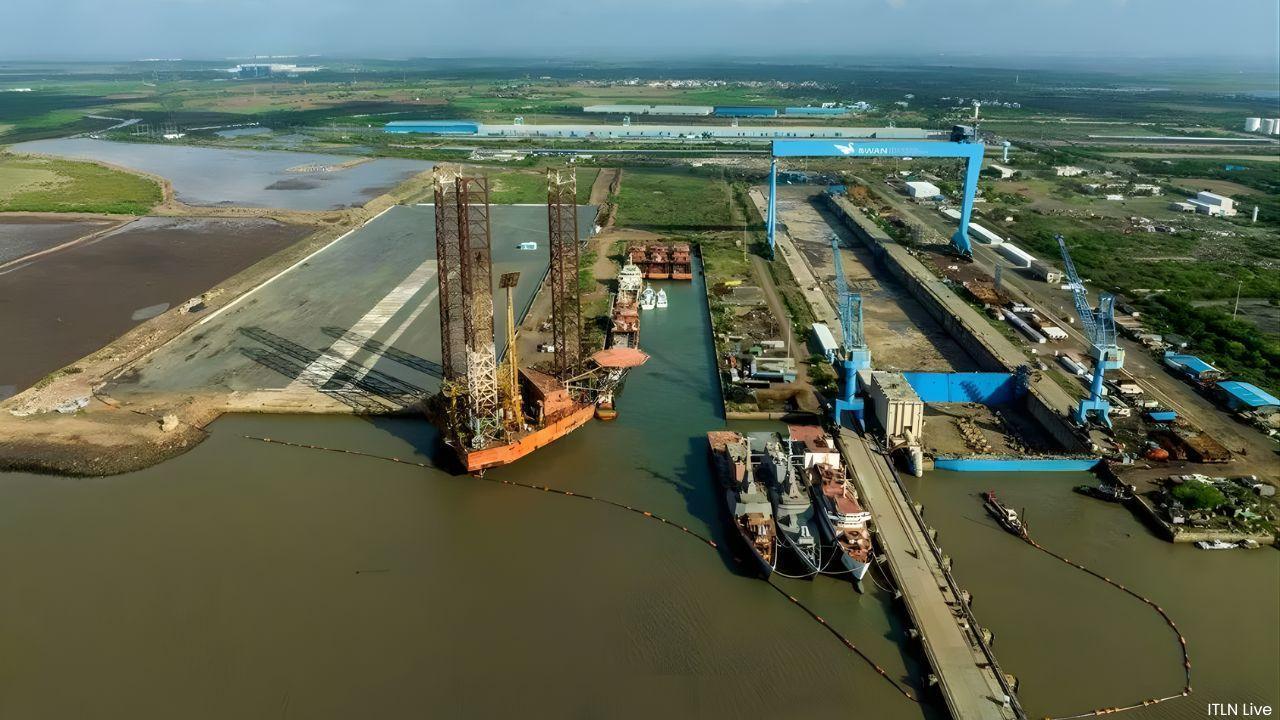
Post by : Avinab Raana
Photo : X / ITLN Live
In a landmark development that could redefine India’s position in global maritime innovation, Swan Defence and Heavy Industries Limited (SDHI) has secured an order to build the country’s first ammonia dual-fuel bulk carriers. This isn’t just another shipbuilding contract, it represents a turning point where India steps decisively into the era of low-emission shipping, aligning itself with global decarbonisation goals and next-generation maritime technologies.
As the shipping industry faces mounting pressure to reduce carbon emissions, ammonia is emerging as one of the most promising alternative fuels. India’s entry into this space signals not just technological readiness, but strategic intent to compete in the future of sustainable global trade.
The order includes the construction of four massive 92,500 deadweight tonne bulk carriers making them among the largest commercial vessels ever to be built at an Indian shipyard. Each vessel will measure approximately 229.5 meters in length, combining scale with cutting-edge engineering to deliver high-capacity, efficient cargo transport.
This project is particularly significant because it represents the first time India will build ammonia-powered dual-fuel ships domestically. It marks a major leap in both industrial capability and technological sophistication, positioning Indian shipyards alongside global leaders in advanced shipbuilding.
At the core of these vessels is ammonia-based propulsion, a breakthrough that could reshape the environmental footprint of global shipping. Unlike conventional fuels, ammonia produces no carbon emissions at the point of use, making it a critical solution in the industry’s push toward net-zero targets.
While still in its early adoption phase, ammonia fuel is rapidly gaining traction due to its potential to support long-haul shipping without compromising performance. By integrating this technology into large bulk carriers, India is not just adopting innovation, it is actively contributing to the global transition toward cleaner maritime operations.
The vessels will be designed by South Korea-based KMS-EMEC and classed by Det Norske Veritas (DNV), ensuring adherence to the highest international safety and environmental standards. This collaboration highlights how global expertise is being leveraged to elevate India’s shipbuilding capabilities to world-class levels.
Such partnerships are crucial in accelerating technology transfer, improving design efficiency, and ensuring that Indian-built vessels can compete seamlessly in international markets.
Beyond technology, this project carries significant economic implications. The order falls under a high-value category, reflecting strong global confidence in India’s shipbuilding ecosystem and its ability to deliver complex, large-scale projects.
It also aligns with India’s broader ambitions to become a global shipbuilding hub. By taking on advanced projects like ammonia-fueled vessels, Indian shipyards are moving up the value chain from conventional manufacturing to high-tech, sustainable engineering.
The first vessel is expected to be delivered by October 2029, with subsequent ships scheduled at four-month intervals. This phased delivery timeline reflects the complexity of the project and the long-term commitment required to build next-generation maritime assets. It also ensures that the technology is implemented in a controlled, scalable manner allowing for continuous improvement and optimization across each vessel.
This development is more than a milestone, it is a statement of intent. India is no longer just participating in global shipping; it is actively shaping its future by investing in sustainable, technologically advanced vessels.
As the world moves toward greener supply chains and stricter environmental regulations, projects like these will define which nations lead and which follow. With this bold step into ammonia-powered shipping, India has firmly positioned itself on the frontlines of maritime innovation.The real transformation, however, is just beginning. Because in the race toward sustainable shipping, the countries that build the future will ultimately control it.
#trending #latest,#GreenShipping #AmmoniaFuel #ShipbuildingIndia #SDHI #SustainableMaritime









Advances in Aerospace Technology and Commercial Aviation Recovery
Insights into breakthrough aerospace technologies and commercial aviation’s recovery amid 2025 chall

Defense Modernization and Strategic Spending Trends
Explore key trends in global defense modernization and strategic military spending shaping 2025 secu

Tens of Thousands Protest in Serbia on Anniversary of Deadly Roof Collapse
Tens of thousands in Novi Sad mark a year since a deadly station roof collapse that killed 16, prote

Canada PM Carney Apologizes to Trump Over Controversial Reagan Anti-Tariff Ad
Canadian PM Mark Carney apologized to President Trump over an Ontario anti-tariff ad quoting Reagan,

The ad that stirred a hornets nest, and made Canadian PM Carney say sorry to Trump
Canadian PM Mark Carney apologizes to US President Trump after a tariff-related ad causes diplomatic

Bengaluru-Mumbai Superfast Train Approved After 30-Year Wait
Railways approves new superfast train connecting Bengaluru and Mumbai, ending a 30-year demand, easi



