Post by : Amit
Photo : X / Green Marine
A Symbol of Japan’s Green Maritime Future
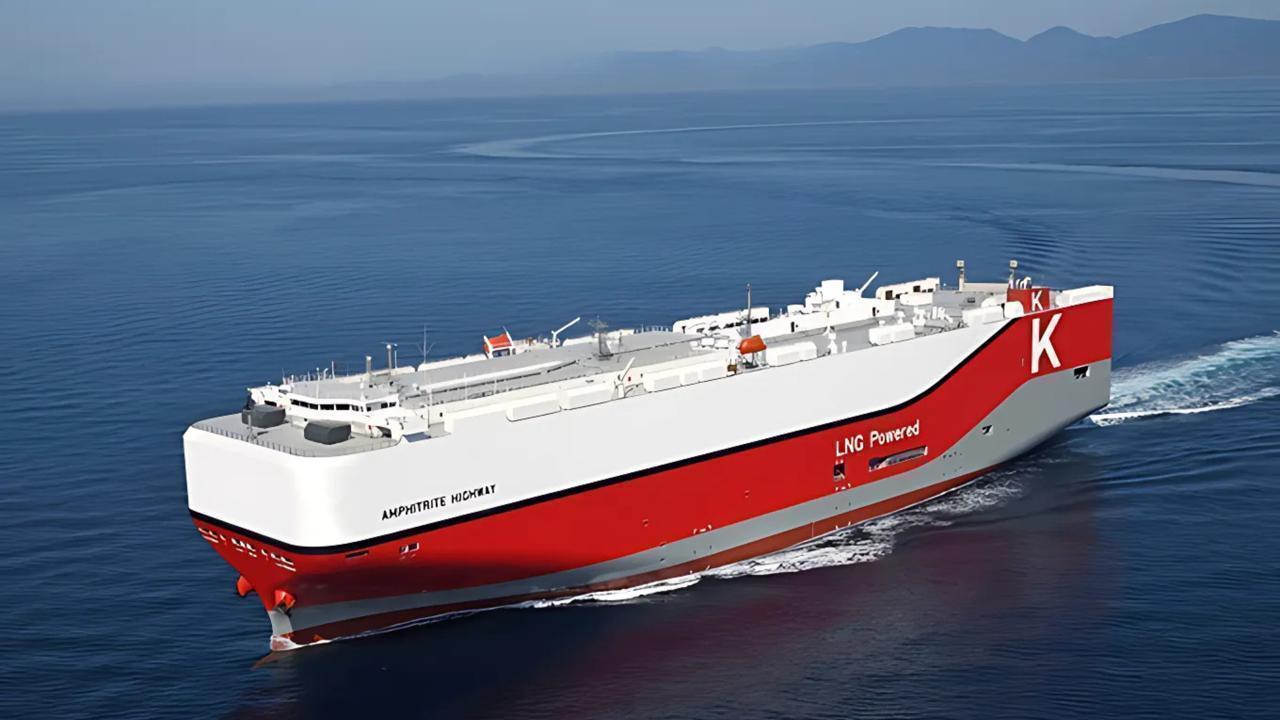
Imabari Shipbuilding has successfully delivered its latest liquefied natural gas (LNG)-fueled pure car and truck carrier (PCTC) to the prominent Japanese shipping giant, Kawasaki Kisen Kaisha, more widely known as K Line. This newly constructed vessel, capable of transporting up to 7,000 cars (measured in CEU – car equivalent units), marks another significant chapter in Japan's ambition to lead the decarbonization of global shipping.
The delivery ceremony, held at the Imabari yard, was more than a routine ship launch. It underscored a strategic alliance between the country’s biggest shipbuilders and shipping lines aiming to meet—and even exceed—International Maritime Organization (IMO) environmental regulations. This new vessel joins a growing fleet of next-generation, energy-efficient ships that are expected to redefine maritime cargo transport across oceans.
What Makes This Vessel Stand Out
The newly launched PCTC is not merely a larger and more modern version of earlier car carriers. It has been designed and engineered to operate on LNG as its primary fuel, sharply reducing greenhouse gas emissions, particulate matter, sulfur oxides (SOx), and nitrogen oxides (NOx). By using LNG instead of traditional heavy fuel oil, the ship can cut carbon dioxide emissions by up to 25%, contributing meaningfully to K Line's pledge to achieve net-zero emissions by 2050.
Measuring around 200 meters in length, with advanced engine technologies and optimal hull design, the vessel is a model of performance efficiency. Imabari has invested heavily in making these LNG PCTCs not only cleaner but also quieter, integrating noise-reduction features to meet new underwater radiated noise regulations.
The vessel is also equipped with an advanced digital navigation suite, onboard data analytics, and condition monitoring systems, enhancing operational safety and fuel optimization throughout its voyage cycle.
K Line’s Sustainability Vision Comes to Life
For K Line, this new addition is part of its larger "Drive Green Project," an initiative that began in the mid-2010s to tackle the global need for cleaner transport. The company has been rapidly expanding its LNG-fueled fleet, which now includes bulk carriers, tankers, and car carriers, aimed at drastically reducing its fleet-wide emissions profile.
K Line has also indicated interest in future fuels, including bio-LNG and ammonia, both seen as promising alternatives for the next decade. However, the immediate availability and maturity of LNG infrastructure across many key ports have made it the most viable option today.
This new PCTC will be deployed on major trans-Pacific and Asia-Europe routes, covering ports in Japan, the United States, and Europe. These are routes where automotive trade is booming, and where large-volume, fuel-efficient vessels can have the biggest environmental impact.
Imabari’s Pioneering Role in Eco-Shipbuilding
Imabari Shipbuilding, Japan’s largest shipbuilder by output, is proving itself a global innovator in green vessel design. The company has already delivered several LNG-fueled ships in recent years, including container vessels and tankers. Its strong orderbook for eco-ships reflects growing market demand for greener solutions, spurred by shipping firms’ urgency to comply with stricter IMO targets.
This particular PCTC is one of multiple sister ships under construction at Imabari’s yards, all part of a broader series tailored to specific operational profiles and emissions goals. The company is also exploring hybrid vessels combining LNG and battery power, and longer-term, is investing in ship designs compatible with carbon-neutral fuels like green methanol and ammonia.
Beyond propulsion, Imabari has optimized internal vehicle loading decks, hull shapes, and hydrodynamic performance, achieving significant fuel savings even during lower-speed operations—a scenario common in fuel economy strategies like "slow steaming."
Global Push for LNG-Fueled Fleets
The delivery also aligns with a global trend: more than 1,000 LNG-fueled ships are either already in service or on order as of mid-2025. Many of the world’s top shipowners—especially in the car carrier segment—are fast-tracking the adoption of dual-fuel ships. European operators like Wallenius Wilhelmsen and Höegh Autoliners, along with Asian heavyweights like NYK and MOL, are pushing similar green agendas, showing a unified front in the shipping sector’s race to decarbonize.
What makes Japan’s strategy slightly different is its focus on indigenous shipbuilding. While many Western companies order their vessels from South Korea or China, Japan is doubling down on domestic shipbuilding prowess to retain technological control, protect jobs, and bolster its maritime economy.
From Compliance to Competitiveness
Although regulatory compliance is a driving factor, shipping companies are increasingly seeing sustainability as a competitive edge. The new generation of eco-ships often benefits from lower port dues, better chartering rates, and easier access to ESG financing.
K Line, for instance, has secured multiple green loans to finance its LNG fleet expansion, with favorable terms tied directly to emissions performance. This enables quicker ROI while strengthening brand reputation among automakers, many of whom have their own net-zero supply chain goals.
Automotive giants such as Toyota, Nissan, and Honda—key clients of K Line—are increasingly favoring shipping partners that align with their environmental strategies. With this in mind, the 7,000-CEU LNG PCTC becomes not just a vessel, but a vital link in a greener global auto supply chain.
Eyes on the Future: Ammonia and Beyond
While LNG is a major leap forward, both Imabari and K Line know it is only a bridge fuel. Research and development are already underway for ships that can run on ammonia—a zero-carbon fuel when produced using renewable energy. Ammonia vessels are still in early testing, but Imabari is collaborating with Japanese academic and governmental institutions to be ready when commercial use becomes feasible.
Until then, LNG remains the cleanest, most scalable marine fuel available, and the latest PCTC demonstrates how shipbuilders and operators can work together to make real progress on the climate front—without compromising performance or reliability.
A Milestone for Greener Shipping
The launch of Imabari’s latest 7,000-CEU LNG-fueled car carrier for K Line is not just a business event—it’s a reflection of the shifting tides in global shipping. As emissions regulations tighten, consumer expectations evolve, and geopolitical pressure mounts on supply chains to decarbonize, vessels like this one are setting the standard.
Japan's leadership in marrying shipbuilding excellence with climate-conscious innovation could serve as a blueprint for others to follow. With every LNG-powered delivery, Imabari and K Line are not just moving goods—they’re moving the needle on climate action.
Imabari, LNG Fuel, K Line





Advances in Aerospace Technology and Commercial Aviation Recovery
Insights into breakthrough aerospace technologies and commercial aviation’s recovery amid 2025 chall

Defense Modernization and Strategic Spending Trends
Explore key trends in global defense modernization and strategic military spending shaping 2025 secu

Tens of Thousands Protest in Serbia on Anniversary of Deadly Roof Collapse
Tens of thousands in Novi Sad mark a year since a deadly station roof collapse that killed 16, prote

Canada PM Carney Apologizes to Trump Over Controversial Reagan Anti-Tariff Ad
Canadian PM Mark Carney apologized to President Trump over an Ontario anti-tariff ad quoting Reagan,

The ad that stirred a hornets nest, and made Canadian PM Carney say sorry to Trump
Canadian PM Mark Carney apologizes to US President Trump after a tariff-related ad causes diplomatic

Bengaluru-Mumbai Superfast Train Approved After 30-Year Wait
Railways approves new superfast train connecting Bengaluru and Mumbai, ending a 30-year demand, easi



