Post by : Avinab Raana
Photo : X / @H2Societies
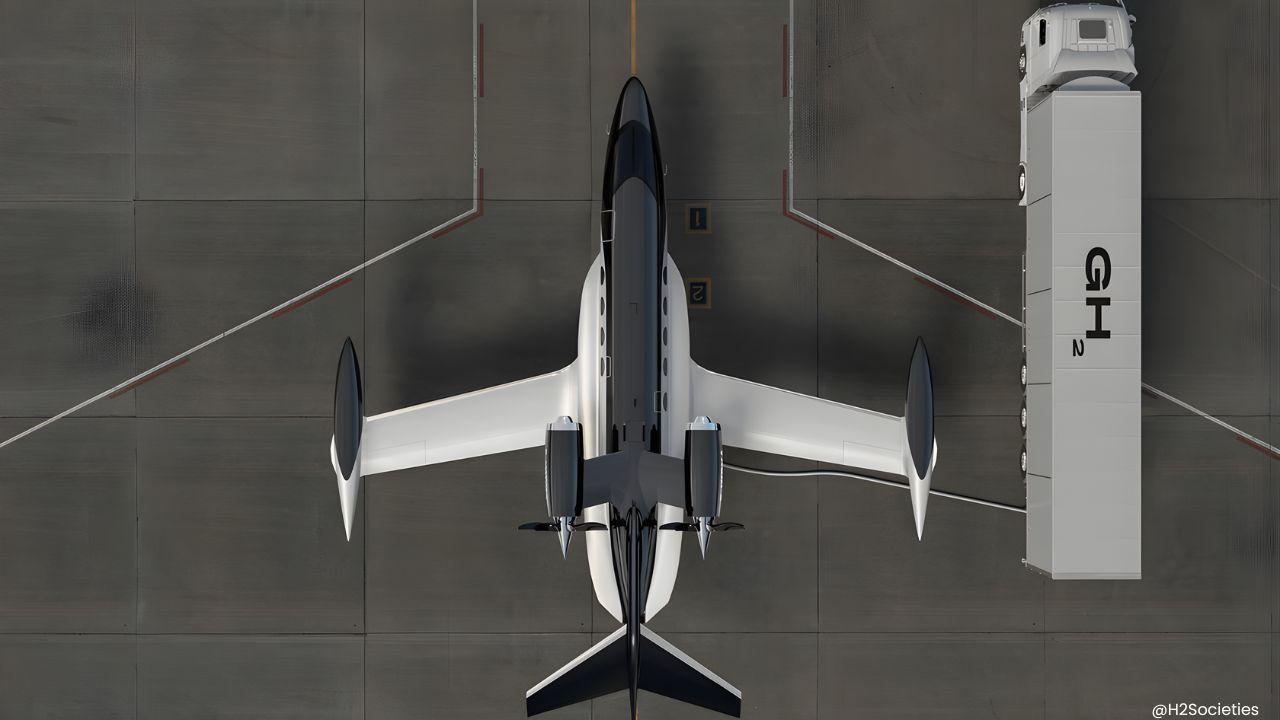
A new hydrogen-powered business jet concept is undergoing significant design refinements as engineers continue shaping the future of sustainable aviation. The aircraft is being developed as a zero-emission alternative to conventional business jets, with hydrogen fuel serving as the primary energy source for propulsion. As the design progresses, developers have introduced several engineering adjustments aimed at improving efficiency and operational performance while ensuring the aircraft can safely integrate hydrogen fuel systems.
One of the major changes in the updated design involves the aircraft’s propulsion layout. Engineers have replaced earlier engine concepts with a new configuration designed to improve aerodynamic performance and overall efficiency. Such adjustments are common during early aircraft development stages, where designers continuously refine propulsion systems and airframe layouts to balance performance, fuel storage requirements, and operational range.
The revised aircraft design also reflects an increase in overall weight, primarily due to the specialized infrastructure required for storing hydrogen fuel onboard. Hydrogen systems require reinforced tanks and additional safety structures, which inevitably add weight to the aircraft. Managing this additional weight is one of the key engineering challenges in hydrogen aviation, as designers must ensure the aircraft remains efficient while accommodating larger fuel storage systems.
Hydrogen-powered aircraft are increasingly viewed as one of the most promising pathways for reducing aviation’s environmental impact. Unlike conventional jet fuel, hydrogen combustion produces no direct carbon emissions, making it an attractive solution for future sustainable aviation systems. As the aviation industry faces growing pressure to reduce emissions, research into hydrogen propulsion is accelerating across both commercial and business aviation sectors.
Smaller aircraft such as business jets are often considered ideal platforms for testing emerging propulsion technologies. Their lower passenger capacity and shorter operational ranges make them suitable candidates for early adoption of alternative fuel systems. Hydrogen-powered business jets could therefore play an important role in demonstrating the feasibility of zero-emission aviation technologies before they are scaled for larger commercial aircraft.
The continued evolution of hydrogen aircraft concepts highlights the aviation industry’s commitment to exploring cleaner propulsion technologies. While hydrogen aviation still faces technical challenges, ongoing research and design refinements are steadily moving the technology closer to practical application. Projects like the hydrogen business jet illustrate how the future of aviation may increasingly depend on innovative fuel systems capable of delivering both performance and environmental sustainability.
hydrogen business jet concept, hydrogen powered aircraft design, sustainable aviation hydrogen jet, hydrogen propulsion business aviation, zero emission aircraft development, hydrogen aviation technology, future hydrogen aircraft







Advances in Aerospace Technology and Commercial Aviation Recovery
Insights into breakthrough aerospace technologies and commercial aviation’s recovery amid 2025 chall

Defense Modernization and Strategic Spending Trends
Explore key trends in global defense modernization and strategic military spending shaping 2025 secu

Tens of Thousands Protest in Serbia on Anniversary of Deadly Roof Collapse
Tens of thousands in Novi Sad mark a year since a deadly station roof collapse that killed 16, prote

Canada PM Carney Apologizes to Trump Over Controversial Reagan Anti-Tariff Ad
Canadian PM Mark Carney apologized to President Trump over an Ontario anti-tariff ad quoting Reagan,

The ad that stirred a hornets nest, and made Canadian PM Carney say sorry to Trump
Canadian PM Mark Carney apologizes to US President Trump after a tariff-related ad causes diplomatic

Bengaluru-Mumbai Superfast Train Approved After 30-Year Wait
Railways approves new superfast train connecting Bengaluru and Mumbai, ending a 30-year demand, easi



