Post by : Amit
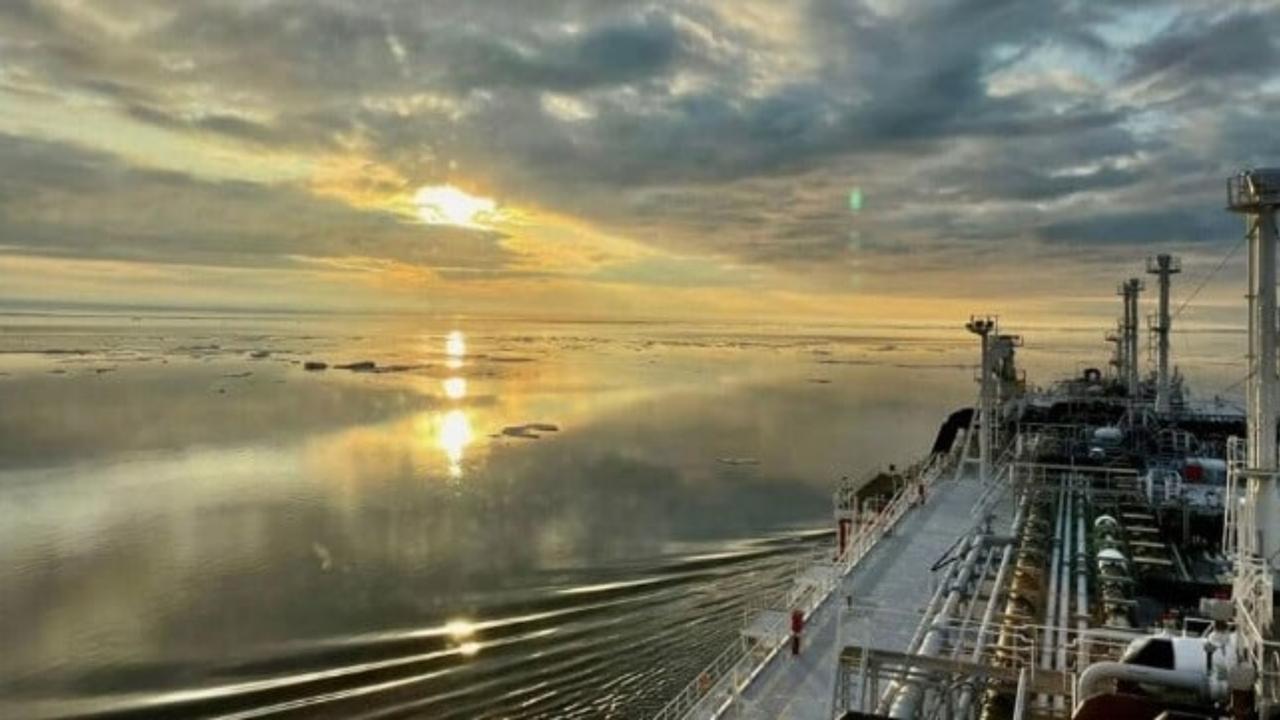
Photo : X / FAN Transport Insights
Shanghai / Murmansk, July, 2025 — In a move that could reshape shipping dynamics across Eurasia, China’s NewNew Shipping Line has announced plans to launch commercial cargo voyages via Russia’s Northern Sea Route (NSR). The decision marks a significant shift for the emerging maritime carrier, which had made headlines earlier this year for its transits through the embattled Red Sea corridor, amid Houthi-led disruptions.
The Arctic venture reflects China’s broader ambitions to strengthen logistics ties with Russia while bypassing traditional chokepoints like the Suez Canal. NewNew Shipping’s proposed NSR operations signal not only commercial opportunism but also growing strategic coordination between Beijing and Moscow in global shipping infrastructure.
From Red Sea flashpoint to Arctic frontier
NewNew Shipping came into international focus earlier in 2025 when its vessels were among the few commercial ships braving the Red Sea amidst growing threats from Houthi militants targeting Western and Israeli-linked shipping. The company’s decision to sail through the region despite elevated maritime risk earned both scrutiny and symbolic praise in Chinese state media for “defending global supply chains.”
But recent developments indicate a pivot toward polar trade routes, with NewNew Shipping now collaborating with Russian port operators to trial Arctic shipping via the NSR—a 3,500 nautical mile passage running along Russia’s northern coast from Murmansk to the Bering Strait.
A NewNew spokesperson confirmed that ice-class vessels will be deployed later this summer, during the peak Arctic melt window, in partnership with Russian maritime authorities and nuclear-powered icebreaker support.
Northern Sea Route: A geopolitical and commercial corridor
The Northern Sea Route has long been viewed by Russia as a strategic asset, particularly under President Vladimir Putin’s “Arctic pivot” vision, which aims to expand economic activity in the polar regions. Melting sea ice—accelerated by climate change—has rendered the NSR more navigable during summer months, allowing for freight movement between Europe and Asia in nearly half the time compared to the traditional Suez Canal route.
Until now, NSR activity has been mostly limited to Russian oil, gas, and mining exports, but NewNew Shipping’s entry represents a notable extension of the corridor to international container and general cargo traffic.
“This is a calculated move,” said Vasily Petrov, an analyst with the Russian Maritime Institute. “China sees strategic and economic advantage in routing trade through the Arctic—fewer delays, fewer geopolitical bottlenecks, and closer ties with Russia.”
Icebreakers, infrastructure, and Arctic diplomacy
NewNew’s plan includes the deployment of two Chinese-built polar-class ships, each retrofitted with strengthened hulls, augmented navigation systems, and insulated cargo holds. The voyages will be escorted by Rosatom’s nuclear icebreakers, which have been a key enabler of NSR traffic.
Both China and Russia are investing heavily in Arctic port upgrades, including the modernization of Murmansk, Arkhangelsk, and Vladivostok terminals, and the development of digital cargo tracking across the NSR. Satellite communications have also improved dramatically, reducing earlier concerns about logistical blackouts in polar latitudes.
“This isn’t just a shipping experiment—it’s a blueprint for a polar logistics corridor,” said Wu Jianming, a researcher at the China Institute of Polar Logistics. “If successful, it could anchor China’s Arctic Belt initiative.”
Red Sea rerouting: Strategic or symbolic?
NewNew Shipping’s initial rise in prominence was partially due to its controversial decision to operate in the Red Sea earlier this year, where most global carriers had suspended routes due to escalating attacks and missile threats from Yemen-based militants. While the move was framed by Chinese media as resilience and independence, it was also viewed in global maritime circles as a calculated soft-power play.
But the reality of continuous Red Sea instability, along with insurance surcharges and operational delays, appears to have nudged the company toward lower-risk, longer-term alternatives like the NSR. Arctic routing could offer more predictability during summer months—even if it requires upfront investment and international cooperation.
Risks: Climate, regulation, and operational hurdles
Despite the promise of faster transit, NSR shipping is not without significant challenges. Arctic weather is highly unpredictable, and even in peak summer, ice floes and fog can cause delays or accidents. Regulatory compliance, especially around emissions, ballast water discharge, and indigenous area protections, is also under global scrutiny.
Environmental groups have criticized increased Arctic shipping for its potential to disrupt fragile ecosystems, especially as black carbon emissions from ships can accelerate ice melt. Russian authorities insist that NSR protocols are among the strictest in the world, requiring environmental risk assessments and ice escort plans.
Additionally, seasonal limitations remain. The NSR is reliably navigable only between late June and October, limiting its utility as a year-round alternative.
Strategic ties: China-Russia maritime alignment
This development aligns closely with the deepening Sino-Russian strategic partnership, particularly in logistics, energy, and Arctic development. Both nations have signed agreements to co-develop dual-use ports, cross-border rail connections, and now, Arctic sea lanes.
“This Arctic route is part of a much larger mosaic,” noted Ekaterina Gracheva, a foreign policy scholar at Moscow’s MGIMO University. “It reflects mutual dependency: Russia needs trade partners bypassing Western routes, and China wants access to faster, controllable corridors.”
The partnership is also unfolding as Western sanctions continue to isolate Russia from traditional maritime supply chains, making China a critical trade lifeline.
Arctic ambitions take shape
NewNew Shipping’s Arctic initiative may be in its infancy, but its implications could be far-reaching. If proven viable, the route could become a key component of China’s global logistics diversification strategy, especially for high-value, time-sensitive goods.
In the short term, analysts expect limited but symbolic voyages to occur by late August, carrying non-perishable goods and industrial parts between Shanghai and St. Petersburg. By 2026, the company aims to expand to containerized traffic, with pilot programs supported by Russian customs and Arctic logistics specialists.
“It’s no longer science fiction,” said Leonid Sidorov, editor of Arctic Shipping Today. “With political will, icebreaker support, and China’s deep pockets, the NSR may finally evolve into a global trade highway.”
Cold waters, warm ties
From the heat of the Red Sea to the chill of the Russian Arctic, NewNew Shipping’s trajectory mirrors China’s evolving maritime playbook—resilient, opportunistic, and increasingly strategic. The Northern Sea Route is not just about faster shipping; it’s about remapping trade flows in a world defined by climate change and shifting geopolitical power.
As the Arctic melt continues and infrastructure grows, the voyage that once seemed risky and remote may become China’s next maritime success story—one frozen step at a time.
China, Russia, Arctic Shipping Route







Advances in Aerospace Technology and Commercial Aviation Recovery
Insights into breakthrough aerospace technologies and commercial aviation’s recovery amid 2025 chall

Defense Modernization and Strategic Spending Trends
Explore key trends in global defense modernization and strategic military spending shaping 2025 secu

Tens of Thousands Protest in Serbia on Anniversary of Deadly Roof Collapse
Tens of thousands in Novi Sad mark a year since a deadly station roof collapse that killed 16, prote

Canada PM Carney Apologizes to Trump Over Controversial Reagan Anti-Tariff Ad
Canadian PM Mark Carney apologized to President Trump over an Ontario anti-tariff ad quoting Reagan,

The ad that stirred a hornets nest, and made Canadian PM Carney say sorry to Trump
Canadian PM Mark Carney apologizes to US President Trump after a tariff-related ad causes diplomatic

Bengaluru-Mumbai Superfast Train Approved After 30-Year Wait
Railways approves new superfast train connecting Bengaluru and Mumbai, ending a 30-year demand, easi



