Post by : Saif
The United States air travel system is facing one of its most difficult moments in recent years. A deadly airport accident, combined with a government funding crisis and staff shortages, has pushed the system close to breaking point.
At the center of this crisis is a tragic accident at New York’s LaGuardia Airport. A passenger plane collided with a fire truck on the runway, killing two young pilots and injuring several others. The crash led to the shutdown of the airport for hours and caused hundreds of flight cancellations.
This incident shocked the country and raised serious questions about airport safety. Investigators are now trying to understand how a fire truck ended up on the runway at the same time as a landing aircraft. Early reports suggest that air traffic control was dealing with another emergency, which may have added to the confusion.
But the accident is only one part of a much larger problem.
Across the United States, airports are struggling due to a shortage of security staff. The Transportation Security Administration (TSA), which handles airport security, has been hit hard by a government funding freeze. Thousands of TSA workers have not been paid for more than a month due to a political dispute in Congress.
Because of this, many workers have stopped coming to work or have resigned. In some airports, more than 40% of security staff were absent on certain days. This has caused extremely long lines at security checkpoints, with passengers waiting for hours just to enter the airport.
The situation has become so serious that authorities have warned some smaller airports may even have to shut down if the problem continues.
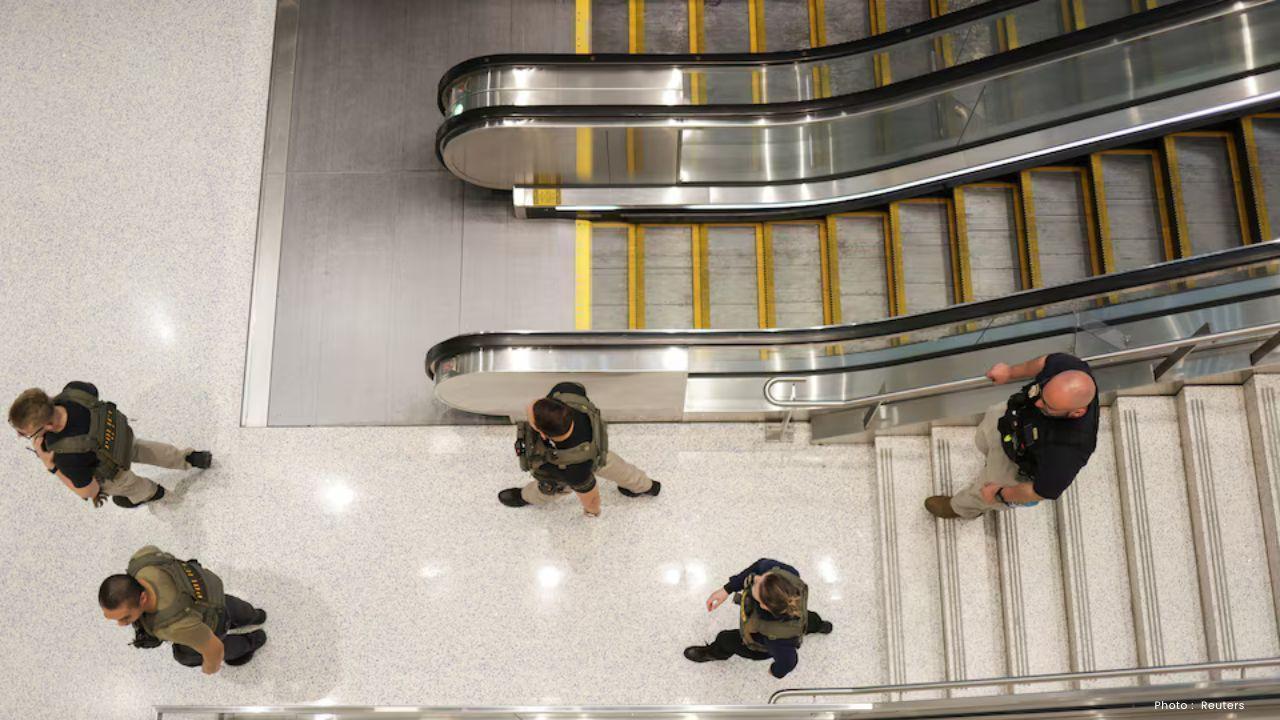
In response to the growing crisis, U.S. President Donald Trump ordered Immigration and Customs Enforcement (ICE) agents to be deployed at major airports. These agents are usually responsible for immigration enforcement, not airport security.
The government says these agents are there to help manage crowds and reduce long lines. However, their presence has created new concerns. Many experts and workers’ unions argue that ICE agents are not trained for airport security duties and should not replace TSA staff.
There is also fear among travelers that these agents could carry out immigration arrests at airports. While officials say this is not their main role, some statements from leaders have suggested that arrests could still happen.
This has made many passengers uneasy, especially in busy cities like New York, Atlanta, and Chicago, where ICE agents have already been deployed.
Behind all these problems is a political standoff in Washington. Lawmakers have failed to agree on funding for the Department of Homeland Security (DHS), which oversees both TSA and ICE. The disagreement is mainly about immigration policies and how they should be enforced.
As the political fight continues, the effects are being felt by ordinary people. Travelers are missing flights, airport workers are struggling without pay, and airlines are dealing with rising costs and delays.
Airlines are also facing higher fuel prices, which are increasing the cost of flights. Some airlines have already started reducing their schedules, adding more pressure to an already stressed system.
Experts warn that the longer this crisis continues, the worse it could become. Airports are complex systems that depend on smooth coordination between many agencies. When even one part fails, the entire system can be affected.
The recent accident at LaGuardia shows how dangerous such a breakdown can be. At the same time, the staff shortage and funding issues show how political decisions can have real-world consequences.
In many ways, this crisis is a warning. It shows what can happen when safety systems are stretched too thin and when workers are not supported. It also highlights the need for better planning and cooperation between government agencies.
In conclusion, the U.S. air travel system is facing a serious test. A tragic accident, combined with a funding freeze and staff shortages, has created a situation that is both risky and unstable. While temporary solutions like deploying ICE agents may provide some relief, they do not address the root problem.
Only a clear political agreement and proper funding can restore stability and confidence in the system. Until then, passengers and workers alike will continue to face uncertainty in the skies and on the ground.
#trending #latest #armustnews #USAirports #AviationCrisis #AirportSafety #FlightDelays #USPolitics #TSA #BreakingNews #GlobalNews #TravelDisruption


Advances in Aerospace Technology and Commercial Aviation Recovery
Insights into breakthrough aerospace technologies and commercial aviation’s recovery amid 2025 chall

Defense Modernization and Strategic Spending Trends
Explore key trends in global defense modernization and strategic military spending shaping 2025 secu

Tens of Thousands Protest in Serbia on Anniversary of Deadly Roof Collapse
Tens of thousands in Novi Sad mark a year since a deadly station roof collapse that killed 16, prote

Canada PM Carney Apologizes to Trump Over Controversial Reagan Anti-Tariff Ad
Canadian PM Mark Carney apologized to President Trump over an Ontario anti-tariff ad quoting Reagan,

The ad that stirred a hornets nest, and made Canadian PM Carney say sorry to Trump
Canadian PM Mark Carney apologizes to US President Trump after a tariff-related ad causes diplomatic

Bengaluru-Mumbai Superfast Train Approved After 30-Year Wait
Railways approves new superfast train connecting Bengaluru and Mumbai, ending a 30-year demand, easi



