Post by : Saif
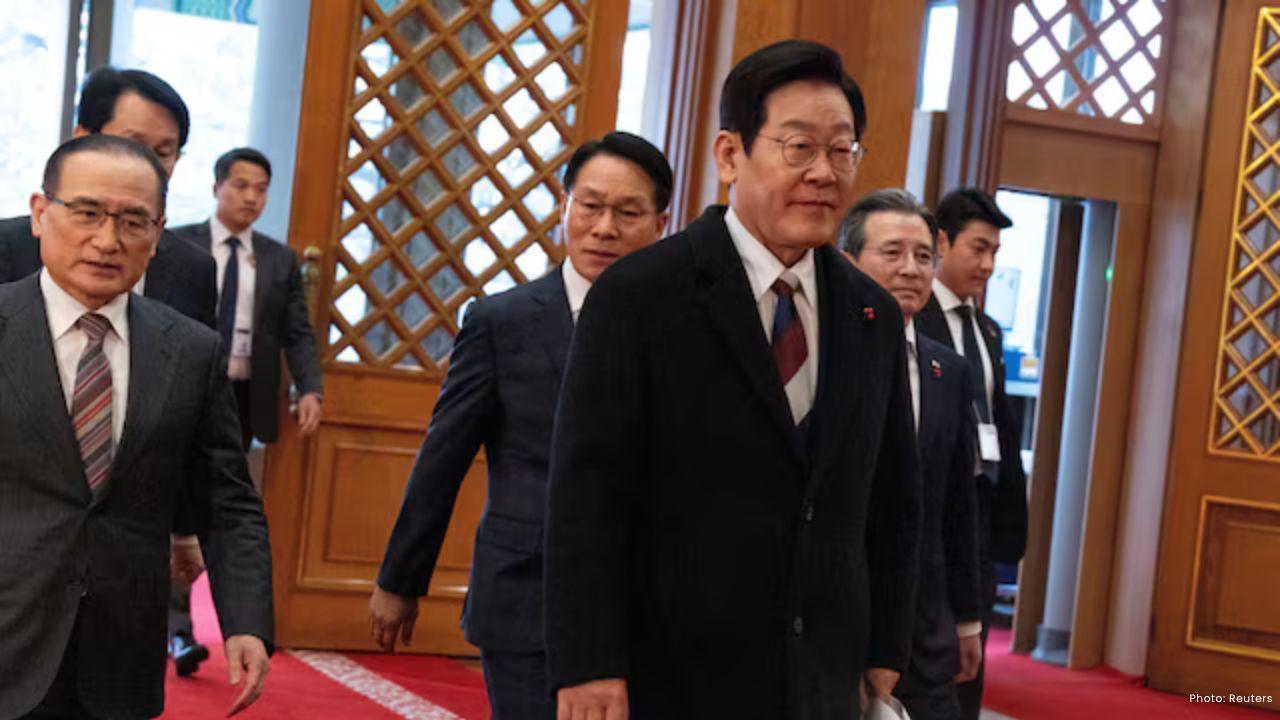
South Korean President Lee Jae Myung has downplayed concerns over a possible United States move to impose heavy tariffs on imported semiconductors, while warning that such a decision could mainly hurt American consumers. Speaking at a news conference in Seoul, Lee said higher tariffs on foreign-made chips would likely lead to higher prices across the U.S. economy.
His comments followed remarks by U.S. Commerce Secretary Howard Lutnick, who said chipmakers from South Korea and Taiwan could face tariffs as high as 100% unless they expand production within the United States. The proposal has caused concern in the global technology industry, as these two countries play a major role in supplying chips used in electronics worldwide.
Lee explained that South Korean and Taiwanese companies together control about 80% to 90% of the global semiconductor market. Because of this strong position, he said any large tariff imposed by the United States would not easily be absorbed by manufacturers. Instead, the extra cost would likely be passed on to buyers, raising prices for American companies and consumers who rely on chips for products such as phones, computers, cars, and household devices.
The president also said South Korea already has trade protections in place under its agreement with the United States. These safeguards are meant to ensure that Korean chipmakers are not treated unfairly compared to competitors from other countries. Lee said his government would continue to monitor the situation closely but did not believe the proposed tariffs posed an immediate threat.
South Korea’s semiconductor industry remains a major strength of its economy. In 2025, the country recorded its highest-ever exports, reaching more than $709 billion, a rise of nearly 4% from the previous year. Semiconductor shipments jumped by 22%, driven largely by global demand for artificial intelligence technology. Chip exports to the United States made up about 8% of total semiconductor exports, while China remained the largest market, followed by Taiwan and Vietnam.
Lee also addressed concerns about the weakening South Korean won. He said authorities expect the currency to strengthen toward around 1,400 won per U.S. dollar in the coming months. However, he noted that domestic policies alone cannot fully stabilize currency markets, as the won’s movement is partly linked to trends in other currencies, including the Japanese yen. He added that the won has performed relatively better than some regional currencies.
In addition to economic issues, Lee spoke about efforts to restart talks between the United States and North Korea. He said his government is pushing for diplomatic engagement and believes a practical approach is needed when dealing with Pyongyang. Lee acknowledged that it is unlikely North Korea will fully abandon its nuclear weapons program but said limiting further production and preventing the export of nuclear materials would still be an important step.
So far, North Korea has rejected outreach efforts from both Lee and U.S. President Donald Trump. Talks have remained stalled since negotiations between Trump and North Korean leader Kim Jong Un broke down in 2019 over disagreements on sanctions and nuclear disarmament.
President Lee’s remarks highlight South Korea’s effort to protect its key industries while maintaining stable relations with the United States and addressing long-standing security concerns. As global competition over semiconductor production grows, discussions around tariffs and trade are expected to remain a central issue in international relations.
#trending #latest #SouthKorea #SemiconductorIndustry #USTariffs #GlobalTrade #TechNews #EconomicPolicy #AsiaEconomy




Advances in Aerospace Technology and Commercial Aviation Recovery
Insights into breakthrough aerospace technologies and commercial aviation’s recovery amid 2025 chall

Defense Modernization and Strategic Spending Trends
Explore key trends in global defense modernization and strategic military spending shaping 2025 secu

Tens of Thousands Protest in Serbia on Anniversary of Deadly Roof Collapse
Tens of thousands in Novi Sad mark a year since a deadly station roof collapse that killed 16, prote

Canada PM Carney Apologizes to Trump Over Controversial Reagan Anti-Tariff Ad
Canadian PM Mark Carney apologized to President Trump over an Ontario anti-tariff ad quoting Reagan,

The ad that stirred a hornets nest, and made Canadian PM Carney say sorry to Trump
Canadian PM Mark Carney apologizes to US President Trump after a tariff-related ad causes diplomatic

Bengaluru-Mumbai Superfast Train Approved After 30-Year Wait
Railways approves new superfast train connecting Bengaluru and Mumbai, ending a 30-year demand, easi



