Post by : Avinab Raana
Photo : X / Jack Kuhr
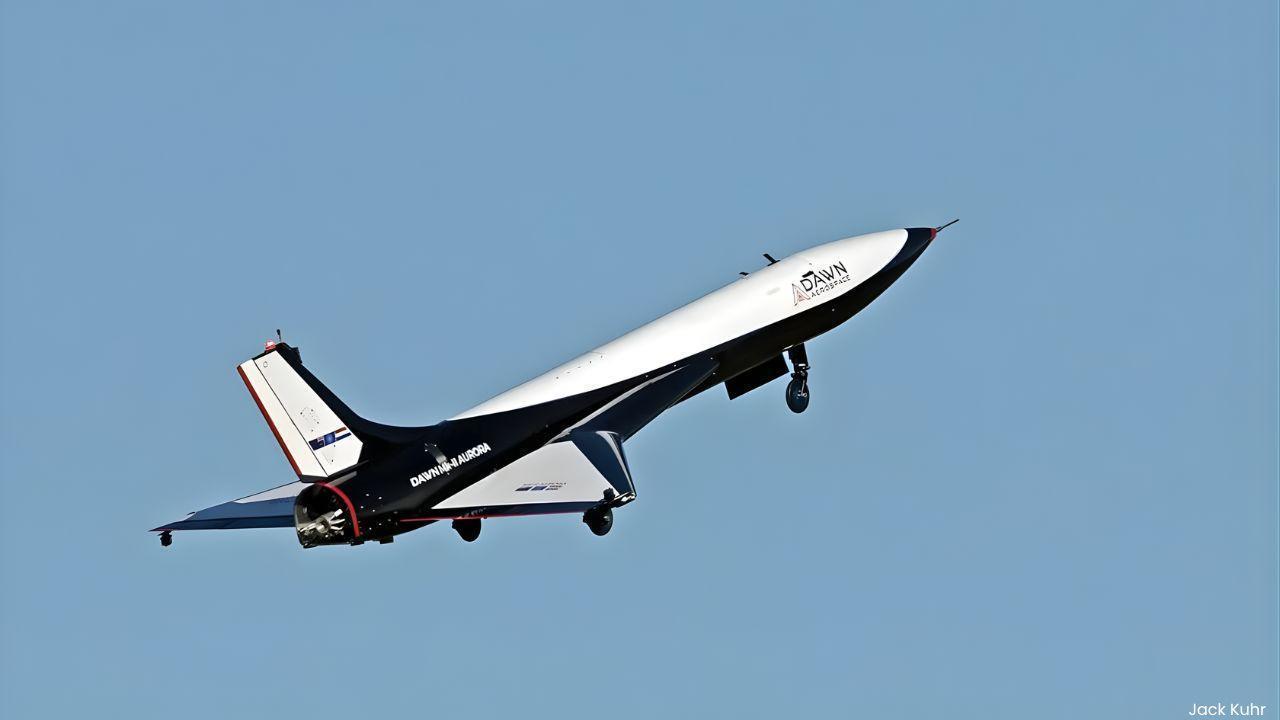
In a breakthrough that blurs the line between aviation and space, New Zealand has successfully deployed a rocket-powered spaceplane in a live naval radar tracking trial marking a significant leap in how modern defence systems are tested. This isn’t just another experiment; it signals the arrival of a new generation of reusable aerospace platforms that could redefine how militaries prepare for high-speed, high-altitude threats.
The trial brought together the Royal New Zealand Navy, defence scientists, and aerospace firm Dawn Aerospace, with the Aurora spaceplane launched from the Tāwhaki National Aerospace Centre while a naval frigate tracked it at sea using advanced radar systems. Unlike conventional tests that rely on simulations or foreign testing grounds, this experiment was conducted entirely within New Zealand’s own airspace and waters, providing real-world performance data under operational conditions. The objective was clear: to assess how effectively existing radar systems can detect and track a fast-moving, high-altitude vehicle in a realistic environment where variables such as speed, altitude, and atmospheric conditions cannot be artificially controlled.
At the centre of this development is Aurora, a compact, reusable suborbital spaceplane designed to deliver consistent, repeatable flight profiles—something traditional rockets or manned aircraft struggle to achieve efficiently. Capable of reaching speeds around Mach 1.1 and climbing to altitudes of approximately 25 kilometres, the platform operates in a unique zone between conventional aviation and near-space environments. What makes Aurora particularly valuable is its ability to fly multiple missions with near-identical conditions, allowing engineers and defence planners to refine radar systems and tracking technologies with far greater precision and frequency than ever before.
The current version of Aurora is only the beginning, with advanced variants already in development that aim to reach speeds exceeding Mach 3.5 and altitudes beyond 100 kilometres effectively entering the edge of space. Such capabilities would place the platform in direct relevance to emerging defence challenges, including hypersonic weapons and high-altitude surveillance systems. By simulating these advanced threat environments in a controlled and repeatable manner, reusable spaceplanes like Aurora could become indispensable tools in both military and commercial aerospace research.
Beyond the technology itself, the decision to conduct this trial domestically carries strategic importance. Historically, countries have depended on overseas test ranges for advanced aerospace experiments, often facing logistical and political constraints. By executing this mission within its own territory, New Zealand has demonstrated a growing sovereign capability combining national infrastructure, industry innovation, and defence expertise to generate and control critical data independently. This shift not only strengthens national security but also positions the country as a potential hub for specialised aerospace testing services in the future.
The successful use of a rocket-powered spaceplane in naval radar testing marks more than a technological milestone, it reflects a broader transformation in how defence systems are developed and validated. As threats become faster, higher, and more complex, the tools used to counter them must evolve just as rapidly. Reusable spaceplanes like Aurora are not just experimental platforms anymore; they are fast becoming the backbone of next-generation defence innovation, where speed, precision, and repeatability will define strategic advantage in the years ahead.
New Zealand spaceplane, Aurora spaceplane radar test, rocket powered aircraft defence, naval radar tracking trial, reusable spaceplane technology, Dawn Aerospace Aurora, hypersonic testing platform







Advances in Aerospace Technology and Commercial Aviation Recovery
Insights into breakthrough aerospace technologies and commercial aviation’s recovery amid 2025 chall

Defense Modernization and Strategic Spending Trends
Explore key trends in global defense modernization and strategic military spending shaping 2025 secu

Tens of Thousands Protest in Serbia on Anniversary of Deadly Roof Collapse
Tens of thousands in Novi Sad mark a year since a deadly station roof collapse that killed 16, prote

Canada PM Carney Apologizes to Trump Over Controversial Reagan Anti-Tariff Ad
Canadian PM Mark Carney apologized to President Trump over an Ontario anti-tariff ad quoting Reagan,

The ad that stirred a hornets nest, and made Canadian PM Carney say sorry to Trump
Canadian PM Mark Carney apologizes to US President Trump after a tariff-related ad causes diplomatic

Bengaluru-Mumbai Superfast Train Approved After 30-Year Wait
Railways approves new superfast train connecting Bengaluru and Mumbai, ending a 30-year demand, easi



