Post by : Avinab Raana
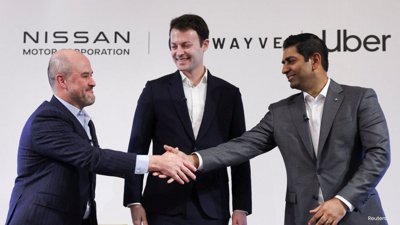
Photo : X / Reuters
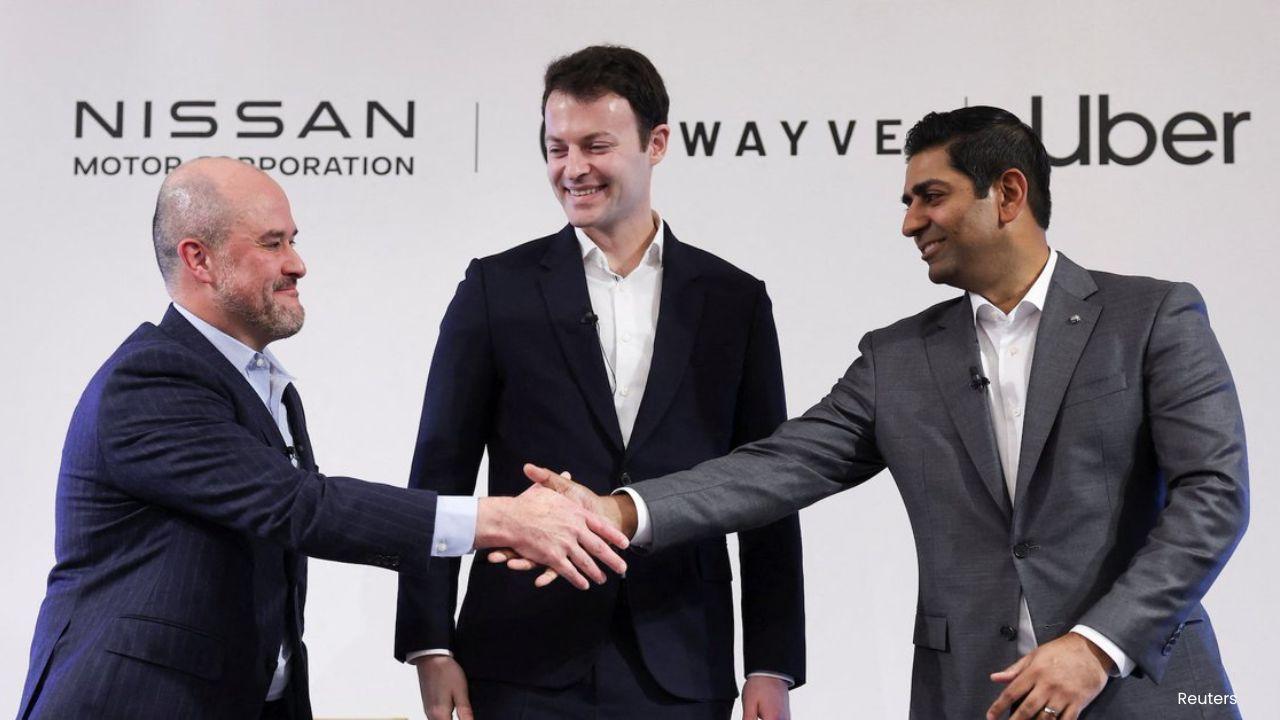
The future of driverless transportation took a significant step forward as a Nissan robotaxi partnership was announced with Uber and British autonomous driving startup Wayve. The collaboration aims to develop and deploy next-generation robotaxis powered by artificial intelligence, combining Nissan’s electric vehicle platform with Wayve’s advanced autonomous driving software and Uber’s global ride-hailing network.
The alliance reflects a growing global push toward robotaxi technology, where autonomous vehicles could transform the way people travel within crowded cities. By integrating electric mobility with cutting-edge AI systems, the three companies are positioning themselves at the forefront of the rapidly evolving urban mobility innovation sector.
Tokyo has been selected as the first city where the Uber robotaxi service pilot will take shape. The companies plan to introduce autonomous ride-hailing vehicles capable of transporting passengers across the city without traditional drivers.
The robotaxi fleet will be built on Nissan’s electric vehicles, which will be equipped with Wayve autonomous drivingtechnology. Through the Uber platform, riders will be able to request these vehicles in the same way they currently book conventional rides, making the transition toward autonomous ride-hailing seamless for passengers. Early phases of the project are expected to involve safety operators inside the vehicles as the technology undergoes real-world testing and regulatory evaluation.
At the heart of the initiative lies Wayve’s artificial intelligence platform designed specifically for AI self-driving cars. Unlike traditional autonomous systems that rely heavily on pre-mapped data, Wayve’s technology uses machine learning to interpret road environments in real time.
This approach allows vehicles to continuously learn and adapt to changing traffic conditions, a crucial factor in dense urban environments like Tokyo. The goal is to create autonomous vehicles capable of navigating complex city streets with the same awareness and responsiveness as human drivers. By integrating this technology into Nissan’s electric vehicles, the partnership aims to accelerate the development of reliable and scalable robotaxi technology.
For Uber, the project represents another major step in expanding its long-term strategy around autonomous ride-hailing. The company has been building partnerships with automakers and autonomous driving companies worldwide to integrate self-driving vehicles into its ride-hailing ecosystem.
Rather than manufacturing its own vehicles, Uber’s approach focuses on providing the digital platform that connects riders with autonomous vehicles developed by partners. Through this model, the Uber robotaxi service could rapidly expand into multiple markets once the technology becomes commercially viable.
The introduction of autonomous ride-hailing services has the potential to reshape how cities move. Supporters of urban mobility innovation believe robotaxis could reduce congestion, lower transportation costs, and improve access to mobility services.
Electric autonomous fleets could also contribute to lower emissions while offering a more efficient transportation system. As cities grow larger and traffic congestion intensifies, technologies like AI self-driving cars may become a critical part of future mobility infrastructure.
The Nissan robotaxi partnership highlights how major automakers, technology startups, and mobility platforms are increasingly collaborating to bring autonomous transportation to life. The combination of Nissan’s vehicle expertise, Wayve’s artificial intelligence, and Uber’s global ride-hailing network creates a powerful ecosystem capable of accelerating robotaxi deployment.
If the Tokyo pilot proves successful, the Uber robotaxi service could expand to other major cities in the coming years. As advancements in Wayve autonomous driving technology continue, the dream of fully autonomous urban transportation is steadily moving from innovation labs to real-world streets.
#trending #latest, Nissan robotaxi partnership, Uber robotaxi service, Wayve autonomous driving, robotaxi technology, autonomous ride-hailing, AI self-driving cars, urban mobility innovation




Advances in Aerospace Technology and Commercial Aviation Recovery
Insights into breakthrough aerospace technologies and commercial aviation’s recovery amid 2025 chall

Defense Modernization and Strategic Spending Trends
Explore key trends in global defense modernization and strategic military spending shaping 2025 secu

Tens of Thousands Protest in Serbia on Anniversary of Deadly Roof Collapse
Tens of thousands in Novi Sad mark a year since a deadly station roof collapse that killed 16, prote

Canada PM Carney Apologizes to Trump Over Controversial Reagan Anti-Tariff Ad
Canadian PM Mark Carney apologized to President Trump over an Ontario anti-tariff ad quoting Reagan,

The ad that stirred a hornets nest, and made Canadian PM Carney say sorry to Trump
Canadian PM Mark Carney apologizes to US President Trump after a tariff-related ad causes diplomatic

Bengaluru-Mumbai Superfast Train Approved After 30-Year Wait
Railways approves new superfast train connecting Bengaluru and Mumbai, ending a 30-year demand, easi



