Post by : Avinab Raana
Photo : X / India Plus
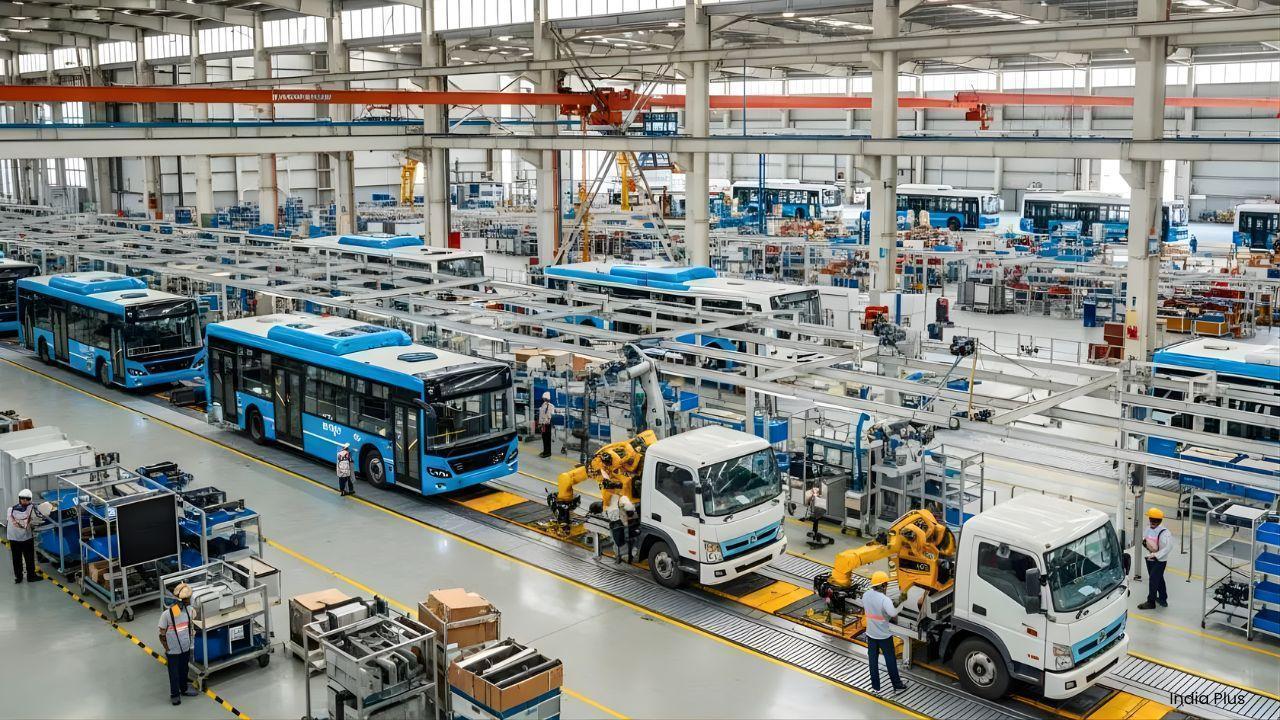
India’s transition toward cleaner transportation gained fresh momentum as Ashok Leyland EV battery production plans advanced with the announcement of a new manufacturing facility in Tamil Nadu. The commercial vehicle giant has unveiled a ₹500 crore EV battery plant India project aimed at strengthening its electric vehicle ecosystem and supporting the growing demand for electric commercial vehicles.
The facility represents a major investment in battery technology and will play a crucial role in supporting Ashok Leyland’s expanding electric mobility portfolio. With global automotive markets shifting rapidly toward electrification, manufacturers are increasingly focusing on building localized battery capabilities.
The new facility will focus on advanced battery pack manufacturing designed specifically for electric buses, trucks, and light commercial vehicles. Battery packs are among the most critical components in electric vehicles, directly influencing performance, range, and reliability.
By establishing its own battery production facility, Ashok Leyland aims to strengthen control over the supply chain while improving cost efficiency and technological integration. Domestic battery manufacturing is also expected to reduce dependence on imported components and enhance the resilience of India’s EV ecosystem.
The plant is expected to deploy advanced production technologies to assemble battery packs that meet high safety and performance standards required for commercial mobility.
The location of the new EV battery plant India facility in Tamil Nadu reflects the state’s growing importance as a hub for automotive and electric mobility manufacturing. Over the past few years, the region has attracted significant investments from global and domestic automakers focused on electric vehicle technology.
Tamil Nadu’s industrial ecosystem supported by strong infrastructure, skilled workforce, and progressive EV policies—has made it one of the most attractive destinations for companies expanding electric vehicle operations.
For Ashok Leyland, which already has a strong manufacturing presence in the state, the new battery facility further strengthens its production network while positioning the region at the center of India’s EV growth story.
The expansion of electric commercial vehicles is expected to transform India’s transport sector in the coming decade. Electric buses are already being deployed in urban public transport networks, while logistics companies are increasingly adopting electric trucks and delivery vehicles to reduce emissions.
Battery technology remains the backbone of this transition. With the establishment of the Ashok Leyland EV batteryfacility, the company is preparing to support large-scale electrification in commercial mobility.
The battery plant will enable the company to produce battery systems optimized for heavy-duty applications, ensuring durability and efficiency for vehicles operating in demanding transportation environments.
One of the most important outcomes of the new facility will be the strengthening of the EV supply chain India. Localized manufacturing of battery packs will encourage the development of supplier networks and technology partnerships across the automotive ecosystem.
This will also help India move closer to building a self-reliant electric mobility sector capable of competing globally. As battery demand rises with increasing EV adoption, investments in domestic manufacturing infrastructure will become critical. Industry experts believe that projects like this will accelerate innovation in energy storage technologies while boosting industrial growth.
The launch of the ₹500 crore EV battery plant India facility highlights the rapid transformation underway in India’s automotive industry. As environmental regulations tighten and sustainability becomes a priority, electric mobility is emerging as a central pillar of future transportation.
For Ashok Leyland, expanding battery manufacturing capability represents a strategic move to lead the transition toward electric commercial vehicles. The project not only strengthens the company’s technological capabilities but also contributes to the broader development of the country’s electric mobility ecosystem.
With large-scale investments and growing policy support, India’s electric vehicle journey is accelerating, and initiatives like this battery plant will play a crucial role in shaping the next phase of industrial and mobility innovation.
#trending #latest,Ashok Leyland EV battery, EV battery plant India, electric commercial vehicles, Tamil Nadu EV manufacturing, battery pack manufacturing, EV supply chain India, electric mobility ecosystem








Advances in Aerospace Technology and Commercial Aviation Recovery
Insights into breakthrough aerospace technologies and commercial aviation’s recovery amid 2025 chall

Defense Modernization and Strategic Spending Trends
Explore key trends in global defense modernization and strategic military spending shaping 2025 secu

Tens of Thousands Protest in Serbia on Anniversary of Deadly Roof Collapse
Tens of thousands in Novi Sad mark a year since a deadly station roof collapse that killed 16, prote

Canada PM Carney Apologizes to Trump Over Controversial Reagan Anti-Tariff Ad
Canadian PM Mark Carney apologized to President Trump over an Ontario anti-tariff ad quoting Reagan,

The ad that stirred a hornets nest, and made Canadian PM Carney say sorry to Trump
Canadian PM Mark Carney apologizes to US President Trump after a tariff-related ad causes diplomatic

Bengaluru-Mumbai Superfast Train Approved After 30-Year Wait
Railways approves new superfast train connecting Bengaluru and Mumbai, ending a 30-year demand, easi



