Post by : Saif
Air travel across the Middle East has faced serious disruption due to the ongoing conflict involving Iran, Israel, and the United States. For several days, missile and drone attacks created major safety concerns, forcing countries in the Gulf region to close their airspace. As a result, airports in the United Arab Emirates were temporarily shut, and hundreds of flights were cancelled. Thousands of passengers were left stranded, unsure when they would be able to travel again.
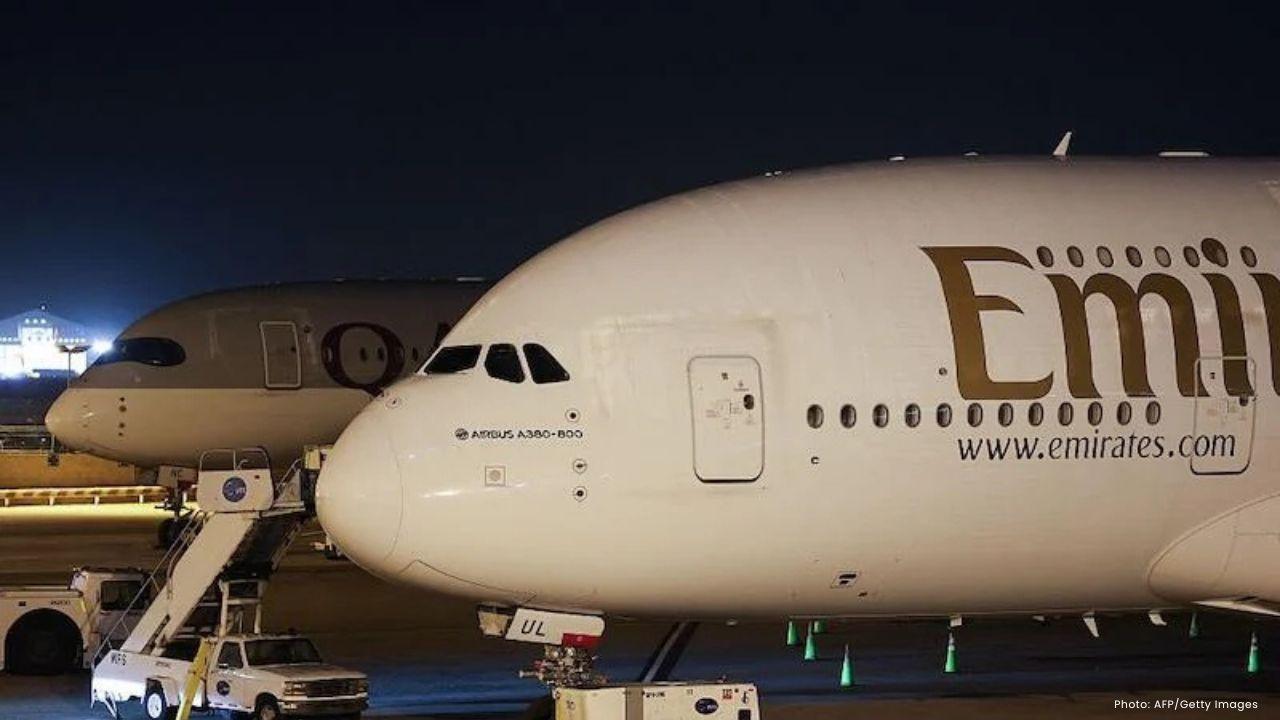
After nearly three days of closure, authorities in the United Arab Emirates allowed limited flight operations to resume. This move came as security officials reviewed the situation and decided that certain carefully planned flights could operate safely. Airlines such as Emirates, Etihad Airways, and flydubai began running a small number of services, mainly to help stranded passengers return home and to reposition aircraft.
The earlier shutdown happened because of growing fears that aircraft could be at risk if they flew through the region during active military exchanges. Missiles and drones launched during the conflict raised serious concerns for civil aviation authorities. In such situations, safety is always the top priority. Even a small risk in busy airspace can have dangerous results, which is why the decision was made to halt flights quickly.
Dubai International Airport and Zayed International Airport in Abu Dhabi are among the busiest hubs in the world. They connect Asia, Europe, Africa, and the Americas. When these airports close, the effect spreads far beyond the Gulf region. Airlines from India, Europe, and other parts of the world had to cancel or reroute flights to avoid the affected airspace. This caused delays not only in the Middle East but also across global flight networks.
The resumption of limited services offers some relief, but normal operations have not yet returned. Airlines are not operating full commercial schedules. Instead, they are focusing on special flights, including repatriation services for citizens and cargo flights that support supply chains. Aviation officials have clearly advised passengers not to go to the airport without confirmed bookings, as operations remain restricted and schedules may change at short notice.
This situation highlights how closely global travel is linked to political and military events. A conflict in one part of the world can quickly disrupt international transportation systems. Modern aviation depends on stable airspace routes. When those routes are closed, airlines must take longer paths, which increases fuel costs, travel time, and ticket prices.
The limited reopening also shows the careful balance that governments must maintain. On one side, they must protect lives and prevent any aviation accident. On the other, they must consider economic activity and the needs of travelers. The UAE economy relies heavily on aviation, tourism, and global business connections. Keeping airports closed for too long can affect trade, tourism, and employment.
Passengers who were stranded during the shutdown faced stress and uncertainty. Many families were separated, business trips were cancelled, and travel plans were disrupted. The gradual return of flights brings hope, but uncertainty remains. If tensions rise again, authorities may need to pause operations once more.
Experts say that airlines will continue to monitor security updates closely. Flight paths may still avoid certain areas as a precaution. International aviation bodies are also sharing intelligence to ensure aircraft safety. Cooperation between countries is essential in times like this, because airspace does not follow political boundaries in the sky.
The current crisis serves as a reminder that aviation safety depends not only on technology and training, but also on peace and stability. Pilots and airlines can manage weather and technical issues, but armed conflict creates unpredictable risks that are harder to control.
For now, the limited restart of UAE flights is a cautious and careful step forward. It provides some relief for travelers while keeping safety at the center of every decision. The coming days will show whether operations can expand further or if fresh tensions will once again ground aircraft in the region.
The world continues to watch the Middle East closely. Air travel, trade, and tourism all depend on stability. As airlines work to restore services step by step, passengers are hoping for calm skies and safer days ahead.
#trending #latest #UAE #AviationNews #MiddleEastConflict #AirTravel #AirlineIndustry #FlightDisruption #GlobalTravel #AviationSafety #armustnews








Advances in Aerospace Technology and Commercial Aviation Recovery
Insights into breakthrough aerospace technologies and commercial aviation’s recovery amid 2025 chall

Defense Modernization and Strategic Spending Trends
Explore key trends in global defense modernization and strategic military spending shaping 2025 secu

Tens of Thousands Protest in Serbia on Anniversary of Deadly Roof Collapse
Tens of thousands in Novi Sad mark a year since a deadly station roof collapse that killed 16, prote

Canada PM Carney Apologizes to Trump Over Controversial Reagan Anti-Tariff Ad
Canadian PM Mark Carney apologized to President Trump over an Ontario anti-tariff ad quoting Reagan,

The ad that stirred a hornets nest, and made Canadian PM Carney say sorry to Trump
Canadian PM Mark Carney apologizes to US President Trump after a tariff-related ad causes diplomatic

Bengaluru-Mumbai Superfast Train Approved After 30-Year Wait
Railways approves new superfast train connecting Bengaluru and Mumbai, ending a 30-year demand, easi



