Post by : Avinab Raana
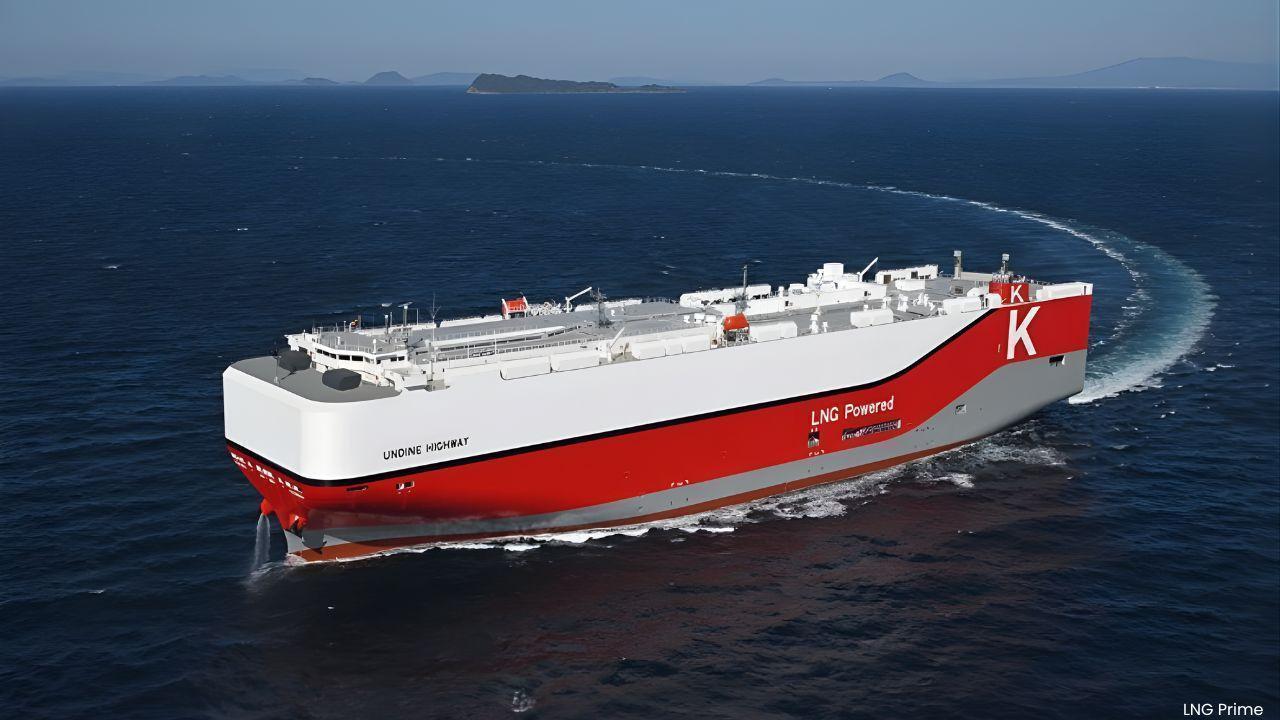
Photo : X / LNG Prime
The global maritime industry is entering a decisive phase in its transition toward cleaner energy, and Japanese shipping giant “K” Line is making a bold move by committing to bio-LNG fuel for its car carrier fleet. This shift is not just an environmental gesture, it represents a strategic transformation in how shipping companies are tackling emissions while maintaining operational efficiency. As pressure mounts from regulators, cargo owners, and global climate commitments, the adoption of alternative fuels is becoming a defining factor in the future of maritime transport.
At the center of this transition is bio-LNG, a renewable fuel derived from organic waste such as agricultural residue, livestock manure, and food byproducts. Unlike conventional fuels, bio-LNG offers significantly lower lifecycle emissions while maintaining compatibility with existing LNG-powered vessels.
This “drop-in” capability is a critical advantage. Shipping companies can reduce emissions without investing heavily in new vessel designs or propulsion systems, allowing for immediate impact. For an industry often constrained by long asset lifecycles and high capital costs, this makes bio-LNG one of the most practical pathways toward sustainability.
“K” Line’s commitment involves securing long-term supplies of bio-LNG and integrating its use across LNG-fuelled car carriers. The initiative is expected to reduce greenhouse gas emissions by approximately 60,800 tonnes annually, marking a significant step toward cleaner operations.
Car carriers, which transport vehicles across global markets, are a critical segment of maritime logistics. Their high-frequency operations and global reach mean that even incremental improvements in fuel efficiency can translate into substantial environmental benefits. By targeting this segment, “K” Line is positioning itself to deliver measurable impact at scale.
The bio-LNG being used is certified under international sustainability frameworks, ensuring compliance with stringent environmental standards. This certification not only validates the fuel’s lower emissions but also enhances transparency and accountability across the supply chain.
For shipping companies, such certifications are becoming increasingly important as customers demand cleaner logistics solutions. The ability to demonstrate reduced emissions across the entire lifecycle from production to consumption adds significant value in a market that is rapidly shifting toward sustainability-driven decision-making.
The initiative is part of “K” Line’s broader environmental strategy, which targets net-zero greenhouse gas emissions by 2050. Bio-LNG is being positioned as a transitional fuel that bridges the gap between traditional fossil fuels and future zero-emission solutions such as hydrogen and ammonia.
This layered approach reflects the complexity of maritime decarbonisation. While next-generation fuels are still in development, bio-LNG offers an immediate and scalable solution that can be deployed today. It allows shipping companies to make tangible progress while continuing to explore long-term alternatives.
“K” Line’s move is not happening in isolation, it reflects a broader shift across the maritime industry toward cleaner fuels and more sustainable operations. As regulatory frameworks tighten and environmental targets become more ambitious, shipping companies are under increasing pressure to innovate.
The adoption of bio-LNG demonstrates how practical solutions can drive immediate change without disrupting existing operations. It also highlights the growing importance of collaboration between shipowners, fuel suppliers, and cargo stakeholders in building a sustainable maritime ecosystem.
The commitment to bio-LNG marks a significant moment in the evolution of marine propulsion systems. It signals that the industry is no longer waiting for future technologies to mature, it is actively implementing solutions that deliver real-world impact today.
As shipping continues to adapt to a low-carbon future, initiatives like this will play a critical role in shaping the trajectory of global trade. The journey toward net-zero is complex, but with scalable and practical solutions like bio-LNG, the maritime industry is proving that progress is not just possible—it is already underway.
#trending #latest,#BioLNG #GreenShipping #CarCarriers #MaritimeSustainability #Decarbonisation








Advances in Aerospace Technology and Commercial Aviation Recovery
Insights into breakthrough aerospace technologies and commercial aviation’s recovery amid 2025 chall

Defense Modernization and Strategic Spending Trends
Explore key trends in global defense modernization and strategic military spending shaping 2025 secu

Tens of Thousands Protest in Serbia on Anniversary of Deadly Roof Collapse
Tens of thousands in Novi Sad mark a year since a deadly station roof collapse that killed 16, prote

Canada PM Carney Apologizes to Trump Over Controversial Reagan Anti-Tariff Ad
Canadian PM Mark Carney apologized to President Trump over an Ontario anti-tariff ad quoting Reagan,

The ad that stirred a hornets nest, and made Canadian PM Carney say sorry to Trump
Canadian PM Mark Carney apologizes to US President Trump after a tariff-related ad causes diplomatic

Bengaluru-Mumbai Superfast Train Approved After 30-Year Wait
Railways approves new superfast train connecting Bengaluru and Mumbai, ending a 30-year demand, easi



