Post by : Avinab Raana
Photo : X / FreightWaves
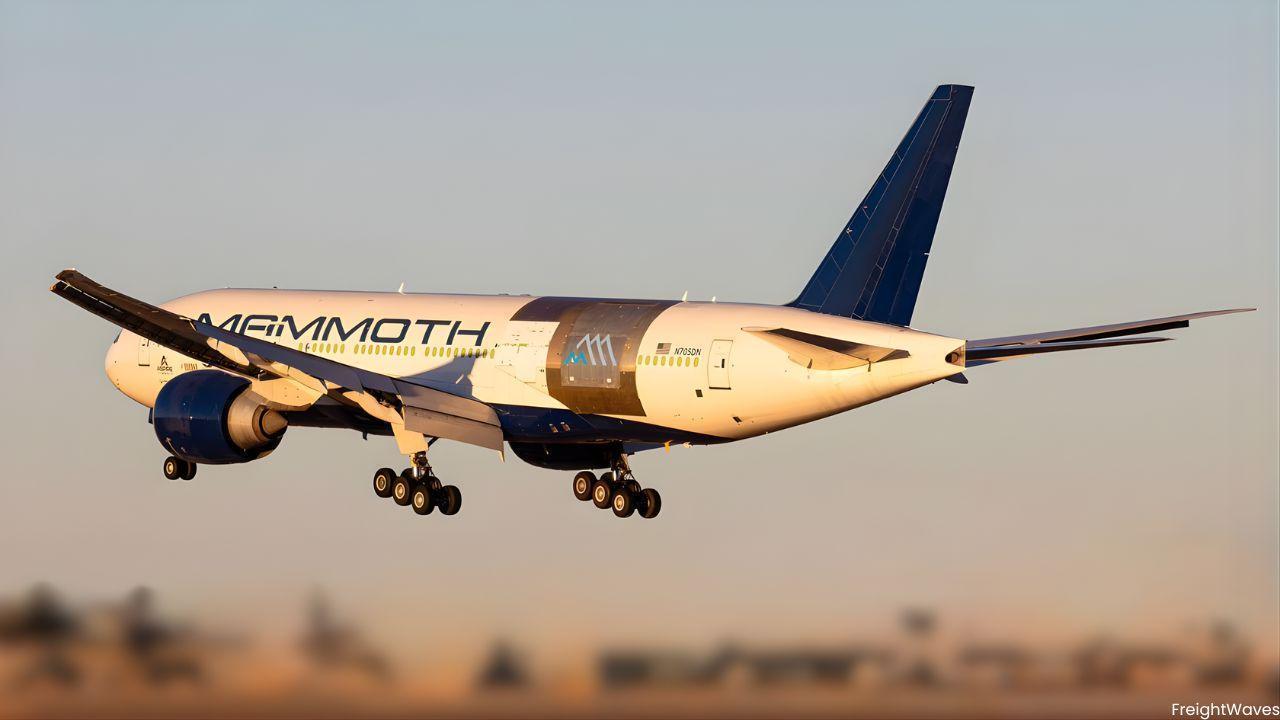
The global air cargo market has just received a powerful boost as Mammoth Freighters secures Federal Aviation Administration (FAA) certification for its 777-200LR freighter conversion, marking a defining moment in the evolution of widebody cargo aircraft. This milestone is not just a regulatory approval—it is a signal that the next generation of high-capacity, long-range freighters is ready to reshape global logistics networks.
At a time when supply chains are under pressure to become faster, more efficient, and more resilient, this certification arrives as a strategic enabler for airlines and cargo operators seeking to expand capacity without investing in entirely new aircraft.
The newly certified 777-200LRMF (Long Range Mammoth Freighter) represents a sophisticated passenger-to-freighter (P2F) conversion built on the robust Boeing 777 platform. Known for its exceptional range and structural reliability, the original aircraft has now been re-engineered into a high-performance cargo solution capable of serving long-haul and high-demand freight routes.
The conversion introduces a reinforced floor system, a large main-deck cargo door among the biggest in its class and an advanced cargo handling system designed for flexibility and efficiency.
These enhancements are not merely technical upgrades; they are tailored to meet the growing demands of e-commerce, express logistics, and global trade flows that require faster turnaround times and higher payload capacities.
With FAA approval now in place, the 777-200LRMF is officially cleared for commercial service, allowing Mammoth Freighters to begin aircraft deliveries and operational deployment.
This certification validates years of engineering, testing, and collaboration with regulatory authorities, ensuring that the aircraft meets stringent safety and performance standards. It also strengthens confidence among airlines, leasing companies, and logistics providers who are increasingly investing in converted freighter fleets.
Launch customers, including major global cargo operators, are expected to integrate these aircraft into their networks, enhancing their ability to serve intercontinental routes with improved cost efficiency.
The certification comes at a time when the air cargo sector is experiencing structural growth driven by digital commerce, supply chain diversification, and geopolitical shifts. Operators are actively seeking aircraft that offer long range, high payload, and operational flexibility, all of which the 777-200LRMF delivers.
Industry observers note that converted widebody freighters are becoming a preferred solution due to their lower acquisition costs compared to factory-built freighters, combined with proven airframe reliability.
However, this segment is also becoming increasingly competitive, with multiple players entering the 777 conversion space. This intensifying competition is expected to accelerate innovation, improve pricing strategies, and expand options for cargo operators worldwide.
Mammoth Freighters is not stopping with this achievement. The company is already advancing its 777-300ER freighter conversion program, aiming to further expand its portfolio and capture a larger share of the global cargo market.
With a growing production network and plans to scale conversion capacity globally, the company is positioning itself at the center of a rapidly evolving freight ecosystem. The ability to convert existing passenger aircraft into high-value cargo assets also aligns with sustainability goals by extending the lifecycle of aircraft and reducing manufacturing demand.
The FAA certification of the 777-200LR freighter conversion is more than an aviation milestone, it is a strategic turning point for global trade and logistics. As demand for faster, more efficient cargo movement continues to rise, aircraft like the 777-200LRMF will play a critical role in shaping the future of air freight.
In a world where speed defines competitiveness, this development reinforces a clear reality: the skies are not just carrying passengers anymore—they are powering the backbone of global commerce.
#trending #latest#AirCargo #FreighterConversion #AviationIndustry #Boeing777 #GlobalLogistics









Advances in Aerospace Technology and Commercial Aviation Recovery
Insights into breakthrough aerospace technologies and commercial aviation’s recovery amid 2025 chall

Defense Modernization and Strategic Spending Trends
Explore key trends in global defense modernization and strategic military spending shaping 2025 secu

Tens of Thousands Protest in Serbia on Anniversary of Deadly Roof Collapse
Tens of thousands in Novi Sad mark a year since a deadly station roof collapse that killed 16, prote

Canada PM Carney Apologizes to Trump Over Controversial Reagan Anti-Tariff Ad
Canadian PM Mark Carney apologized to President Trump over an Ontario anti-tariff ad quoting Reagan,

The ad that stirred a hornets nest, and made Canadian PM Carney say sorry to Trump
Canadian PM Mark Carney apologizes to US President Trump after a tariff-related ad causes diplomatic

Bengaluru-Mumbai Superfast Train Approved After 30-Year Wait
Railways approves new superfast train connecting Bengaluru and Mumbai, ending a 30-year demand, easi



