Post by : Avinab Raana
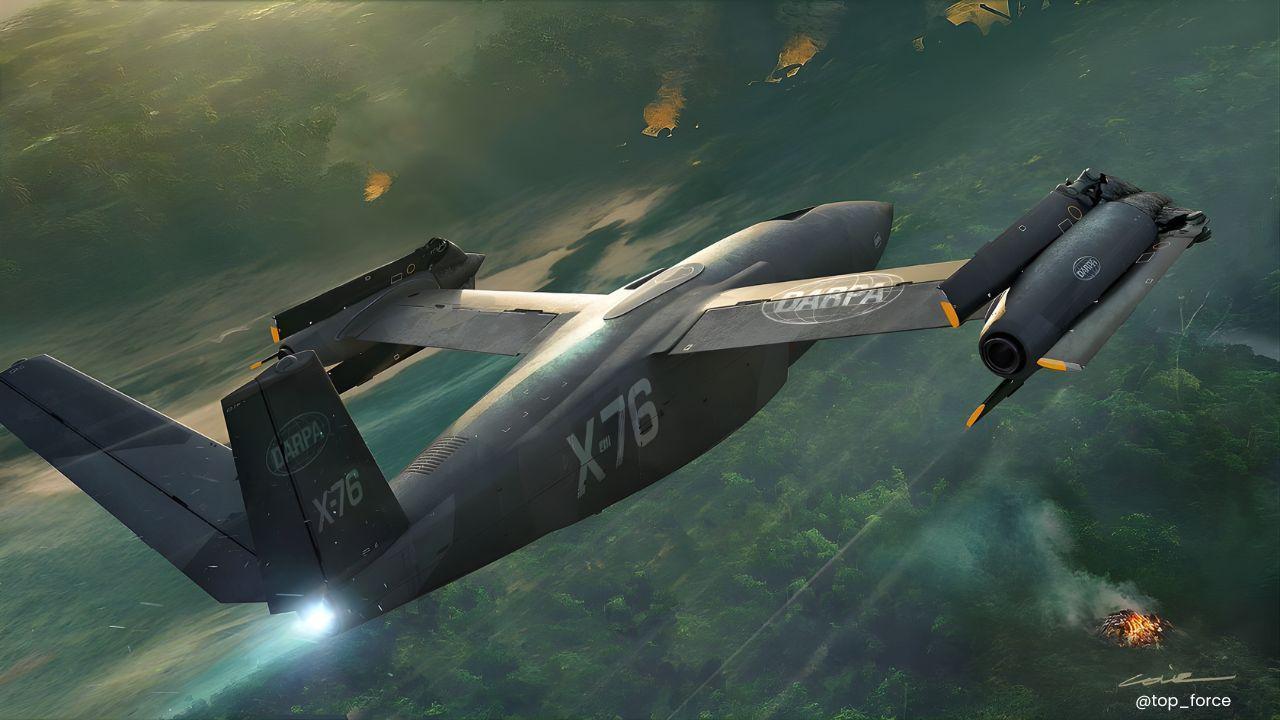
Photo : X / @top_force
In a major step toward redefining military aviation, the U.S. Defense Advanced Research Projects Agency has unveiled the X-76 experimental aircraft, a cutting-edge vertical take-off and landing platform designed to fly at jet-like speeds without relying on traditional runways. Developed under DARPA’s ambitious SPRINT (Speed and Runway Independent Technologies) programme, the aircraft aims to merge two capabilities that have long remained separated in aviation—high speed and operational flexibility.
For decades, aircraft designers have struggled with a fundamental limitation. Helicopters can operate from almost anywhere but are relatively slow, while fixed-wing jets offer incredible speed but depend heavily on long, secure runways. The X-76 programme is attempting to close this gap, creating a new generation of aircraft capable of vertical operations combined with high-speed forward flight.
The SPRINT initiative represents DARPA’s long-term vision for future combat aircraft that can deploy quickly from remote or contested environments. Modern warfare increasingly targets airbases and infrastructure, making runway-independent aircraft more valuable than ever.
By developing technologies that allow aircraft to take off vertically yet cruise at speeds approaching those of conventional jets, DARPA hopes to unlock a new operational advantage for military forces. Aircraft emerging from this programme are expected to reach speeds of roughly 400 to 450 knots, dramatically exceeding the performance of traditional rotorcraft while retaining their operational versatility.
Such capabilities would allow aircraft to launch from unprepared surfaces, remote bases, or even temporary forward locations, dramatically expanding tactical options in high-risk environments.
The X-76 demonstrator is being developed by aerospace manufacturer Bell Textron, a company with decades of experience in vertical-lift innovation. After successfully completing a critical design review, the programme has now entered the build phase, where engineers will begin manufacturing the experimental aircraft.
One of the most fascinating aspects of the X-76 design is its stop-fold tiltrotor technology. During vertical take-off and landing, the aircraft uses large rotors to generate lift, much like a helicopter. However, once the aircraft transitions into forward flight, the rotors stop spinning and fold into the wings, dramatically reducing drag.
This clever engineering approach allows the aircraft to switch from rotor-powered flight to jet-like propulsion, enabling far greater speed while maintaining vertical lift capabilities.
The designation X-76 places the aircraft within the historic family of experimental “X-planes” that have pushed the boundaries of aerospace engineering for decades. These experimental aircraft programmes are designed to test revolutionary technologies that could shape the future of aviation.
The number 76 itself carries symbolic significance. It references the year 1776, reflecting the spirit of innovation and experimentation associated with American technological leadership.
Bell’s involvement also builds on a strong heritage of experimental aircraft. Over the decades, the company has contributed to multiple breakthrough vertical-lift designs that laid the foundation for modern tiltrotor aircraft used in military service today.
With the design phase completed, the focus now shifts to building and testing the X-76 demonstrator. The aircraft will undergo extensive ground testing before moving into flight trials later in the decade.
These tests will focus on validating the complex transition between vertical lift and high-speed forward flight—a key technical challenge that has historically limited hybrid aircraft concepts. Engineers will carefully monitor performance, aerodynamic stability, and the reliability of the rotor-folding mechanism during these experiments.
Although the X-76 itself will remain a technology demonstrator rather than an operational platform, its success could open the door to entirely new aircraft concepts for military aviation.
The X-76 programme represents more than just another experimental aircraft—it reflects a broader transformation in how military forces envision air mobility. As conflicts become more complex and infrastructure becomes increasingly vulnerable, the ability to deploy aircraft quickly without relying on fixed runways could become a decisive advantage.
If the SPRINT programme achieves its goals, the technologies proven by the X-76 could influence the design of next-generation military aircraft capable of operating faster, farther, and from almost anywhere. In a world where speed, flexibility, and survivability are becoming equally critical, the X-76 may offer a glimpse into the future of aviation itself.
#trending #latest,DARPA X-76 aircraft, VTOL aircraft technology, DARPA SPRINT programme, high-speed VTOL aircraft, Bell Textron experimental aircraft, runway independent aircraft, military aviation innovation, next generation VTOL aircraft









Advances in Aerospace Technology and Commercial Aviation Recovery
Insights into breakthrough aerospace technologies and commercial aviation’s recovery amid 2025 chall

Defense Modernization and Strategic Spending Trends
Explore key trends in global defense modernization and strategic military spending shaping 2025 secu

Tens of Thousands Protest in Serbia on Anniversary of Deadly Roof Collapse
Tens of thousands in Novi Sad mark a year since a deadly station roof collapse that killed 16, prote

Canada PM Carney Apologizes to Trump Over Controversial Reagan Anti-Tariff Ad
Canadian PM Mark Carney apologized to President Trump over an Ontario anti-tariff ad quoting Reagan,

The ad that stirred a hornets nest, and made Canadian PM Carney say sorry to Trump
Canadian PM Mark Carney apologizes to US President Trump after a tariff-related ad causes diplomatic

Bengaluru-Mumbai Superfast Train Approved After 30-Year Wait
Railways approves new superfast train connecting Bengaluru and Mumbai, ending a 30-year demand, easi



