Post by : Avinab Raana
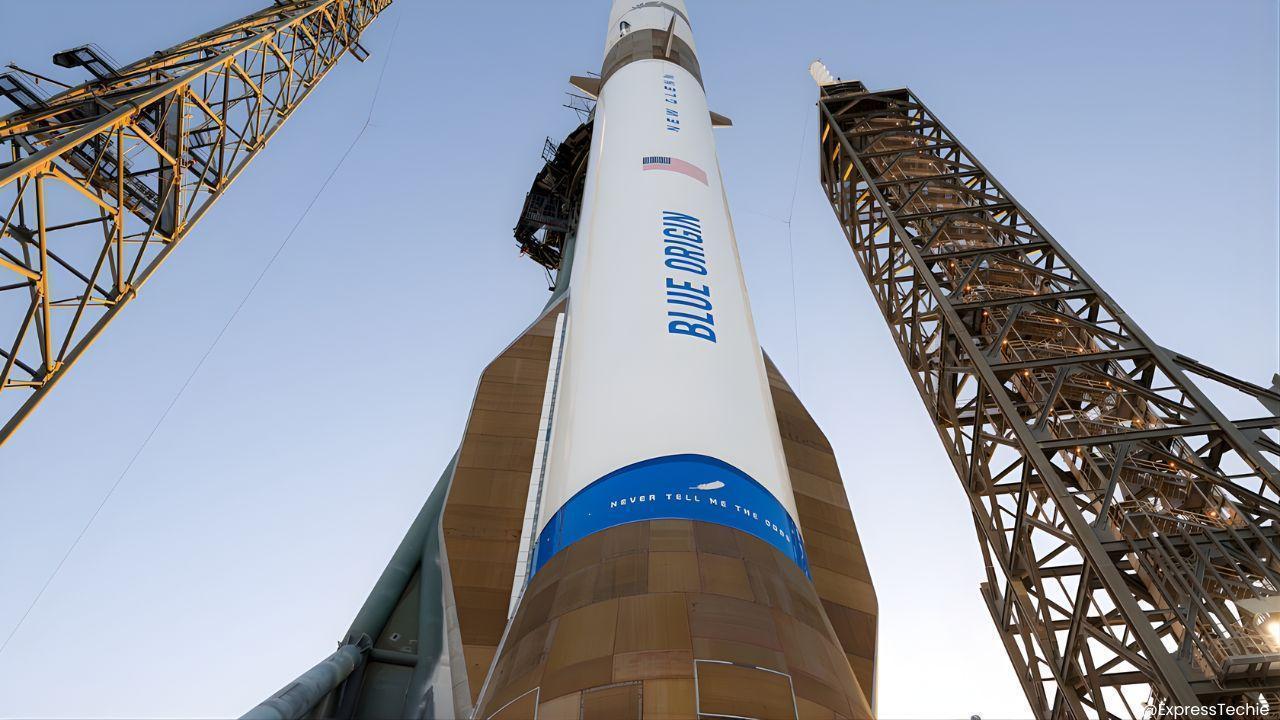
Photo : X / @ExpressTechie
In a defining moment for the global space industry, Blue Origin has successfully landed a reused booster from its heavy-lift New Glenn rocket, marking a major leap forward in the race toward cost-efficient space travel. The mission, launched from Cape Canaveral, was not just another test flight, it was a statement of intent. By demonstrating that a previously flown booster can return safely once again, Blue Origin has moved closer to achieving one of the most transformative goals in modern aerospace: making space launches more frequent, affordable, and commercially viable. This milestone positions the company more firmly in competition with industry leader SpaceX, signaling that the era of reusable heavy-lift rockets is no longer experimental, it is becoming the new standard.
The launch, which marked the third flight of the New Glenn rocket, showcased a successful booster recovery roughly minutes after liftoff. An achievement that reinforces the reliability of Blue Origin’s reusable rocket technology. However, the mission was not without complications. The rocket’s upper stage failed to place its payload, a communications satellite, into the intended orbit, resulting in a partial mission failure. While the satellite successfully separated and powered on, it was deployed at a lower-than-required altitude, making sustained operations impossible and ultimately leading to its planned deorbit.This dual outcome technical success in booster reuse but failure in payload deployment highlights the complex challenges still inherent in orbital launch systems.
At the core of this achievement lies a fundamental shift in how space missions are approached. Reusability is no longer just a technological ambition; it is a financial necessity. The New Glenn’s first-stage booster is designed to be reused multiple times, significantly reducing the cost per launch and enabling higher mission frequency. This approach mirrors the model pioneered by SpaceX but introduces new competition into the market, which could accelerate innovation and drive down costs across the entire aerospace industry. For commercial satellite operators, governments, and space agencies, this translates into more accessible launch opportunities and faster deployment timelines. An evolution that could reshape global communications, Earth observation, and deep-space exploration.
The successful landing of the reused booster underscores Blue Origin’s growing ambition to challenge SpaceX’s dominance in the commercial launch sector. With New Glenn designed as a heavy-lift rocket capable of carrying large payloads, the company is targeting high-value missions, including satellite constellations, lunar programs, and deep-space exploration initiatives.The mission also comes at a time of heightened activity in the space sector, where both companies are competing for major contracts and technological milestones. From satellite internet networks to lunar landers, the stakes are higher than ever, and each successful test strengthens a company’s credibility in securing future partnerships.
Despite the setback with the satellite deployment, the successful reuse and landing of the New Glenn booster is a milestone that cannot be overlooked. It demonstrates that the pathway to fully reusable, heavy-lift launch systems is becoming increasingly viable. For the aerospace industry, this represents a turning point where efficiency, sustainability, and scalability converge to redefine space transportation. As Blue Origin continues to refine its technology, the focus will now shift toward improving mission reliability while maintaining its advancements in reusability. The balance between innovation and execution will determine whether the company can truly emerge as a dominant force in the global space economy.
The successful landing of a reused booster is more than a technical achievement, it is a glimpse into the future of space exploration. It signals a world where rockets are not discarded after a single use but become part of a sustainable, repeatable system that unlocks new possibilities beyond Earth. For Blue Origin, this mission is both a milestone and a reminder that the journey to space leadership is defined not just by breakthroughs, but by consistency, precision, and resilience. As the competition intensifies and ambitions grow, one thing is certain: the next chapter of the space race will be defined by those who can not only reach space—but return, rebuild, and launch again.
#trending #latest#BlueOrigin #NewGlenn #ReusableRocket #SpaceLaunch #AerospaceInnovation







Advances in Aerospace Technology and Commercial Aviation Recovery
Insights into breakthrough aerospace technologies and commercial aviation’s recovery amid 2025 chall

Defense Modernization and Strategic Spending Trends
Explore key trends in global defense modernization and strategic military spending shaping 2025 secu

Tens of Thousands Protest in Serbia on Anniversary of Deadly Roof Collapse
Tens of thousands in Novi Sad mark a year since a deadly station roof collapse that killed 16, prote

Canada PM Carney Apologizes to Trump Over Controversial Reagan Anti-Tariff Ad
Canadian PM Mark Carney apologized to President Trump over an Ontario anti-tariff ad quoting Reagan,

The ad that stirred a hornets nest, and made Canadian PM Carney say sorry to Trump
Canadian PM Mark Carney apologizes to US President Trump after a tariff-related ad causes diplomatic

Bengaluru-Mumbai Superfast Train Approved After 30-Year Wait
Railways approves new superfast train connecting Bengaluru and Mumbai, ending a 30-year demand, easi



