Post by : Avinab Raana
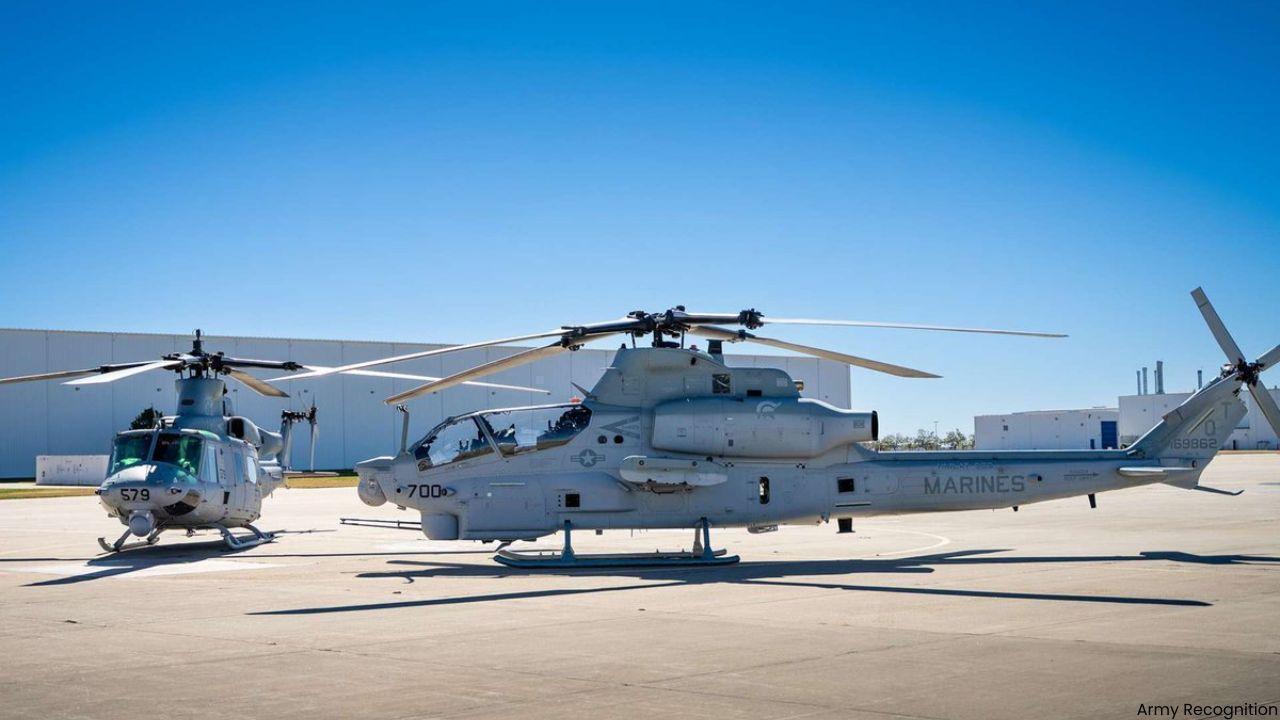
Photo : X / Army Recognition
Bell has reached an important milestone in military aviation modernization by completing structural spine upgrades on the first U.S. Marine Corps H-1 helicopters. The upgrade program is designed to strengthen the aircraft’s internal structure while expanding onboard electrical capacity, allowing the helicopters to support next-generation mission systems and advanced combat technologies. The H-1 helicopter family, which includes the AH-1Z Viper attack helicopter and the UH-1Y Venom utility helicopter, forms a core part of the Marine Corps’ aviation capabilities. These aircraft perform critical missions ranging from close air support and reconnaissance to troop transport and battlefield coordination.
At the heart of the modernization effort is the structural spine upgrade, a key modification that reinforces the helicopter’s internal framework. This improvement increases the aircraft’s ability to handle additional electrical loads generated by modern avionics, sensors, and weapon systems. As military aircraft evolve to incorporate more digital and electronic technologies, electrical power capacity becomes increasingly important. The upgraded H-1 helicopters are now better equipped to operate advanced mission equipment without compromising performance or reliability.
The upgraded architecture allows the Marine Corps to integrate emerging technologies into the H-1 fleet over time. Future weapons systems, electronic warfare capabilities, and enhanced communication platforms are expected to require significantly more onboard power. By completing these structural and electrical upgrades early, the Marine Corps ensures that the helicopters can accommodate these technologies as they become operational. This approach helps maintain the combat effectiveness of the fleet without requiring an entirely new aircraft platform.
The H-1 helicopter series remains one of the most important rotorcraft platforms used by the Marine Corps. The AH-1Z Viper provides precision attack and close air support capabilities, while the UH-1Y Venom serves as a versatile utility helicopter supporting troop movement, command operations, and logistical missions. Both aircraft were originally introduced as part of a modernization program aimed at improving the performance, survivability, and operational efficiency of earlier H-1 variants.
Rather than replacing the helicopters outright, the Marine Corps has chosen to extend the service life of its H-1 fleet through targeted upgrades. Structural improvements and electrical enhancements allow the aircraft to adapt to modern mission demands while continuing to operate reliably in diverse operational environments. This strategy allows military forces to maintain proven aircraft platforms while gradually integrating new technologies.
Bell’s completion of the first structural spine upgrades represents a significant step in ensuring that the Marine Corps’ helicopter fleet remains capable of supporting future missions. As defense technologies continue evolving, aircraft modernization programs like this one are becoming essential for maintaining operational readiness. With enhanced power capacity and reinforced structures, the upgraded H-1 helicopters are now better prepared to support the next generation of military aviation capabilities.
Bell H-1 helicopter upgrade, USMC AH-1Z UH-1Y modernization, Bell spine upgrade helicopters, H-1 electrical power upgrade, US Marine Corps helicopter upgrade, Bell H-1 fleet modernization, military helicopter systems upgrade


Advances in Aerospace Technology and Commercial Aviation Recovery
Insights into breakthrough aerospace technologies and commercial aviation’s recovery amid 2025 chall

Defense Modernization and Strategic Spending Trends
Explore key trends in global defense modernization and strategic military spending shaping 2025 secu

Tens of Thousands Protest in Serbia on Anniversary of Deadly Roof Collapse
Tens of thousands in Novi Sad mark a year since a deadly station roof collapse that killed 16, prote

Canada PM Carney Apologizes to Trump Over Controversial Reagan Anti-Tariff Ad
Canadian PM Mark Carney apologized to President Trump over an Ontario anti-tariff ad quoting Reagan,

The ad that stirred a hornets nest, and made Canadian PM Carney say sorry to Trump
Canadian PM Mark Carney apologizes to US President Trump after a tariff-related ad causes diplomatic

Bengaluru-Mumbai Superfast Train Approved After 30-Year Wait
Railways approves new superfast train connecting Bengaluru and Mumbai, ending a 30-year demand, easi



