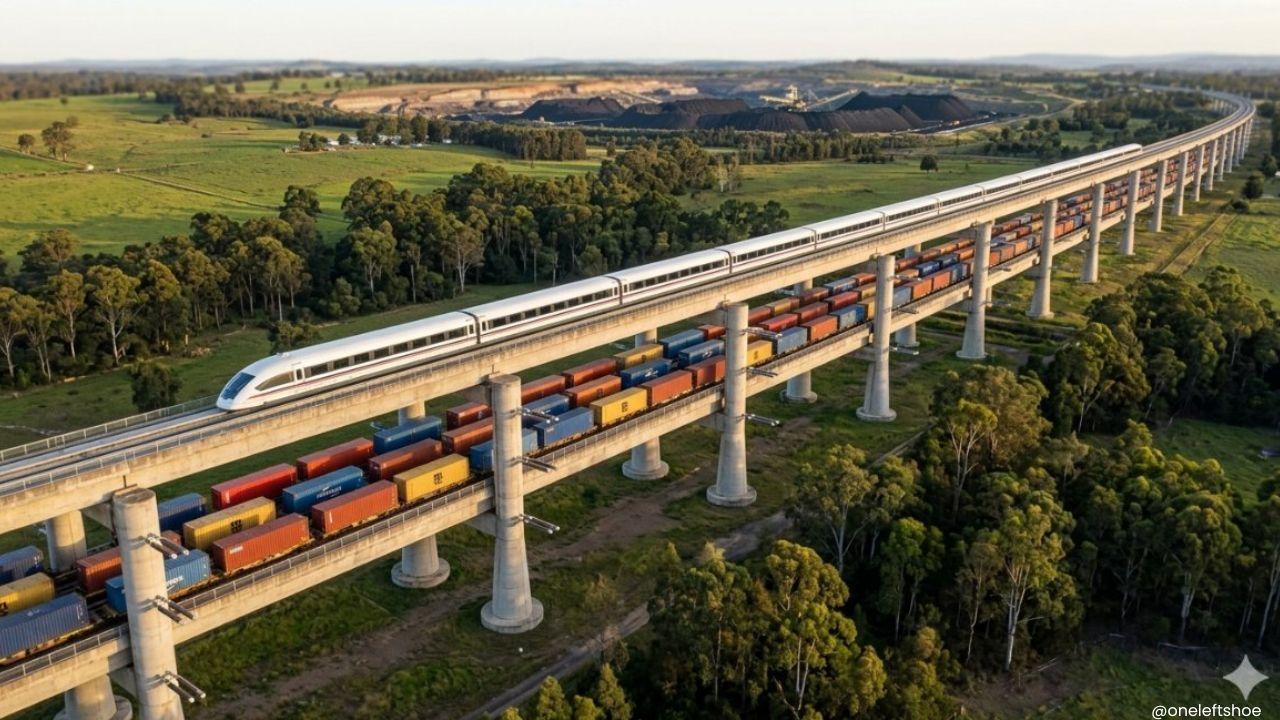
Post by : Avinab Raana
Photo : X / @oneleftshoe
In a bold and transformative move that signals the next phase of sustainable urban mobility, New South Wales has secured a landmark $1.9 billion renewable energy deal to power its entire public transport network including trains, metro systems, buses, and light rail. This is not just a policy shift or an infrastructure upgrade; it is a structural redefinition of how large-scale transport ecosystems will operate in a decarbonised future. At a time when global cities are grappling with rising fuel costs, climate commitments, and increasing passenger demand, this deal places Australia firmly at the forefront of integrating clean energy with mass transit. More importantly, it sets a powerful precedent proving that sustainability and operational efficiency can coexist at scale, reshaping how governments and transport authorities approach long-term mobility planning.
At the core of this initiative is a seven-year agreement between Transport for NSW and Snowy Energy, designed to consolidate the electricity supply for the entire public transport system under a single contract for the first time. Previously, various transport divisions operated under fragmented power agreements, limiting efficiency and cost optimization. By centralising procurement, the government has leveraged its scale to negotiate better terms ensuring both financial savings and operational consistency. The deal, running from 2027 to 2034, represents a strategic consolidation that aligns energy supply with the growing demands of an expanding transport network.
One of the most compelling aspects of this agreement lies in its financial implications. The deal is expected to generate savings of approximately AUD 130 million over its lifecycle, funds that will be reinvested directly into frontline transport services.In an era marked by rising fuel prices and cost-of-living pressures, such savings are not merely accounting benefits, they translate into tangible improvements for commuters. Enhanced services, better frequency, and infrastructure upgrades become achievable when operational costs are optimised. This financial efficiency underscores a broader trend where sustainability initiatives are increasingly delivering economic advantages alongside environmental benefits.
Beyond economics, the environmental impact of the deal is profound. By transitioning to renewable energy sources such as wind, solar, and hydroelectric power, the NSW transport network is set to avoid more than 800,000 tonnes of carbon emissions annually.This shift is critical as transport remains one of the largest contributors to urban emissions globally. Electrified trains and buses powered by clean energy create a multiplier effect reducing reliance on fossil fuels while accelerating the transition toward net-zero targets. For NSW, this deal aligns with broader climate goals, including significant emission reductions by 2030 and a pathway to full net-zero operations in the coming years.
Transport for NSW is one of the largest energy consumers in the public sector, using nearly as much electricity as all other government agencies combined. This makes the transition to renewable energy not only impactful but essential. The agreement will support a rapidly expanding network that includes new metro lines, electrified rail systems, and thousands of zero-emission buses. As urban populations grow and demand for public transport increases, ensuring a stable and sustainable energy supply becomes a critical operational priority. This deal effectively future-proofs the network, enabling it to scale without proportionally increasing its environmental footprint.
The NSW renewable energy deal reflects a larger global shift where transportation and energy sectors are becoming increasingly interconnected. Cities worldwide are exploring similar models to decarbonise public transport while maintaining cost efficiency. What makes this initiative particularly significant is its scale and integration. By combining multiple transport modes under a single renewable energy framework, NSW has created a blueprint that other regions can replicate. It demonstrates that sustainability is no longer an isolated goal, it is becoming a core pillar of transport strategy and urban development.
As the world accelerates toward a cleaner, more sustainable future, the NSW renewable energy deal stands as a defining moment in the evolution of public transport. It is a clear signal that the future of mobility will not be driven solely by vehicles or infrastructure, but by the energy systems that power them.
This initiative goes beyond reducing emissionsm it reimagines the very foundation of transport networks, where efficiency, sustainability, and passenger experience converge. For Australia, it is a step toward leadership in green mobility. For the global industry, it is a wake-up call: the transition to renewable-powered transport is no longer a distant ambition. It is happening now, at scale, and with measurable impact. The cities that adapt fastest will define the future of transportation.
#trending #latest#NSWTransport #RenewableEnergy #GreenMobility #PublicTransport #SustainableTransit








Advances in Aerospace Technology and Commercial Aviation Recovery
Insights into breakthrough aerospace technologies and commercial aviation’s recovery amid 2025 chall

Defense Modernization and Strategic Spending Trends
Explore key trends in global defense modernization and strategic military spending shaping 2025 secu

Tens of Thousands Protest in Serbia on Anniversary of Deadly Roof Collapse
Tens of thousands in Novi Sad mark a year since a deadly station roof collapse that killed 16, prote

Canada PM Carney Apologizes to Trump Over Controversial Reagan Anti-Tariff Ad
Canadian PM Mark Carney apologized to President Trump over an Ontario anti-tariff ad quoting Reagan,

The ad that stirred a hornets nest, and made Canadian PM Carney say sorry to Trump
Canadian PM Mark Carney apologizes to US President Trump after a tariff-related ad causes diplomatic

Bengaluru-Mumbai Superfast Train Approved After 30-Year Wait
Railways approves new superfast train connecting Bengaluru and Mumbai, ending a 30-year demand, easi



