Post by : Saif
Oil prices declined on Friday after US President Donald Trump said Washington would not launch new attacks on Iran before the November 3 midterm elections. His comments, alongside reports of productive diplomatic discussions, eased immediate concerns about further disruptions to Middle East oil supplies.
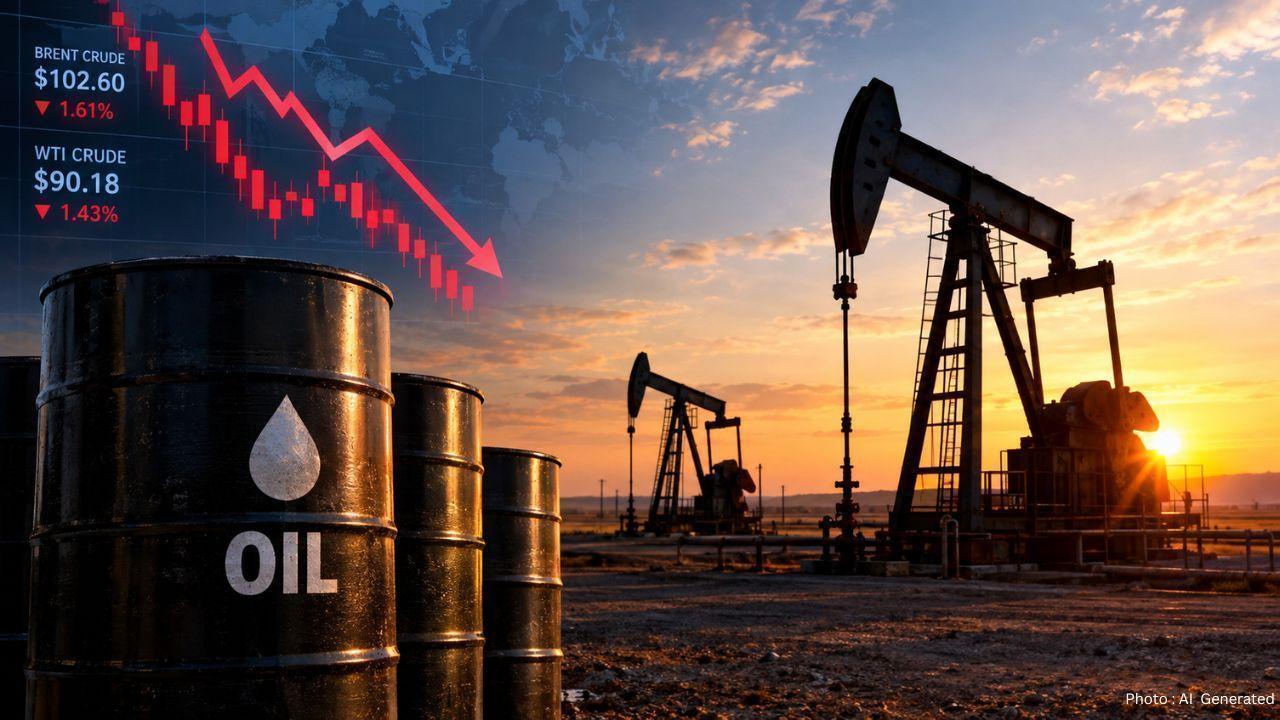
Brent crude futures fell by $1.68, or 1.61%, to $102.60 per barrel, while US West Texas Intermediate (WTI) crude dropped $1.31, or 1.43%, to $90.18 by 0819 GMT on October 9, 2026.
However, continuing security threats in the Persian Gulf and the Red Sea, uncertainty over negotiations and disruptions to oil production elsewhere have limited expectations of a sustained decline in prices.
International oil benchmarks moved lower as traders assessed the possibility of reduced military tensions between Washington and Tehran.
Brent crude was trading at $102.60 per barrel after falling 1.61%, while WTI crude declined 1.43% to $90.18 per barrel.
Despite Friday's losses, Brent was on course for a weekly gain after settling around 4% higher on Thursday. WTI, meanwhile, was heading towards a slight weekly decline.
Oil prices have remained volatile because traders are weighing the possibility of diplomatic progress against continuing threats to energy infrastructure and shipping routes.
Market analysts said Trump's comments helped ease immediate supply concerns, but a lasting reduction in prices would depend on developments beyond political statements.
Trump said on Thursday that the United States was holding productive discussions with Iran and would not attack the country before the November 3 congressional midterm elections.
His remarks followed media reports suggesting that Washington had been considering military action against Iran before the vote.
The announcement reduced some fears of an immediate escalation that could further disrupt oil production and exports across the Middle East.
However, the conflict remains unresolved, and the economic pressure on Tehran continues. The United States announced additional sanctions on Thursday targeting individuals, networks and 17 vessels accused of transporting Iranian crude oil, petroleum products and petrochemicals.
The sanctions demonstrate that Washington continues to use economic measures while diplomatic discussions are underway.
Negotiations over the Strait of Hormuz remain central to the outlook for global energy supplies.
Iran's Tasnim news agency reported that Foreign Minister Abbas Araqchi said Tehran was reviewing the US response to an Iranian proposal that would reopen the strategic waterway within seven days.
Before the war, the Strait of Hormuz carried shipments equivalent to approximately 20% of global oil and fuel supplies. Disruptions to traffic through the passage have therefore raised significant concerns among energy traders and importing countries.
A reopening could improve the movement of oil and fuel shipments and reduce pressure on global markets. However, traders are waiting for concrete progress in negotiations and improvements in shipping safety before concluding that supply risks have eased.
The continued uncertainty surrounding the waterway has contributed to sharp price movements throughout October.
China, the world's largest oil importer, is expected to resume refined fuel exports after a brief suspension during its Golden Week holiday, according to the report.
The return of Chinese fuel shipments could help ease tight supplies of refined products in international markets.
The conflict in the Middle East, combined with the Russia-Ukraine war, has disrupted the availability of gasoline, jet fuel and diesel. Diesel supplies have faced particular pressure.
Additional exports from China could provide some relief to countries dealing with higher fuel costs and limited availability. However, the extent of that relief will depend on export volumes and the broader condition of international markets.
Oil prices are also being influenced by Hurricane Isaias in the Gulf of Mexico, where the storm has forced producers to shut down a substantial amount of production.
According to the US Marine Minerals Administration figures cited in the report, approximately 1.3 million barrels per day of oil production had been shut in as of Thursday. That represented 62.9% of current production in the affected region.
The disruption provides support for oil prices by reducing available supplies, even as diplomatic developments involving Iran place downward pressure on the market.
The duration of the impact will depend on inspections of offshore facilities after the storm and how quickly normal operations can resume.
Despite Friday's decline, security concerns around the Persian Gulf and Red Sea remain a major risk for global energy markets.
Threats to shipping and energy infrastructure could interrupt exports, increase transportation costs and force traders to reassess supply expectations.
Analysts have warned that improved diplomatic relations alone may not be enough to bring oil prices down significantly while shipping risks remain high.
The market is therefore balancing three competing factors: hopes for progress in US-Iran negotiations, the possibility of additional fuel supplies from China, and production disruptions caused by the hurricane.
The fall in Brent and WTI prices reflects reduced fears of an immediate US military attack on Iran. However, it does not mean that the wider supply crisis has been resolved.
A lasting decline will depend on progress towards reopening the Strait of Hormuz, safer shipping conditions and the restoration of disrupted oil production.
For oil-importing countries, lower crude prices could eventually reduce pressure on fuel costs, although the effect on petrol, diesel and other products will depend on refining costs, transport expenses, taxes and currency movements.
#trending #latest #OilPrices #CrudeOil #BrentCrude #WTI #OilMarket #IranUSRelations #DonaldTrump #StraitOfHormuz #GlobalOilSupply #EnergyMarket #MiddleEastNews #WorldNews #OilPriceUpdate #Geopolitics







Advances in Aerospace Technology and Commercial Aviation Recovery
Insights into breakthrough aerospace technologies and commercial aviation’s recovery amid 2025 chall

Defense Modernization and Strategic Spending Trends
Explore key trends in global defense modernization and strategic military spending shaping 2025 secu

Tens of Thousands Protest in Serbia on Anniversary of Deadly Roof Collapse
Tens of thousands in Novi Sad mark a year since a deadly station roof collapse that killed 16, prote

Canada PM Carney Apologizes to Trump Over Controversial Reagan Anti-Tariff Ad
Canadian PM Mark Carney apologized to President Trump over an Ontario anti-tariff ad quoting Reagan,

The ad that stirred a hornets nest, and made Canadian PM Carney say sorry to Trump
Canadian PM Mark Carney apologizes to US President Trump after a tariff-related ad causes diplomatic

Bengaluru-Mumbai Superfast Train Approved After 30-Year Wait
Railways approves new superfast train connecting Bengaluru and Mumbai, ending a 30-year demand, easi



