Post by : Meena Rani
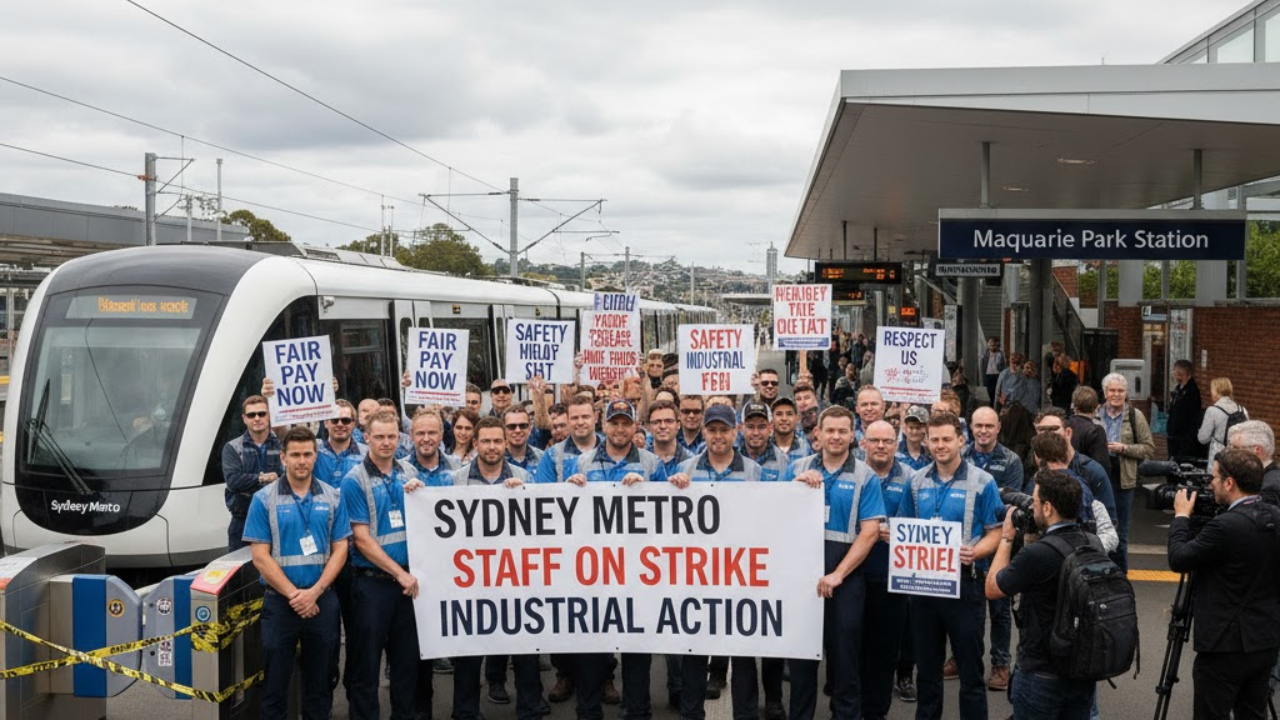
In a significant escalation of transport sector tensions, Sydney Metro staff — represented by the Rail, Tram and Bus Union (RTBU) — are set to commence indefinite protected industrial action starting at midnight on a coming Friday. The dispute centers around wage conditions, staff safety, and working conditions.
Although Sydney Metro trains operate driverless and largely automatically, the industrial action is not expected to interrupt the running of train services — instead, the protest will take the form of union campaigns such as wearing uniforms, distributing materials, and other non-work stoppage measures.
This move follows a protracted pay dispute and represents one of the latest flashpoints in ongoing industrial tensions across Sydney’s rail and metro operations.
Sydney Metro is operated by Metro Trains Sydney (MTS), a private operator majority controlled by Hong Kong-based MTR Corporation. Metro Trains runs the automated driverless trains, while staff roles include customer service, station operations, signalling, control centre functions, and other operational support tasks.
Because the trains themselves do not require drivers, the staff demands and industrial friction focus less on train shifts and more on conditions, safety, and recognition of essential service roles.
Sydney’s heavy rail network has seen considerable industrial tension in recent years. In 2024 and early 2025, protracted union actions led to severe commuting disruptions.
Notably, in mid-2025 a new enterprise agreement ended some heavy rail strikes, providing pay rises to a large group of rail workers.
However, the metro system was largely insulated from those disruptions — until now. The current dispute arises as pay negotiations with Metro Trains Sydney have reportedly stalled, and staff feel their concerns about safety and working environment have not been adequately addressed.
A principal demand from the union is increased wages for frontline staff, to bring their remuneration more in line with comparable transport roles. RTBU argues that metro staff have been under-rewarded.
One notable demand is a request that metro trains be retrofitted with staff cabins / “safe space” cabins. Even though the trains run automatically, the union asserts that staff should have a secure compartment in emergencies.
Union demands also include improved staff seating at metro stations, better workplace amenities, and recognition of the continuous operational burden placed on staff throughout service hours.
Because the industrial action is protected, the union plans to mount public campaigns, distribute union materials, wear uniforms, and communicate grievances publicly. These communication efforts are part of the strategy to raise awareness of staff concerns.
Protected industrial action is authorized under Australian labour laws, ensuring that employees participating in the action cannot be penalized or dismissed for engaging in those measures, provided they follow due process.
Because the industrial action is “protected”, it will not include actual work stoppages or strikes in the initial phase. Rather, it will manifest through union visibility efforts (uniforms, signage, public statements) and communications.
Service disruptions are not expected immediately, given that the metro trains themselves are driverless; the direct core operations may continue unimpeded.
However, the union notes that engineering and control centre staff may later escalate or file additional protected actions if negotiations do not progress.
In the short term, direct train service is expected to continue. However, public perception, staff morale, and station operations may feel pressure from increased union activism and visibility.
Longer term, if the dispute intensifies, escalated actions or strikes could threaten service continuity and commuter confidence.
Sydney’s metro has been a showcase project of modern, driverless transport. Industrial unrest undermines the narrative of seamless, frictionless rail.
Politically, the state government and transport authorities may come under pressure to intervene, mediate, or take a stance to protect public services.
If the union succeeds, it may embolden similar industrial actions in other automated or semi-automated transit systems elsewhere in Australia or abroad, especially where staff support roles are undervalued.
Earlier in September 2025, the Fair Work Commission authorized a protected action ballot for metro workers, meaning union members could vote on potential industrial measures.
If the ballot results in consent, the union gains legal cover to initiate action.
With no resolution emerging by October, the RTBU has now formally announced indefinite protected industrial action starting at midnight Friday, emphasizing that train services will still run.
The union also signaled that further measures by engineering or control staff may follow if negotiations remain stalled.
Metro Trains Sydney said it continued to engage in negotiations with RTBU and Professionals Australia.
State transport ministers have urged a fair resolution and warned of consequences if services are disrupted.
Since the metro is run by a private operator in partnership with government agencies, the locus of negotiation is partly in the hands of Metro Trains, complicating direct ministerial leverage.
The government must walk a tight line: protecting uninterrupted public transport while ensuring staff rights, safety, and fair pay.
Retrofits of staff cabins on driverless trains may pose design, cost, and regulatory challenges — especially for a system built without those features.
If talks fail, additional protected actions — or full strikes by critical staff — could disrupt metro services in ways that damage commuter trust and revenue.
Keep an eye on RTBU statements for updated bargaining positions, escalation plans, or temporary work bans.
Metro Trains Sydney will likely issue advisories or contingency notices — commuters should monitor those, especially in the event of future escalation.
Whether state or federal agencies step in (e.g. via Fair Work Commission mediation) could shift the frame of negotiation.
Media coverage, commuter sentiment, and political backlash can all exert pressure for a swift settlement.
This dispute underscores a few key lessons in modern transport labor:
Automation ≠ no labor friction: Even highly automated systems depend on staff for safety, customer service, operations, and maintenance.
Recognition of support roles: As core functions become automated, the value and working conditions of support staff become central bargaining zones.
Industrial law nuance: Protected action allows unions to campaign without immediate service disruptions—blurring lines between protest and work stoppage.
Complex governance in private-public systems: When private operators deliver public transit, accountability, negotiation, and public interest must be carefully managed.
Disclaimer
This article is intended for general informational purposes based on public reporting and statements as of 15 October 2025. Situations involving labor disputes, industrial actions, and negotiations can evolve rapidly. Readers should refer to official statements from unions, government agencies, and metro operators for the most current and authoritative information.
Sydney Metro, industrial action, RTBU, Metro Trains Sydney, transit strike, protected action, commuter impact, driverless metro, transport dispute, Australia






Advances in Aerospace Technology and Commercial Aviation Recovery
Insights into breakthrough aerospace technologies and commercial aviation’s recovery amid 2025 chall

Defense Modernization and Strategic Spending Trends
Explore key trends in global defense modernization and strategic military spending shaping 2025 secu

Tens of Thousands Protest in Serbia on Anniversary of Deadly Roof Collapse
Tens of thousands in Novi Sad mark a year since a deadly station roof collapse that killed 16, prote

Canada PM Carney Apologizes to Trump Over Controversial Reagan Anti-Tariff Ad
Canadian PM Mark Carney apologized to President Trump over an Ontario anti-tariff ad quoting Reagan,

The ad that stirred a hornets nest, and made Canadian PM Carney say sorry to Trump
Canadian PM Mark Carney apologizes to US President Trump after a tariff-related ad causes diplomatic

Bengaluru-Mumbai Superfast Train Approved After 30-Year Wait
Railways approves new superfast train connecting Bengaluru and Mumbai, ending a 30-year demand, easi



