Post by : Avinab Raana
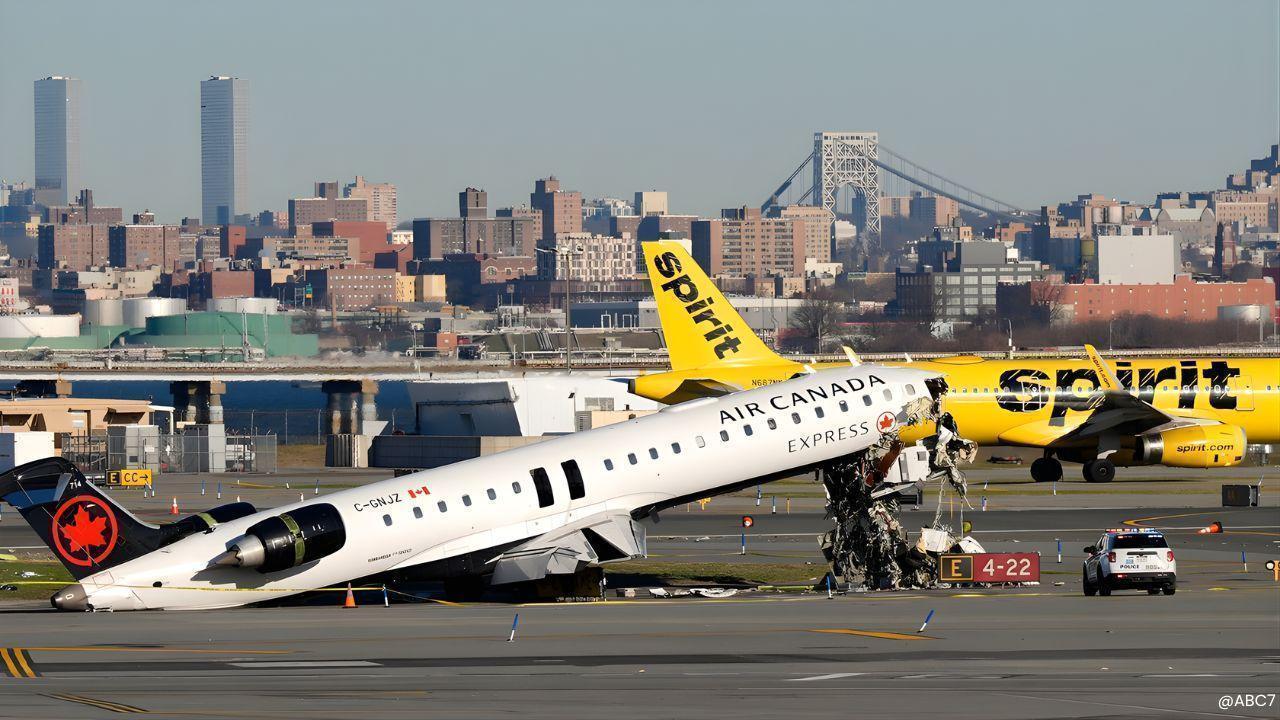
Photo : X / @ABC7
A tragic collision at New York’s LaGuardia Airport has exposed a critical vulnerability in aviation safety systems, after investigators revealed that a key ground tracking system failed to alert controllers in time. The incident, involving a regional passenger jet and an airport fire truck, resulted in the deaths of two pilots and injuries to dozens of passengers. At the center of the investigation is the breakdown of a system designed to prevent exactly such incidents—raising serious concerns about the reliability of modern airport surveillance infrastructure.
The airport’s surface tracking system, responsible for monitoring the movement of aircraft and vehicles on the ground, did not generate a warning before the collision. Investigators highlighted that the system was unable to create a reliable track due to the close proximity and movement of multiple objects near the runway. Compounding the issue, the fire truck involved in the incident lacked a functioning transponder, significantly limiting the system’s ability to detect and track its position in real time.
The sequence of events unfolded within a matter of seconds. The aircraft had been cleared to land while the fire truck was authorized to cross the runway to respond to another situation. The overlap of instructions, combined with the absence of timely alerts, created a scenario where both the aircraft and the vehicle occupied the same runway space. Despite last-minute attempts to correct the situation, the collision became unavoidable—highlighting how quickly small lapses can escalate into catastrophic outcomes in high-speed aviation environments.
While the tracking system failure is a central factor, investigators have emphasized that the accident likely resulted from a combination of breakdowns rather than a single point of failure. Issues related to communication, coordination, and operational oversight are also under scrutiny. In complex airport environments, safety depends on the seamless interaction between technology and human decision-making, and this incident underscores how fragile that balance can be under pressure.
The investigation has also brought attention to operational conditions within the control tower. Reports indicate that controllers were managing multiple responsibilities simultaneously, a common but demanding scenario during night operations. Such conditions can increase the risk of oversight, particularly when combined with high traffic volumes and unexpected emergencies. The incident has reignited discussions around staffing levels, workload distribution, and the need for enhanced support systems in air traffic management.
The LaGuardia collision is being viewed as a critical wake-up call for the global aviation industry. As airports become increasingly busy and technologically advanced, the expectation is that safety systems will provide an additional layer of protection. However, this incident demonstrates that gaps still exist, particularly in the integration and reliability of tracking technologies. It is likely to accelerate calls for stricter regulations, improved system redundancy, and mandatory equipment standards for all ground vehicles operating near active runways.
The failure of a key tracking system at LaGuardia has raised fundamental questions about the future of aviation safety. In an industry where seconds matter and margins for error are minimal, reliance on technology must be matched by robust backup systems and human vigilance. As investigations continue, the lessons from this incident are expected to drive significant changes in how airports manage ground operations. The challenge ahead is clear ensuring that the systems designed to protect lives are as reliable as the skies they help navigate.
LaGuardia crash 2026, airport tracking system failure, ASDE-X failure aviation, runway collision USA, aviation safety systems, air traffic control crisis, airport surveillance technology









Advances in Aerospace Technology and Commercial Aviation Recovery
Insights into breakthrough aerospace technologies and commercial aviation’s recovery amid 2025 chall

Defense Modernization and Strategic Spending Trends
Explore key trends in global defense modernization and strategic military spending shaping 2025 secu

Tens of Thousands Protest in Serbia on Anniversary of Deadly Roof Collapse
Tens of thousands in Novi Sad mark a year since a deadly station roof collapse that killed 16, prote

Canada PM Carney Apologizes to Trump Over Controversial Reagan Anti-Tariff Ad
Canadian PM Mark Carney apologized to President Trump over an Ontario anti-tariff ad quoting Reagan,

The ad that stirred a hornets nest, and made Canadian PM Carney say sorry to Trump
Canadian PM Mark Carney apologizes to US President Trump after a tariff-related ad causes diplomatic

Bengaluru-Mumbai Superfast Train Approved After 30-Year Wait
Railways approves new superfast train connecting Bengaluru and Mumbai, ending a 30-year demand, easi



