Post by : Saif
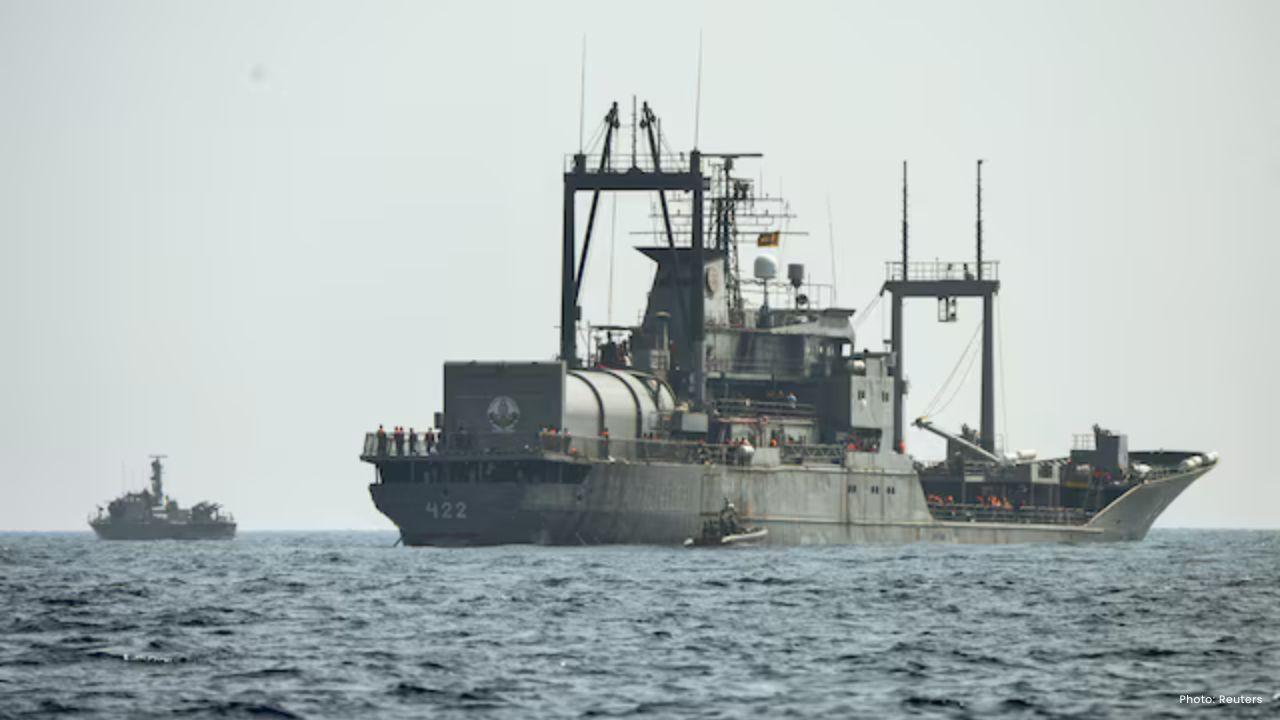
Sri Lanka has confirmed that another Iranian vessel is currently located very close to its coastline, raising new concerns about regional security and the wider conflict involving Iran. According to Sri Lankan officials, the ship was detected about nine nautical miles from the island nation’s coast, and authorities say it will eventually be moved away from the area.
The announcement comes at a time when tensions in the Indian Ocean have increased following a recent military incident involving Iran and the United States near Sri Lanka’s waters.
Sri Lanka’s cabinet spokesperson said the government is carefully monitoring the situation and working to ensure that the ship does not create security risks for the country or nearby shipping routes. Officials did not immediately reveal the type of the vessel or its mission, but they confirmed that it was being closely watched by Sri Lankan authorities.
The presence of the ship follows a dramatic naval incident earlier this month in which a U.S. submarine sank an Iranian warship near Sri Lanka’s southern coast. That warship, known as IRIS Dena, was torpedoed in the Indian Ocean while returning from a naval exercise in India. The attack killed at least 87 sailors, while dozens of others were missing or rescued.
The sinking took place roughly 19 nautical miles off the coast of Galle, within Sri Lanka’s exclusive economic zone but outside its territorial waters.
The event shocked many countries in the region because submarine attacks of this kind are extremely rare in modern naval conflicts. The strike also marked one of the few known cases in recent decades where a submarine sank a large warship during a military confrontation.
Following the attack, Sri Lanka launched search and rescue operations to help survivors and recover bodies from the sea. The Sri Lankan Navy and Air Force worked together to respond quickly after the distressed Iranian vessel sent a signal reporting an explosion.
While rescue teams were dealing with the aftermath of the sinking, another Iranian ship was already in the same region.
That vessel, known as IRIS Bushehr, was a support ship that had been traveling with the frigate that was later destroyed. Soon after the incident, the Bushehr reported mechanical problems and requested assistance from Sri Lankan authorities.
Sri Lanka decided to help the ship on humanitarian grounds. Around 208 Iranian sailors were taken off the vessel and moved to Sri Lankan naval facilities for medical checks and temporary accommodation.
Officials stressed that Sri Lanka’s actions were based on international maritime law and the country’s commitment to neutrality. The government said its priority was to protect human life rather than take sides in the conflict.
The new report about a second Iranian ship being only nine nautical miles from Sri Lanka’s coast adds another layer of complexity to an already tense situation.
Sri Lanka is located along one of the busiest shipping routes in the world. Every day, thousands of cargo ships and oil tankers pass through the Indian Ocean near the island nation. Because of this strategic location, any military activity in nearby waters can quickly become a matter of international concern.
Security experts say the presence of foreign naval vessels so close to Sri Lanka’s coastline places the country in a delicate diplomatic position. Sri Lanka has friendly relations with many global powers, including the United States, Iran, India, and China.
Balancing these relationships is not always easy, especially when tensions rise between major countries.
Officials in Colombo have repeatedly stated that Sri Lanka wants to remain neutral and avoid being drawn into international conflicts. The government says its focus is on protecting its territory, maintaining maritime safety, and following international law.
At the same time, the situation highlights how the wider conflict involving Iran and its rivals is spreading beyond the Middle East. Military actions connected to that conflict have already affected areas far from the Gulf region, including parts of the Indian Ocean.
Experts warn that such developments could threaten important trade routes and increase security risks for nearby countries.
The Indian Ocean is a key corridor for global trade, especially for energy shipments traveling between the Middle East and Asia. Any instability in this region could affect shipping costs, insurance rates, and international supply chains.
For Sri Lanka, the challenge is to manage these tensions carefully while protecting its national interests. The country’s navy and coast guard are continuing to monitor the waters around the island to ensure that no unexpected incidents occur.
Diplomatic discussions are also expected to continue between Sri Lanka and other nations involved in the situation. Governments across the region are watching closely to see whether tensions in the Indian Ocean will rise further or begin to calm.
For now, Sri Lankan officials say the Iranian vessel near its coast remains under observation and that steps will be taken to move it away from the area if necessary.
The incident is another reminder of how quickly regional conflicts can spread across oceans and affect countries that are not directly involved in the fighting.
As global tensions continue to grow, the world will be watching how Sri Lanka and other nations respond to the complex security challenges unfolding in the Indian Ocean.
#trending #latest #armustnews #SriLanka #IranNavy #IndianOcean #GlobalSecurity #NavalTensions #WorldNews #Geopolitics #MiddleEastConflict #MaritimeSecurity








Advances in Aerospace Technology and Commercial Aviation Recovery
Insights into breakthrough aerospace technologies and commercial aviation’s recovery amid 2025 chall

Defense Modernization and Strategic Spending Trends
Explore key trends in global defense modernization and strategic military spending shaping 2025 secu

Tens of Thousands Protest in Serbia on Anniversary of Deadly Roof Collapse
Tens of thousands in Novi Sad mark a year since a deadly station roof collapse that killed 16, prote

Canada PM Carney Apologizes to Trump Over Controversial Reagan Anti-Tariff Ad
Canadian PM Mark Carney apologized to President Trump over an Ontario anti-tariff ad quoting Reagan,

The ad that stirred a hornets nest, and made Canadian PM Carney say sorry to Trump
Canadian PM Mark Carney apologizes to US President Trump after a tariff-related ad causes diplomatic

Bengaluru-Mumbai Superfast Train Approved After 30-Year Wait
Railways approves new superfast train connecting Bengaluru and Mumbai, ending a 30-year demand, easi



