Post by : Amit
Photo : X / DOFT
Green Ports Take Center Stage in the U.S. Decarbonization Push
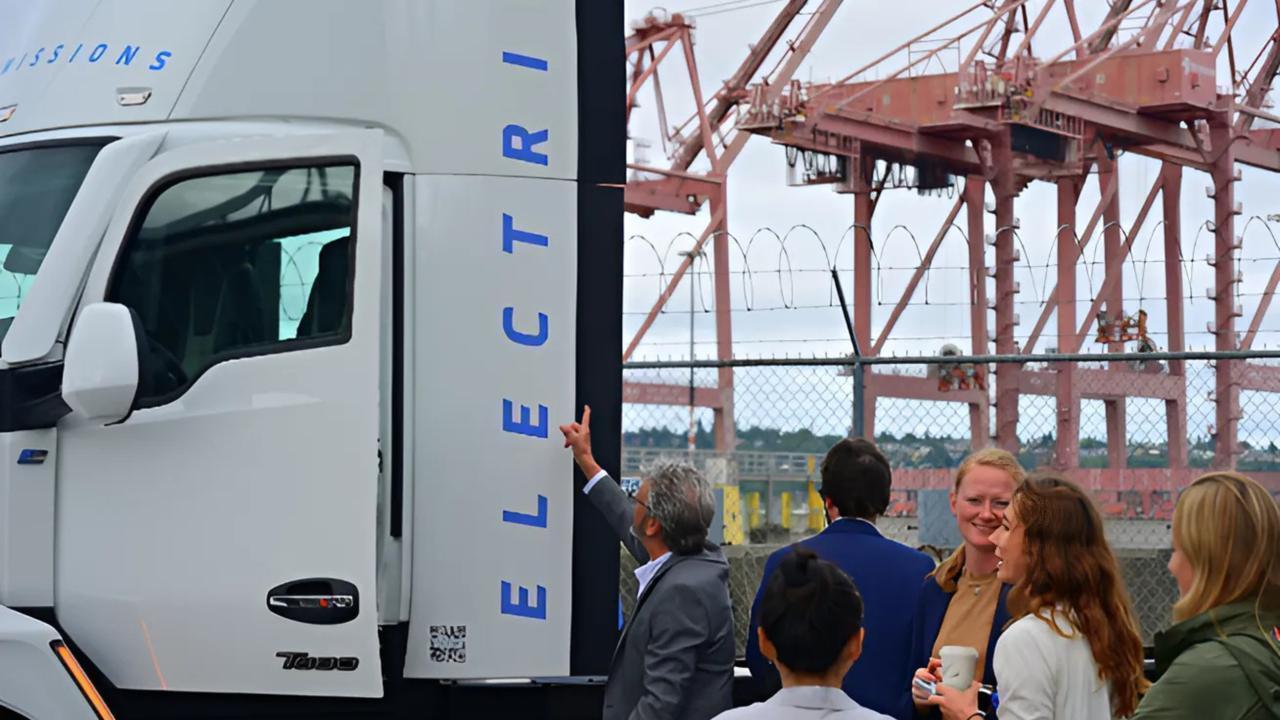
The Northwest Seaport Alliance (NWSA)—a critical trade partnership between the ports of Seattle and Tacoma—has rolled out a new $1.6 million incentive program to accelerate the deployment of zero-emission (ZE) drayage trucks and charging infrastructure. The initiative, launched in July 2025, is a key part of NWSA’s broader Maritime Clean Air Strategy (MCAS), which aims to achieve zero emissions from port-related sources by 2050.
This bold step underscores the growing momentum among U.S. ports to clean up their operations and align with federal climate goals, even as international shipping continues to grapple with emissions challenges. As one of North America’s busiest container gateways, NWSA’s move sets an example for ports globally striving to balance cargo throughput with environmental stewardship.
Breaking Down the $1.6 Million ZE Program
The NWSA program is designed to lower the entry barrier for drayage operators looking to switch to electric or hydrogen-powered trucks. It will provide up to:
for drayage operators serving the Seattle and Tacoma terminals.
The funding, while modest in national terms, is expected to catalyze early adoption in a segment long dominated by older diesel rigs. The first phase of the program will target small fleet owners and independent operators, who often lack the capital to make the transition to ZE technology without financial support.
Strategic Focus: Drayage Sector as a Clean Tech Frontline
Drayage trucks—used for short-haul container transport between terminals, warehouses, and railyards—are among the most polluting and least regulated components of the port logistics chain. With their frequent idling, stop-start motion, and urban exposure, they are a major source of localized air pollution affecting port-adjacent communities.
By targeting this segment first, NWSA is addressing both climate impact and environmental justice. Communities around Seattle and Tacoma, especially lower-income and historically marginalized groups, have long borne the brunt of freight-related emissions. This program seeks to improve public health while modernizing logistics.
Aligning with the Maritime Clean Air Strategy (MCAS)
The incentive program directly supports MCAS’s 2020 goals, which lay out a detailed path to eliminate emissions from:
While NWSA has already made gains in reducing ship and cargo equipment emissions, trucks remain a high-impact laggard. This funding signals a renewed push to hit the port’s 2025 and 2030 milestone targets, which include 100% ZE truck purchases by 2030 and a complete ZE drayage fleet by 2050.
Building the Charging Backbone
NWSA’s ZE initiative doesn’t stop with trucks. The alliance is equally focused on expanding EV charging capacity across its port ecosystem. Under the new program, operators can get funding for the purchase and installation of Level 3 fast chargers compatible with Class 8 trucks.
In addition to financial incentives, NWSA will provide technical assistance, permitting support, and site assessments to help truckers identify optimal charger locations—either in fleet yards or near-terminal staging zones.
To overcome the barrier of grid connectivity, NWSA is also working with regional utilities to prioritize infrastructure upgrades, streamline approvals, and coordinate demand forecasting for EV fleet rollouts.
National and Federal Backing Strengthen Momentum
This local program is expected to dovetail with U.S. federal initiatives, including the EPA’s Clean Ports Program and California’s Advanced Clean Trucks (ACT) rule, which are pushing port authorities to transition to clean freight movement.
Though Washington state is not bound by California’s ACT mandates, NWSA’s proactive stance allows it to align voluntarily and attract federal grants and investor interest. Industry watchers believe early movers like NWSA will gain an edge in funding, innovation, and operational adaptability.
Industry Response and Stakeholder Engagement
Initial responses from trucking stakeholders have been positive. Several small drayage firms and independent contractors have expressed interest in the incentive, citing the high cost of ZE trucks (typically over $400,000 per unit) as the biggest hurdle to adoption.
NWSA has initiated outreach programs in multiple languages, targeting underrepresented and minority-owned trucking firms. This aligns with the port’s commitment to equity and inclusive transition, ensuring the benefits of clean mobility reach all segments of the logistics workforce.
Scaling ZE Adoption
While the incentive marks an important milestone, challenges remain. Charging infrastructure deployment, battery range limitations, and upfront truck costs still make ZE adoption difficult for many port operators. NWSA acknowledges that longer-term success will require policy consistency, private-sector innovation, and continued public investment.
To scale the program, NWSA is exploring partnerships with OEMs, clean tech startups, and energy firms. The alliance also plans to track emissions reductions, vehicle performance, and user feedback to fine-tune the program and shape future funding rounds.
Port Decarbonization as a Strategic Imperative
The launch of this incentive program signals a broader strategic shift: ports are no longer just facilitators of trade—they are becoming gateways of climate action. By enabling zero-emission trucking and charging networks, NWSA is moving the needle not only on port sustainability but on national freight decarbonization goals.
As supply chains get greener and more resilient, early investments like these will define the competitiveness and compliance-readiness of ports across the globe.
NWSA, Cargo Ship, Port



Advances in Aerospace Technology and Commercial Aviation Recovery
Insights into breakthrough aerospace technologies and commercial aviation’s recovery amid 2025 chall

Defense Modernization and Strategic Spending Trends
Explore key trends in global defense modernization and strategic military spending shaping 2025 secu

Tens of Thousands Protest in Serbia on Anniversary of Deadly Roof Collapse
Tens of thousands in Novi Sad mark a year since a deadly station roof collapse that killed 16, prote

Canada PM Carney Apologizes to Trump Over Controversial Reagan Anti-Tariff Ad
Canadian PM Mark Carney apologized to President Trump over an Ontario anti-tariff ad quoting Reagan,

The ad that stirred a hornets nest, and made Canadian PM Carney say sorry to Trump
Canadian PM Mark Carney apologizes to US President Trump after a tariff-related ad causes diplomatic

Bengaluru-Mumbai Superfast Train Approved After 30-Year Wait
Railways approves new superfast train connecting Bengaluru and Mumbai, ending a 30-year demand, easi



