Post by : Avinab Raana
Photo : X / Bloomberg
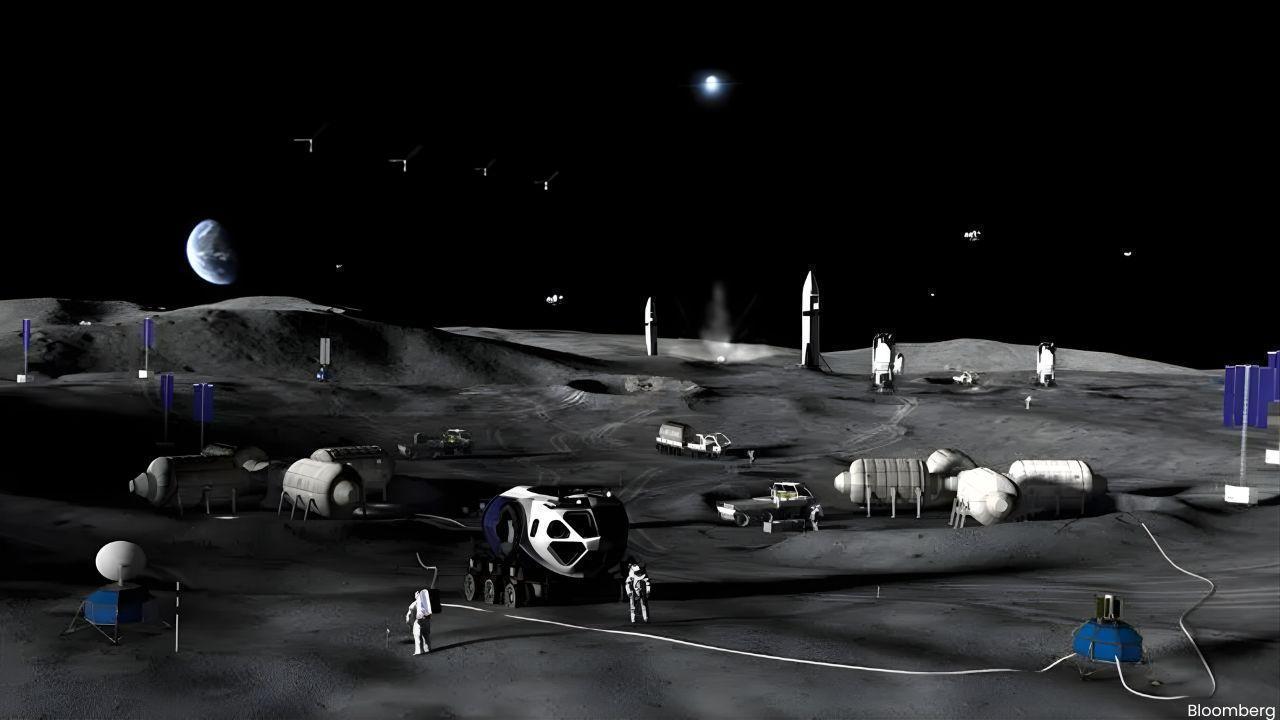
NASA is undergoing a significant transformation in its lunar exploration roadmap, with the Lunar Gateway space station now facing removal from the core mission architecture. Once envisioned as a critical outpost orbiting the Moon, Gateway is being sidelined as the agency pivots toward a more streamlined approach focused on faster, more direct human landings. This shift marks one of the most consequential strategic resets in modern space exploration, signaling that simplicity and speed are now taking priority over complex orbital infrastructure.
The Lunar Gateway was originally designed as a multi-purpose station in lunar orbit, intended to support astronaut missions, scientific research, and long-term deep space exploration. It was also a symbol of international collaboration, bringing together multiple global space agencies under one framework. However, rising costs, technical complexity, and evolving mission priorities have gradually eroded its position within the Artemis program. What was once seen as a cornerstone is now increasingly viewed as an optional component rather than a necessity.
At the heart of this shift lies a growing emphasis on cost control and program efficiency. The Gateway project, along with other large-scale infrastructure elements, has faced scrutiny for its financial demands and extended timelines. With space budgets under pressure and competition from commercial players intensifying, NASA is redirecting resources toward mission elements that deliver quicker and more tangible results. This financial recalibration reflects a broader trend in the aerospace sector, where leaner and more agile approaches are replacing traditional large-scale programs.
NASA’s revised Artemis strategy places greater focus on direct missions to the Moon, reducing reliance on intermediate orbital stations. Upcoming missions are being redesigned to prioritize testing, docking, and landing capabilities closer to Earth before committing to full-scale lunar operations. This approach allows NASA to accelerate timelines while minimizing risk, ensuring that each mission contributes directly to the ultimate goal of establishing a sustained human presence on the lunar surface.
The potential sidelining of Gateway also has far-reaching implications for international partners and private contractors involved in its development. Companies and agencies that had invested in the station must now adapt to a shifting landscape where priorities are evolving rapidly. At the same time, the move opens new opportunities for commercial space companies to play a larger role in lunar missions, reinforcing the growing importance of public-private partnerships in shaping the future of space exploration.
NASA’s new direction reflects a clear intent to simplify its path back to the Moon. By removing layers of complexity and focusing on mission-critical elements, the agency aims to achieve more frequent launches and faster progress toward long-term goals. The emphasis is shifting toward operational efficiency, technological readiness, and scalable mission designs that can adapt as the space economy evolves.
The decision to move away from the Lunar Gateway signals a defining moment in the global space race. It highlights a growing realization that agility and execution speed are now just as important as ambition. As NASA recalibrates its strategy, the focus is firmly on delivering results, getting humans back to the Moon, building sustainable infrastructure, and paving the way for future missions to Mars. In this new era of exploration, the roadmap may be changing, but the destination remains the same—only now, the journey is becoming faster, sharper, and far more competitive.
NASA Lunar Gateway cancelled, Artemis program changes, Moon mission strategy, space exploration shift, lunar base plans, NASA budget cuts, future space missions










Advances in Aerospace Technology and Commercial Aviation Recovery
Insights into breakthrough aerospace technologies and commercial aviation’s recovery amid 2025 chall

Defense Modernization and Strategic Spending Trends
Explore key trends in global defense modernization and strategic military spending shaping 2025 secu

Tens of Thousands Protest in Serbia on Anniversary of Deadly Roof Collapse
Tens of thousands in Novi Sad mark a year since a deadly station roof collapse that killed 16, prote

Canada PM Carney Apologizes to Trump Over Controversial Reagan Anti-Tariff Ad
Canadian PM Mark Carney apologized to President Trump over an Ontario anti-tariff ad quoting Reagan,

The ad that stirred a hornets nest, and made Canadian PM Carney say sorry to Trump
Canadian PM Mark Carney apologizes to US President Trump after a tariff-related ad causes diplomatic

Bengaluru-Mumbai Superfast Train Approved After 30-Year Wait
Railways approves new superfast train connecting Bengaluru and Mumbai, ending a 30-year demand, easi



