Post by : Saif
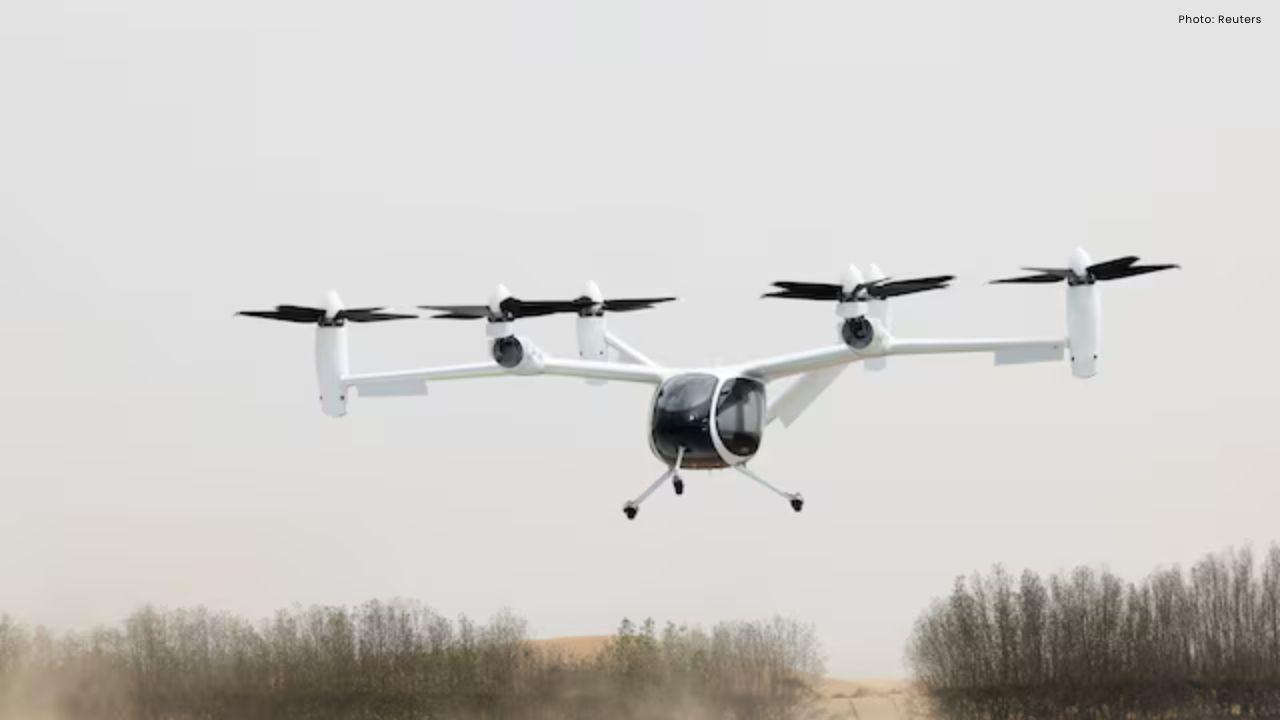
The dream of flying taxis moving people across cities is moving closer to reality. Joby Aviation, a California-based aerospace company, has successfully flown the first production model of its electric air taxi. The flight marks an important step toward bringing air taxi services into everyday transportation.
The aircraft recently completed its first flight at Joby’s facility in Marina, California. This aircraft will now be used for certification testing with aviation regulators before it can begin commercial operations. The company said the testing phase will help prepare the aircraft for approval from the United States Federal Aviation Administration (FAA), which is required before passengers can be carried.
This milestone is significant because the aircraft is the first built according to designs approved by regulators. It is expected to play a key role in the final stage of testing before the aircraft can receive permission to operate commercially.
Joby Aviation is one of several companies working to develop electric vertical takeoff and landing aircraft, commonly known as eVTOLs. These aircraft are designed to take off and land vertically like helicopters but fly forward like airplanes. This combination allows them to operate from small landing areas while traveling faster than traditional helicopters.
The company’s air taxi is designed to carry a pilot and four passengers. It can travel at speeds of up to about 200 miles per hour and cover distances of around 100 miles on a single charge. Because it runs on electric power, the aircraft produces no direct emissions and is much quieter than traditional helicopters.
The aircraft uses six electric propellers powered by battery systems similar to those used in electric cars. These propellers allow the aircraft to lift vertically from the ground and then tilt to move forward efficiently once it reaches cruising speed.
The first production aircraft will be used for extensive testing by both Joby pilots and FAA officials. During these tests, regulators will study how the aircraft performs in real flight conditions. The tests will examine safety systems, flight controls, battery performance and emergency procedures.
If the aircraft successfully passes these tests, the FAA could grant a key approval known as Type Inspection Authorization. This step is necessary before the aircraft can receive full certification for passenger service.
Air taxis are seen by many experts as an important part of the future of urban transportation. As cities grow larger and traffic congestion increases, new transportation solutions are being explored. Electric air taxis could allow people to travel quickly across cities without relying on crowded roads.
Instead of driving long distances in heavy traffic, passengers could take short flights between small landing stations called vertiports. These stations could be located on rooftops, near airports or in other convenient locations.
Joby Aviation has already announced plans to introduce its air taxi services in several parts of the world. The company is working closely with transportation authorities in Dubai, where commercial air taxi operations are expected to begin soon. The service aims to reduce travel time dramatically in busy cities.
For example, a journey that might take 45 minutes by car could be reduced to about 12 minutes using an air taxi. Such time savings could make the technology attractive for both business travelers and commuters.
The company has also been selected for several advanced air mobility programs supported by the U.S. government. These programs aim to speed up the development of electric aircraft and integrate them safely into existing airspace systems.
However, experts say there are still challenges before air taxis become widely available. Regulatory approval is one of the biggest hurdles. Aviation authorities must carefully test new aircraft technologies to ensure they meet strict safety standards.
Infrastructure is another challenge. Cities will need to build vertiports, charging stations and air traffic systems designed specifically for low-altitude electric aircraft.
Cost is also a factor. Early air taxi services may be expensive and mainly used by business travelers or premium customers. Over time, as production increases and technology improves, prices could become more affordable for the general public.
Despite these challenges, progress in the industry has been steady. Joby Aviation has already completed thousands of test flights and accumulated tens of thousands of flight miles during development.
The successful flight of the first production model shows that the technology is moving from the experimental stage toward real commercial use.
Industry analysts believe the next few years will be critical for the air taxi sector. Several companies around the world are competing to launch the first commercial services. Governments are also investing in new aviation technologies that could transform how people travel within cities.
If companies like Joby succeed, electric air taxis could become a common sight in the skies above major cities. They may offer a cleaner, faster and quieter way to travel, helping reduce traffic congestion and pollution.
For now, the successful test flight represents an important step toward that future. The coming months of testing and certification will determine how quickly air taxis move from experimental aircraft to everyday transportation.
#trending #latest #ElectricAirTaxi #JobyAviation #UrbanAirMobility #eVTOL #FutureOfTransport #AviationInnovation #AirTaxi #ElectricAircraft #SustainableAviation #armustnews







Advances in Aerospace Technology and Commercial Aviation Recovery
Insights into breakthrough aerospace technologies and commercial aviation’s recovery amid 2025 chall

Defense Modernization and Strategic Spending Trends
Explore key trends in global defense modernization and strategic military spending shaping 2025 secu

Tens of Thousands Protest in Serbia on Anniversary of Deadly Roof Collapse
Tens of thousands in Novi Sad mark a year since a deadly station roof collapse that killed 16, prote

Canada PM Carney Apologizes to Trump Over Controversial Reagan Anti-Tariff Ad
Canadian PM Mark Carney apologized to President Trump over an Ontario anti-tariff ad quoting Reagan,

The ad that stirred a hornets nest, and made Canadian PM Carney say sorry to Trump
Canadian PM Mark Carney apologizes to US President Trump after a tariff-related ad causes diplomatic

Bengaluru-Mumbai Superfast Train Approved After 30-Year Wait
Railways approves new superfast train connecting Bengaluru and Mumbai, ending a 30-year demand, easi



