Post by : Saif
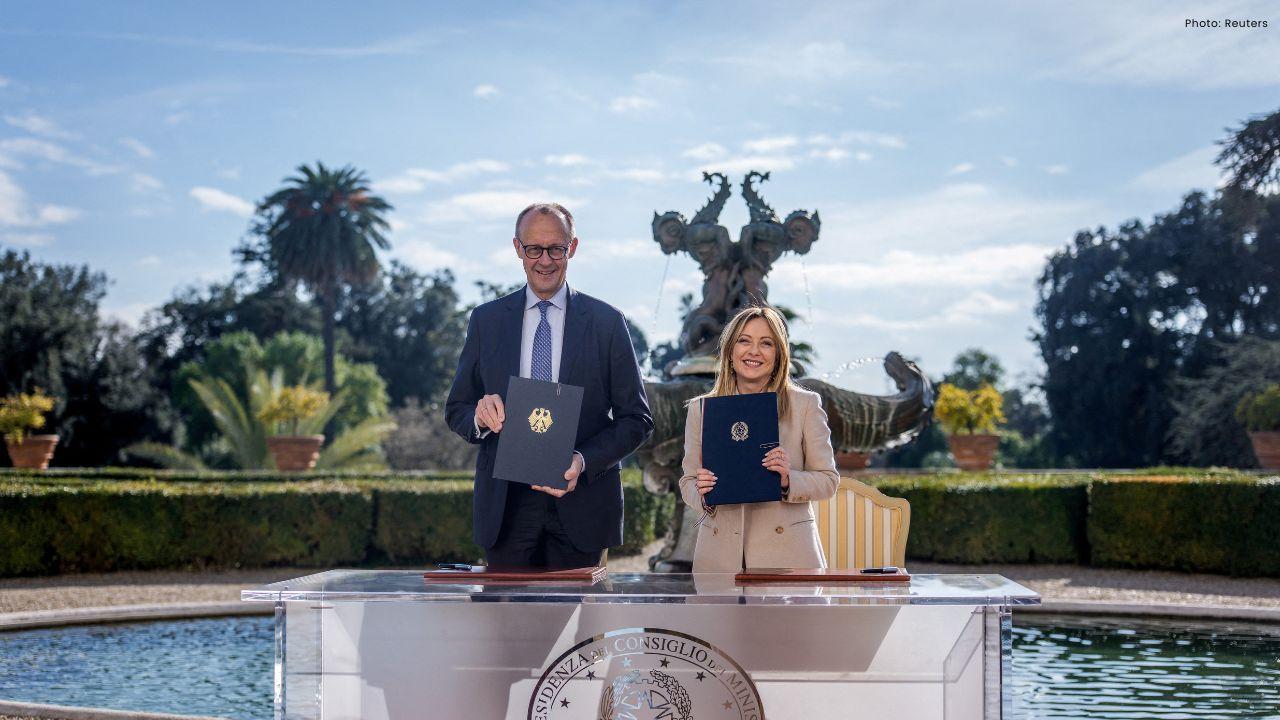
Germany and Italy, the two biggest manufacturing powers in the European Union, have announced a new alliance aimed at protecting industry and making the EU more competitive. The move shows a growing effort by both countries to work closely together as Europe faces economic pressure from China, the United States, and its own complex regulations.
The plan was unveiled in Rome during talks between Italian Prime Minister Giorgia Meloni and German Chancellor Friedrich Merz. The two leaders agreed to coordinate their policies inside the EU to reduce excessive rules, support industry, and strengthen cooperation in key areas such as energy, defence, security, and migration.
Both governments said Europe must be able to act faster and more decisively, especially as Russia’s war in Ukraine continues and global competition increases. They warned that slow decision-making and heavy regulation are hurting European businesses and weakening the EU’s industrial base.
Meloni said Italy and Germany are now closer than ever in their views. She strongly criticized the EU’s environmental policies, saying the green transition has badly damaged industries, especially the car sector, while giving China an advantage. Germany has also raised concerns that strict EU rules are making it harder for manufacturers to compete globally.
The alliance also reflects differences within the EU. While France has taken a tougher public stance toward the United States in recent weeks, Germany and Italy have been more careful. Both countries depend heavily on exports to the U.S. and prefer dialogue over confrontation, especially during sensitive issues such as tensions linked to Greenland and Denmark.
In their joint 19-page action plan, Berlin and Rome called for simpler EU laws and what they described as “regulatory self-restraint.” Their goal is to reduce red tape and make it easier for businesses to operate and invest. They also pushed for deeper integration of the EU’s single market, especially in services, which they see as a major source of future growth.
The two countries highlighted key industries that need support, including automobiles and energy-intensive sectors. They warned that without coordinated action, Europe risks falling further behind the U.S. and China in technology, industry, and economic security.
Germany and Italy also agreed to work together on securing supplies of critical raw materials. These materials are vital for modern industries, and China currently has strong control over many supply chains. The leaders said Europe must protect itself from unfair competition, including from cheap online retailers based outside the EU.
On trade, both countries supported quickly approving an EU trade agreement with South and Central American nations and finishing deals in the Indo-Pacific region. This position differs from France, which has raised concerns about protecting its farmers.
In addition to economic cooperation, Germany and Italy signed a defence agreement. This will deepen joint work across land, air, sea, and electronic warfare systems, showing their intention to strengthen Europe’s security and defence capabilities.
The new alliance signals a shift inside the EU, with Germany and Italy stepping forward to shape the bloc’s future direction. As global competition grows and Europe faces internal challenges, their partnership could play a key role in deciding how the EU balances regulation, growth, and industrial strength in the years ahead.
#trending #latest #Germany #Italy #EuropeanUnion #EUReforms #IndustryPolicy #GlobalEconomy #Defense #armustnews




Advances in Aerospace Technology and Commercial Aviation Recovery
Insights into breakthrough aerospace technologies and commercial aviation’s recovery amid 2025 chall

Defense Modernization and Strategic Spending Trends
Explore key trends in global defense modernization and strategic military spending shaping 2025 secu

Tens of Thousands Protest in Serbia on Anniversary of Deadly Roof Collapse
Tens of thousands in Novi Sad mark a year since a deadly station roof collapse that killed 16, prote

Canada PM Carney Apologizes to Trump Over Controversial Reagan Anti-Tariff Ad
Canadian PM Mark Carney apologized to President Trump over an Ontario anti-tariff ad quoting Reagan,

The ad that stirred a hornets nest, and made Canadian PM Carney say sorry to Trump
Canadian PM Mark Carney apologizes to US President Trump after a tariff-related ad causes diplomatic

Bengaluru-Mumbai Superfast Train Approved After 30-Year Wait
Railways approves new superfast train connecting Bengaluru and Mumbai, ending a 30-year demand, easi



