Post by : Meena Rani
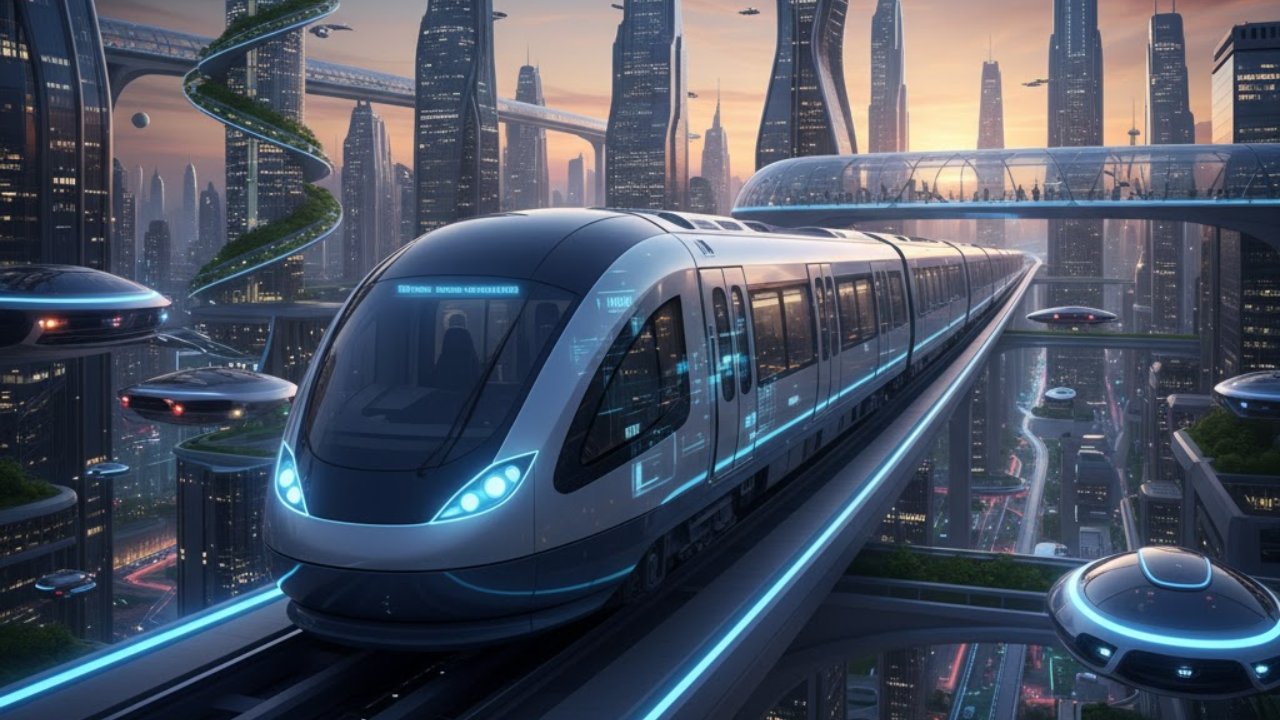
The world’s railways are stepping into a new age of automation — one where trains no longer need drivers to stay on schedule. From Paris to Dubai, Tokyo to Singapore, fully autonomous and driverless train systems are redefining how cities move millions of people safely and efficiently.
In 2025, automation is no longer experimental — it’s operational. But behind every driverless train lies a complex network of sensors, artificial intelligence, and safety systems ensuring every journey runs with human-level precision — and sometimes better.
The idea of automated train operation isn’t new — metros in Paris and Vancouver began testing driverless systems decades ago. But recent advancements in AI, 5G, IoT, and digital signalling have taken automation to an entirely new level.
Automation in rail is classified into four grades by the International Association of Public Transport (UITP):
GoA 1 (Manual Operation): Traditional trains controlled entirely by human drivers.
GoA 2 (Semi-Automated): Automatic speed and braking, but human supervision required.
GoA 3 (Driverless Operation): No onboard driver, but staff monitor systems remotely.
GoA 4 (Fully Autonomous): Complete automation — no human intervention at all.
The trend is clear: most global metros are moving toward GoA 3 and GoA 4 systems.
Urban congestion, rising fuel costs, and the push for sustainability are driving cities to adopt autonomous metro networks.
Driverless trains offer enormous benefits:
Higher frequency: Shorter intervals between trains without increasing risk.
Energy efficiency: Automated systems adjust acceleration and braking precisely.
Reduced operational costs: No need for onboard staff on every train.
Enhanced safety: AI and real-time sensors minimize human error — still the leading cause of rail incidents.
Driverless metros can run 24/7, adjust to passenger demand dynamically, and integrate seamlessly with smart city transport systems, improving the overall commuting experience.
Paris’s Line 14 was one of the first fully automated metro lines in Europe, launched in 1998. In 2025, Lines 4 and 18 are also transitioning to GoA 4 automation, reducing waiting times to under 90 seconds during peak hours.
Singapore operates one of the world’s most advanced driverless metro systems, featuring automatic train control and obstacle detection. Its reliability rate exceeds 99.9%, setting global benchmarks for safety and punctuality.
Dubai’s driverless metro system is the largest fully automated network in the world, operating across 75 kilometers. Integrated AI ensures optimal scheduling and energy use — perfectly aligned with Dubai’s Smart City initiative.
Japan is testing AI-assisted autonomous train prototypes on suburban lines, combining machine learning and real-time sensor data to improve precision and safety.
The Delhi Metro’s Magenta Line became India’s first driverless metro in 2021. In 2025, expansion of similar systems across Mumbai, Pune, and Bengaluru is underway, reflecting India’s growing investment in rail automation and AI-based signalling systems.
Driverless trains rely on a combination of AI, sensors, and communication-based control systems to navigate the tracks safely and efficiently.
Sensors & Cameras: Detect track obstacles, station proximity, and passenger movement.
Automatic Train Control (ATC): Manages acceleration, braking, and door operations.
Communication-Based Train Control (CBTC): Uses wireless signals to monitor train positions and maintain safe distances.
Artificial Intelligence: Learns from operational data to optimize energy use, predict faults, and respond to emergencies.
This digital ecosystem allows trains to operate with precision measured in milliseconds, ensuring both safety and speed — often beyond what a human driver could achieve consistently.
Safety remains the most critical element in driverless operations.
Autonomous trains are designed with multiple fail-safe systems — if one system malfunctions, another immediately takes over.
Real-time diagnostics monitor every aspect of the train, from brake pressure to door locks, ensuring immediate detection of any anomaly.
AI-based algorithms can even identify patterns of potential failure before they occur — a predictive capability that traditional systems lack.
In metros like Copenhagen and Singapore, these systems have led to zero accident rates since automation was implemented.
Additionally, 5G connectivity allows control centers to communicate instantly with every train in motion, giving engineers live access to diagnostics, performance metrics, and emergency protocols.
Despite rapid progress, not every rail network is ready to go fully autonomous. Several challenges remain:
High Capital Investment: Converting existing lines into automated systems requires redesigning signalling, stations, and rolling stock.
Public Perception: Many passengers still prefer a visible operator for reassurance and accountability.
Cybersecurity Risks: As trains become digital, they are also exposed to potential hacking and data breaches.
Regulatory Barriers: Countries lack standardized laws for unmanned operations.
Integration Complexity: Mixing autonomous and manual trains on shared tracks remains difficult and risky.
Governments and operators are gradually overcoming these barriers by focusing on phased automation — starting with metros and moving toward regional and freight lines.
The future of autonomous trains lies in artificial intelligence and 5G connectivity.
AI-powered predictive maintenance ensures components are replaced before failure, while 5G enables instant communication between trains and control centers.
Newer models also use LiDAR (Light Detection and Ranging) and computer vision to detect obstacles, animals, or intrusions on tracks in real time.
By 2030, experts predict that over 60% of new metro lines will include some form of automation, making rail one of the most technologically advanced transport sectors globally.
Automation isn’t just about convenience — it’s also about sustainability.
Autonomous trains consume 15–20% less energy through optimized braking and speed control. The reduced need for lighting, ventilation, and onboard staffing also lowers carbon emissions and operating costs.
Moreover, driverless systems allow higher train frequencies without adding new tracks — effectively doubling passenger capacity on existing infrastructure.
With cities aiming to cut emissions and congestion, autonomous metros are emerging as the cleanest and most efficient mode of public transport in the urban landscape.
This article is for informational and educational purposes only. It reflects recent global developments and publicly available data on rail automation. It should not be considered as engineering, investment, or regulatory advice.
autonomous trains, driverless metro, AI in railways, smart rail technology, train automation 2025, automated train operation, unmanned train systems, future of transport, digital signalling, smart metro networks








Advances in Aerospace Technology and Commercial Aviation Recovery
Insights into breakthrough aerospace technologies and commercial aviation’s recovery amid 2025 chall

Defense Modernization and Strategic Spending Trends
Explore key trends in global defense modernization and strategic military spending shaping 2025 secu

Tens of Thousands Protest in Serbia on Anniversary of Deadly Roof Collapse
Tens of thousands in Novi Sad mark a year since a deadly station roof collapse that killed 16, prote

Canada PM Carney Apologizes to Trump Over Controversial Reagan Anti-Tariff Ad
Canadian PM Mark Carney apologized to President Trump over an Ontario anti-tariff ad quoting Reagan,

The ad that stirred a hornets nest, and made Canadian PM Carney say sorry to Trump
Canadian PM Mark Carney apologizes to US President Trump after a tariff-related ad causes diplomatic

Bengaluru-Mumbai Superfast Train Approved After 30-Year Wait
Railways approves new superfast train connecting Bengaluru and Mumbai, ending a 30-year demand, easi



