Post by : Avinab Raana
Photo : X / @hiwarscom
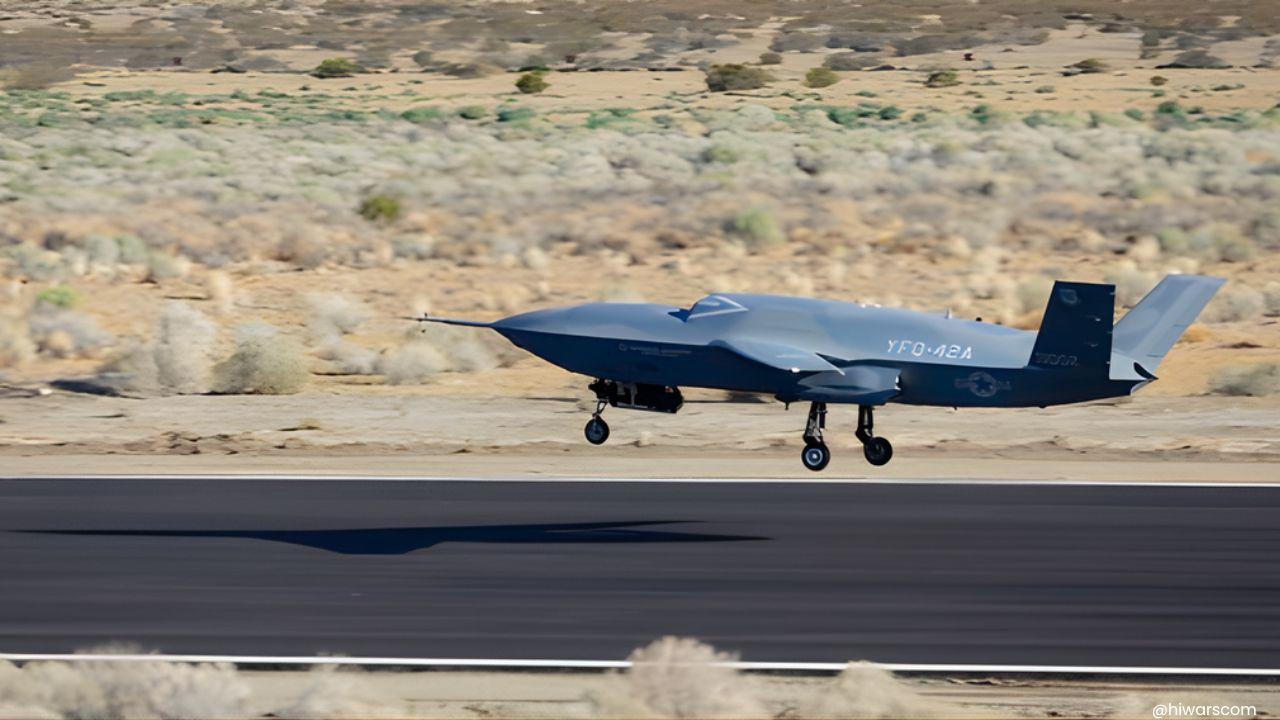
In a dramatic turn for one of the most advanced defense programs in modern aviation, a prototype YFQ-42A drone part of the United States Air Force’s highly anticipated “loyal wingman” initiative crashed shortly after takeoff during a test flight in California. What was meant to be a routine developmental sortie quickly transformed into a critical incident, forcing an immediate halt to ongoing flight testing.
The crash has sent ripples across the aerospace and defense ecosystem, not just because of the loss of a prototype, but because of what it represents: a rare glimpse into the challenges of building the future of autonomous air combat. In a program designed to redefine warfare, even a single failure carries outsized significance.
The YFQ-42A is more than just another drone, it is a cornerstone of the Collaborative Combat Aircraft (CCA) program, a bold initiative aimed at pairing unmanned systems with manned fighter jets. These drones are envisioned as intelligent wingmen, capable of performing reconnaissance, electronic warfare, and even combat roles alongside pilots.
What makes this concept revolutionary is its reliance on advanced avionics and artificial intelligence. The aircraft is designed to think, adapt, and execute missions with minimal human intervention, fundamentally changing how air operations are conducted. But with that ambition comes complexity and complexity often brings risk.
Early indications suggest that the drone encountered a failure shortly after takeoff, leading to a crash within minutes of becoming airborne. While the exact cause remains under investigation, the timing of the incident during the critical takeoff phase points to potential vulnerabilities in system integration, flight control, or real-time response mechanisms.
The aircraft went down within the test range area, avoiding any collateral damage or injuries. However, the immediate decision to suspend further test flights highlights the seriousness of the event. In programs of this scale, safety and reliability are non-negotiable, and every anomaly is treated as a learning opportunity.
The crash comes at a pivotal moment for the CCA program, as multiple prototypes are being evaluated for future deployment. With billions of dollars and strategic military advantage at stake, the pressure to deliver reliable, combat-ready systems is immense.
This incident could influence timelines, testing protocols, and even procurement decisions. In a competitive environment where multiple platforms are vying for selection, consistency and reliability are just as important as innovation. A single setback, while not unusual in aerospace development, can shift momentum in subtle but significant ways.
Developing autonomous combat aircraft is one of the most complex engineering challenges of our time. These systems must seamlessly integrate navigation, communication, decision-making algorithms, and mission execution, all while operating in unpredictable environments.
The crash serves as a powerful reminder that innovation at this level is rarely smooth. Every breakthrough is built on a series of trials, errors, and refinements. The path to autonomy is not just about technology. It is about resilience, iteration, and the ability to learn from failure faster than competitors.
While the loss of the YFQ-42A prototype is a setback, it is unlikely to derail the broader vision of autonomous air combat. Instead, it may accelerate improvements, forcing engineers and program leaders to address vulnerabilities sooner rather than later.
The future of airpower is undeniably shifting toward unmanned and AI-driven systems. As nations race to develop these capabilities, incidents like this will shape how quickly and how safely that future arrives. In the high-stakes world of defense innovation, every crash tells a story and every story brings the future one step closer.
#trending #latest,#DroneCrash #CCADrone #USAF #AerospaceTech #DefenseInnovation







Advances in Aerospace Technology and Commercial Aviation Recovery
Insights into breakthrough aerospace technologies and commercial aviation’s recovery amid 2025 chall

Defense Modernization and Strategic Spending Trends
Explore key trends in global defense modernization and strategic military spending shaping 2025 secu

Tens of Thousands Protest in Serbia on Anniversary of Deadly Roof Collapse
Tens of thousands in Novi Sad mark a year since a deadly station roof collapse that killed 16, prote

Canada PM Carney Apologizes to Trump Over Controversial Reagan Anti-Tariff Ad
Canadian PM Mark Carney apologized to President Trump over an Ontario anti-tariff ad quoting Reagan,

The ad that stirred a hornets nest, and made Canadian PM Carney say sorry to Trump
Canadian PM Mark Carney apologizes to US President Trump after a tariff-related ad causes diplomatic

Bengaluru-Mumbai Superfast Train Approved After 30-Year Wait
Railways approves new superfast train connecting Bengaluru and Mumbai, ending a 30-year demand, easi



