Post by : Avinab Raana
Photo: X / Aviation Week
The United States and Israel are testing a new model of modern warfare, one where airpower campaigns attempt to achieve strategic political change without large-scale ground invasions. In the ongoing conflict with Iran, both countries have launched an intense aerial assault targeting military leadership, air defenses, and strategic infrastructure. The goal is ambitious: weaken the Iranian state enough to trigger Iran regime change without committing ground troops.
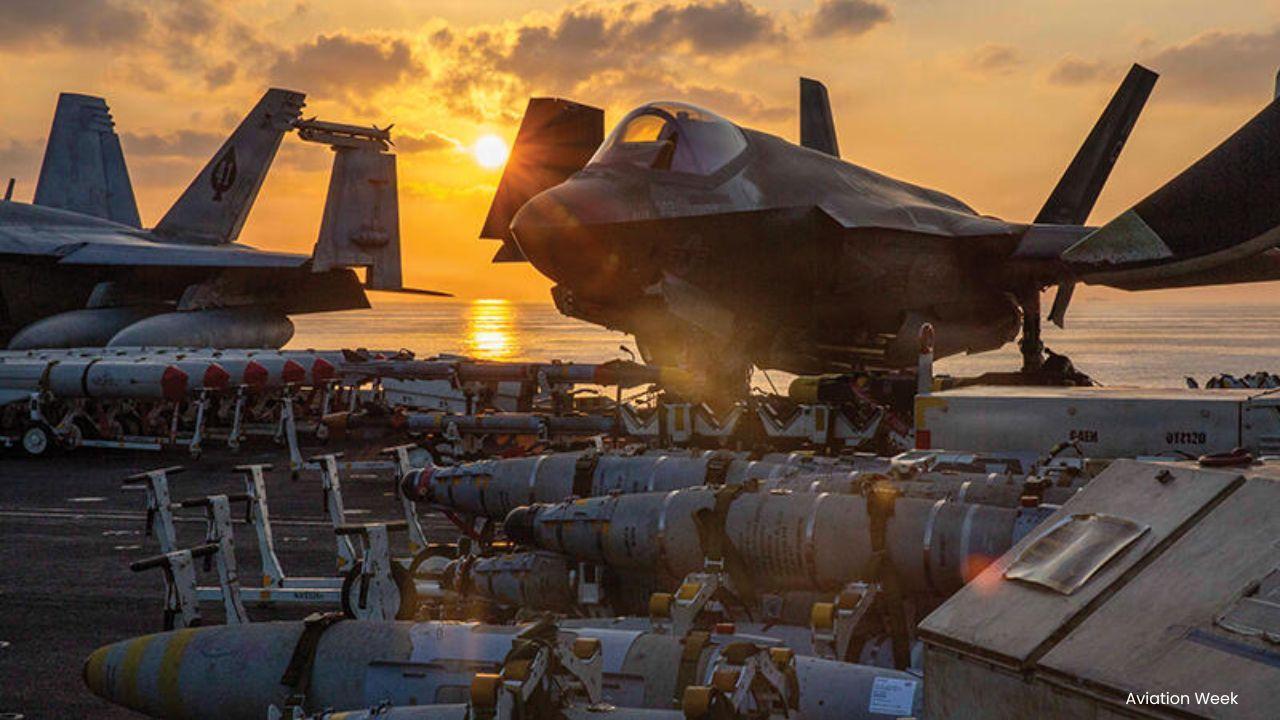
Within the first days of the campaign, U.S. and Israeli forces established overwhelming air superiority. Advanced fighter aircraft, surveillance drones, and precision missiles have been deployed across the region to strike command centers, missile bases, and defense networks. Cutting-edge F-35 operations have played a central role, enabling stealth penetration of defended airspace and precision targeting deep within Iranian territory.
The conflict has also introduced new military technologies into active combat. Unmanned aerial systems and low-cost attack drones have been used in large numbers to overwhelm defensive systems. Precision long-range missiles and advanced surveillance platforms are providing real-time targeting information, allowing coalition aircraft to strike mobile launchers and strategic assets quickly. These developments show how future wars may rely heavily on autonomous systems and networked strike capabilities.
A major focus of the campaign has been Iran’s leadership and strategic command structure. Key political and military figures have reportedly been targeted alongside missile and air defense systems. The intention behind this approach is to disrupt decision-making capacity and weaken Iran’s ability to coordinate retaliation. If successful, this strategy could accelerate political instability inside the country and intensify internal pressure on the governing system.
History shows that regime change has usually required ground forces or large-scale internal uprisings. What makes this campaign different is the attempt to rely almost entirely on air and missile strikes. The success or failure of this strategy could redefine how military power is used in future geopolitical conflicts. If airpower alone can reshape governments, it would mark a major shift in the doctrine of modern warfare.
Beyond the battlefield, the escalation has wide geopolitical consequences. Regional security alliances, global energy markets, and international diplomacy are all being affected by the unfolding conflict. As airpower campaigns intensify and F-35 operations continue to dominate the skies, the world is watching closely to see whether aerial warfare alone can achieve something historically accomplished only through ground intervention lasting Iran regime change.
Airpower campaign, Iran regime change, F-35 operations








Advances in Aerospace Technology and Commercial Aviation Recovery
Insights into breakthrough aerospace technologies and commercial aviation’s recovery amid 2025 chall

Defense Modernization and Strategic Spending Trends
Explore key trends in global defense modernization and strategic military spending shaping 2025 secu

Tens of Thousands Protest in Serbia on Anniversary of Deadly Roof Collapse
Tens of thousands in Novi Sad mark a year since a deadly station roof collapse that killed 16, prote

Canada PM Carney Apologizes to Trump Over Controversial Reagan Anti-Tariff Ad
Canadian PM Mark Carney apologized to President Trump over an Ontario anti-tariff ad quoting Reagan,

The ad that stirred a hornets nest, and made Canadian PM Carney say sorry to Trump
Canadian PM Mark Carney apologizes to US President Trump after a tariff-related ad causes diplomatic

Bengaluru-Mumbai Superfast Train Approved After 30-Year Wait
Railways approves new superfast train connecting Bengaluru and Mumbai, ending a 30-year demand, easi



