Post by : Avinab Raana
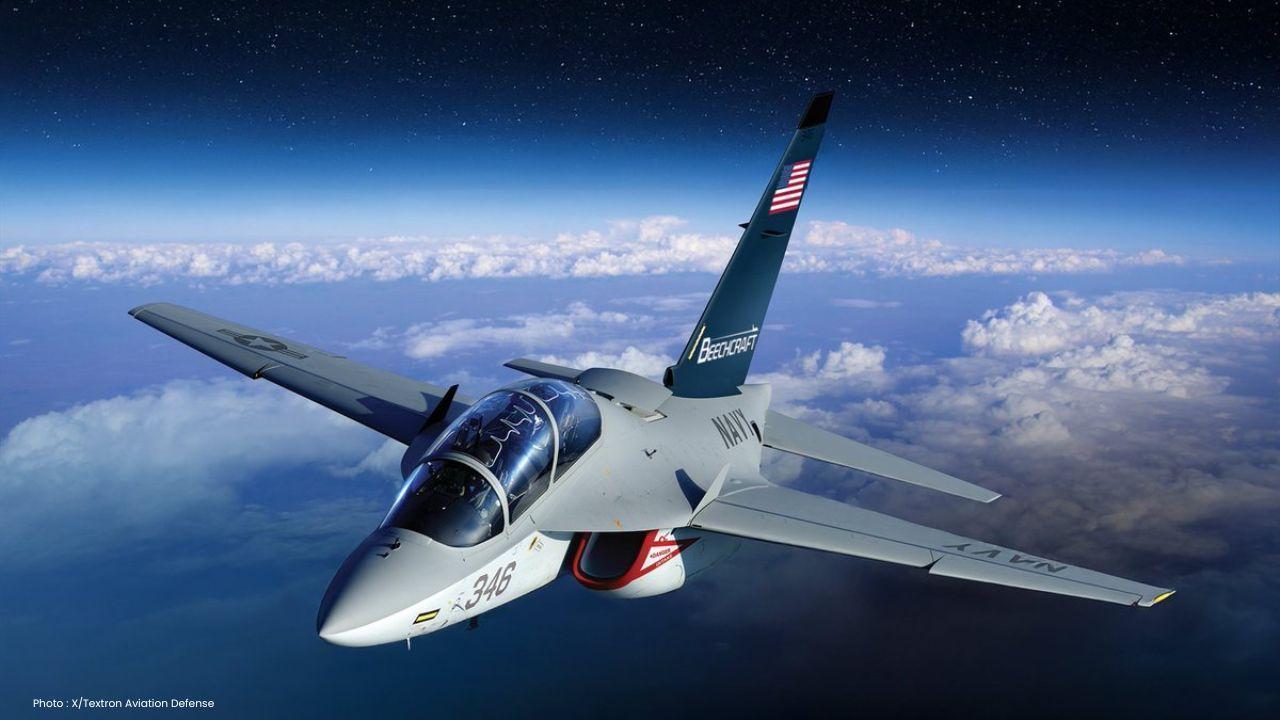
The September skies above Wichita carried more than just a demonstration flight; they carried the ambitions of Textron Aviation Defense and Leonardo’s next-generation training jet. For the first time on American soil, the Beechcraft M-346N trainer took to the air in a public showcase, signaling Textron’s intent to make a bold play for the U.S. Navy’s future training programme. The jet is not merely a derivative of the proven M-346 family , it is a carefully refined machine blending modern avionics, embedded tactical training, and a cockpit environment designed to mirror the most advanced combat aircraft in service today.
The debut in Kansas was more than just an aerial display; it was a strategic pitch. Textron wants the U.S. Navy to view the M-346N not only as a replacement for aging training aircraft but as an integrated ecosystem capable of preparing tomorrow’s aviators for a digital battlespace. The flight was the opening act in a wider national tour that will bring the aircraft to different corners of the United States, offering military decision-makers, industry insiders, and policymakers an up-close look at what Textron insists is a “ready-now” solution.
Inside the cockpit, the M-346N demonstrates why it is being described as a game changer. Its Embedded Tactical Training System (ETTS) brings simulated threats, weapons effects, and sensor inputs into the pilot’s real-time flying experience. During demonstration flights, simulated enemy fighters appeared on the radar displays, virtual transports and missile systems populated the tactical landscape, and synthetic weapons such as AIM-9X missiles and precision-guided bombs were virtually “fired,” with their impact calculated and displayed instantly. This is not just about flying.It is about compressing hours of simulator learning into one sortie, sharpening reflexes, and teaching decision-making in a way older trainers cannot.
The M-346N also benefits from Leonardo’s Block 20 enhancements. These upgrades introduce a large-area touchscreen display, helmet-mounted systems compatible with augmented reality, and a reimagined human-machine interface that reflects what young aviators will see when they climb into fifth-generation fighters. The advantage is obvious: a student pilot transitions from this trainer to an operational aircraft with a seamless sense of familiarity. For armed forces seeking to shorten training pipelines and reduce costs, such fidelity is invaluable.
At the heart of this unveiling lies the U.S. Navy’s Undergraduate Jet Training System (UJTS), a programme that has taken on new urgency. The Navy’s current fleet of T-45 Goshawks is showing its age, and the service is determined to find a replacement that can handle not just the basics of flight but the complexity of modern combat training. The competition is expected to be fierce, with Textron’s M-346N going up against established players offering clean-sheet designs or proven export trainers. The Navy’s final choice, scheduled for 2027, will shape how America’s future carrier aviators learn their trade.
Textron is betting on a combination of maturity and modernity. The M-346 family has clocked thousands of flight hours in international service, giving it a credibility new designs have yet to earn. At the same time, the M-346N’s digital training architecture puts it on par with the demands of 21st-century combat. For procurement officials weighing risk and readiness, that balance between proven reliability and cutting-edge systems could prove persuasive.
The demonstration flight also highlighted the industrial narrative. Textron has made it clear that U.S. assembly, sustainment, and supply chain integration would be central to its offer. This is no small point: in an era when defense contracts are scrutinized not only for capability but also for their economic footprint, local jobs and long-term support infrastructure carry considerable weight. For the Navy, an aircraft that comes with a ready-made sustainment plan could ease the transition from the Goshawk era into the digital age.
Beyond America’s borders, the stakes ripple outward. If the U.S. Navy selects the M-346N, allied nations operating or considering the M-346 platform will see a powerful validation of their choice. It could open the door to multinational training programs, joint exercises, and shared logistics pathways. For Gulf states and other regional partners, interoperability with a U.S.-endorsed trainer would strengthen ties and ensure compatibility in both training and operations.
Still, challenges remain. Critics point to the absence of carrier-representative operations in the M-346N, a capability some of its competitors emphasize. Others warn of long-term software sustainment costs tied to its advanced digital systems. Yet the Navy itself has shifted its priorities, signaling that replicating every aspect of carrier landings may not be as crucial as ensuring pilots can master modern sensors, weapons, and networked operations. In that evolving context, Textron’s offering looks well-aligned.
As the Wichita debut fades into memory and the M-346N begins its nationwide tour, one truth stands out: this competition is about more than airframes. It is about how America and its allies will train aviators for wars increasingly defined by digital complexity, networked operations, and rapid decision-making under pressure. The M-346N, with its blend of simulated battles and real-world flying, offers a glimpse into how training itself is transforming.
For the Gulf region and other international audiences, the unveiling is not just another aviation milestone; it is a signal of where the future of training is headed. The U.S. Navy’s eventual decision will resonate far beyond American shores, shaping doctrine, alliances, and industry partnerships for years to come. Textron’s public flight of the M-346N is therefore more than an exhibition, it is a marker in the evolution of modern military aviation training.
Textron M346N TrainerJet, MilitaryAviation ,Aerospace , USNavy AviationNews,FlightTraining, DefenseIndustry, FutureAviation










Advances in Aerospace Technology and Commercial Aviation Recovery
Insights into breakthrough aerospace technologies and commercial aviation’s recovery amid 2025 chall

Defense Modernization and Strategic Spending Trends
Explore key trends in global defense modernization and strategic military spending shaping 2025 secu

Tens of Thousands Protest in Serbia on Anniversary of Deadly Roof Collapse
Tens of thousands in Novi Sad mark a year since a deadly station roof collapse that killed 16, prote

Canada PM Carney Apologizes to Trump Over Controversial Reagan Anti-Tariff Ad
Canadian PM Mark Carney apologized to President Trump over an Ontario anti-tariff ad quoting Reagan,

The ad that stirred a hornets nest, and made Canadian PM Carney say sorry to Trump
Canadian PM Mark Carney apologizes to US President Trump after a tariff-related ad causes diplomatic

Bengaluru-Mumbai Superfast Train Approved After 30-Year Wait
Railways approves new superfast train connecting Bengaluru and Mumbai, ending a 30-year demand, easi



