Post by : Avinab Raana
Photo : X / @airlivenet
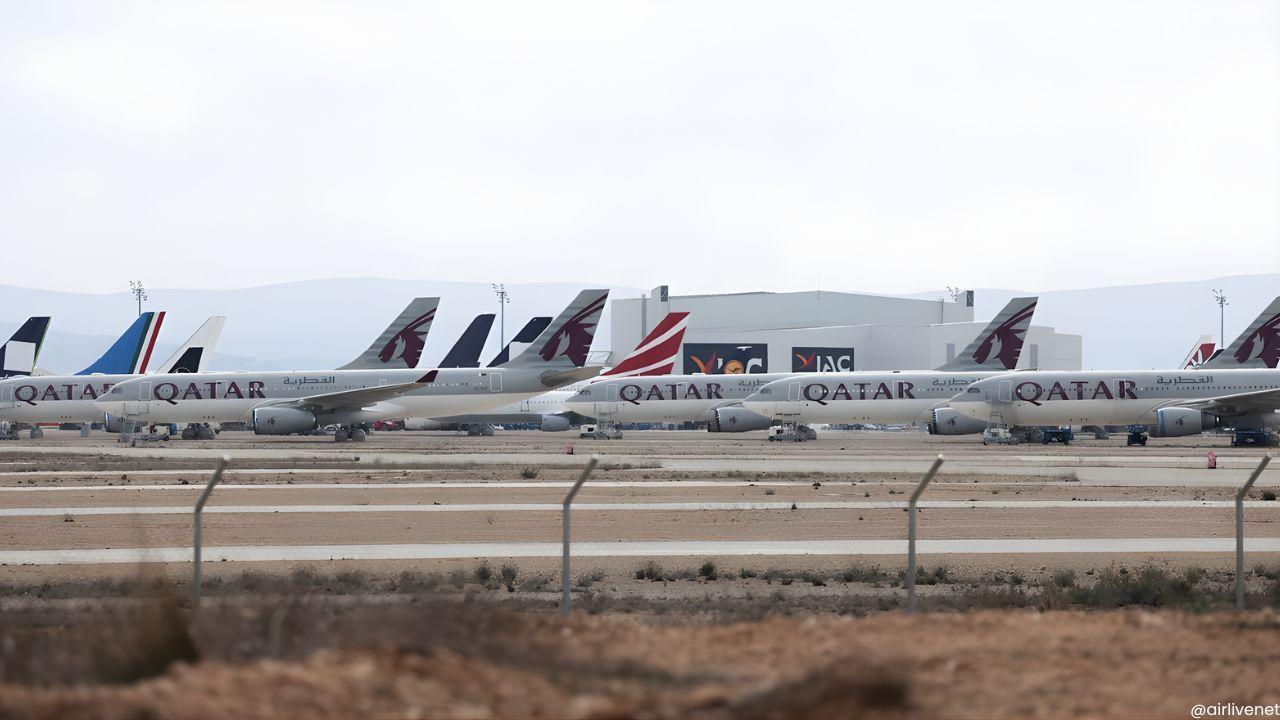
In a move that reflects the shifting dynamics of global aviation, Qatar Airways has begun relocating several of its widebody aircraft to Teruel Airport in Spain. At a time when geopolitical tensions and restricted airspaces are disrupting traditional flight routes, the airline’s decision signals a calculated pause rather than a setback—one that highlights the evolving nature of airline strategy in uncertain times.
Teruel Airport has steadily gained recognition as one of Europe’s most reliable aircraft storage destinations. Its dry climate, expansive space, and specialized infrastructure make it ideal for housing large aircraft for extended periods. For airlines like Qatar Airways, it offers a secure environment to preserve valuable assets while waiting for operational clarity to return.
The relocation of widebody jets is not merely about parking aircraft, it reflects a broader effort to optimize fleet usage. Airlines today are navigating fluctuating demand, longer flight paths due to restricted airspace, and increasing operational costs. By temporarily grounding certain aircraft, Qatar Airways is ensuring that its fleet remains aligned with current demand while maintaining readiness for rapid redeployment.
Ongoing disruptions in key global air corridors have forced airlines to rethink their route planning and capacity deployment. Longer detours and rising fuel costs are putting pressure on operations, making it impractical to keep all aircraft in active service. In this context, strategic storage becomes an essential tool for maintaining efficiency without compromising long-term capability.
The aviation industry has seen similar patterns before, particularly during the pandemic when aircraft storage facilities across Europe were filled to capacity. Teruel once again finds itself at the center of this cycle, underlining its importance in helping airlines navigate periods of volatility. The current situation reinforces how critical such infrastructure has become in the broader aviation ecosystem.
Qatar Airways’ decision underscores a key lesson for the aviation sector adaptability is no longer optional. Airlines must now be prepared to scale operations up or down at short notice, responding to geopolitical shifts, market demand, and operational constraints. In this environment, the ability to strategically pause operations is just as important as expanding them. As uncertainty continues to shape the skies, moves like these reveal a more cautious, calculated approach to aviation—one where resilience and flexibility define success.
Qatar Airways, Teruel Airport, aircraft storage, widebody jets, aviation disruption, fleet strategy, airline operations, Spain aviation








Advances in Aerospace Technology and Commercial Aviation Recovery
Insights into breakthrough aerospace technologies and commercial aviation’s recovery amid 2025 chall

Defense Modernization and Strategic Spending Trends
Explore key trends in global defense modernization and strategic military spending shaping 2025 secu

Tens of Thousands Protest in Serbia on Anniversary of Deadly Roof Collapse
Tens of thousands in Novi Sad mark a year since a deadly station roof collapse that killed 16, prote

Canada PM Carney Apologizes to Trump Over Controversial Reagan Anti-Tariff Ad
Canadian PM Mark Carney apologized to President Trump over an Ontario anti-tariff ad quoting Reagan,

The ad that stirred a hornets nest, and made Canadian PM Carney say sorry to Trump
Canadian PM Mark Carney apologizes to US President Trump after a tariff-related ad causes diplomatic

Bengaluru-Mumbai Superfast Train Approved After 30-Year Wait
Railways approves new superfast train connecting Bengaluru and Mumbai, ending a 30-year demand, easi



