Post by : Amit
Photo : X / Max Montero
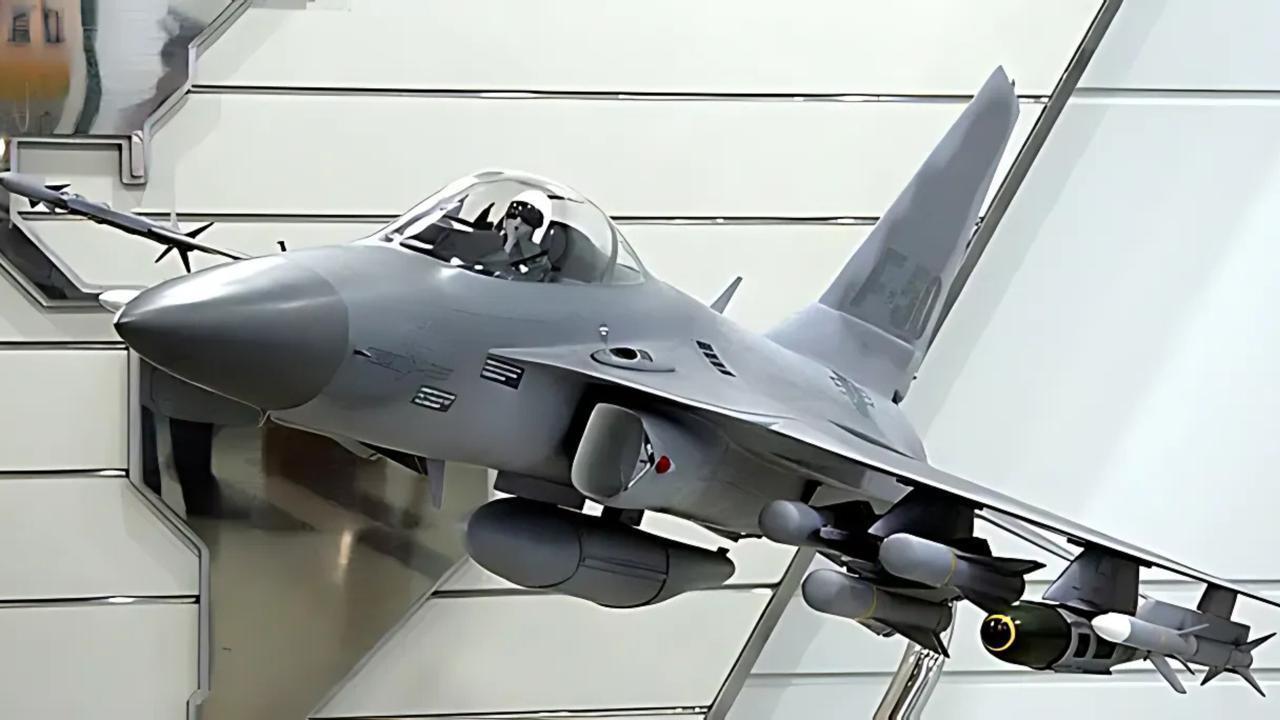
South Korea’s KAI Pushes Stealth Envelope with KF-21EX Internal Bay
In a bold move to enhance the stealth profile and combat flexibility of its next-generation fighter aircraft, Korea Aerospace Industries (KAI) has confirmed plans to equip a new variant of the KF-21 fighter—named the KF-21EX—with an internal weapons bay. The announcement was made during an exclusive update at Farnborough 2025, signaling South Korea’s strategic intention to evolve beyond near-stealth into full-spectrum low observability, making the KF-21EX a more competitive option in the global export fighter market.
The decision to incorporate an internal weapons bay places the KF-21EX squarely in the company of fifth-generation fighters like the F-35, J-20, and Su-57, and represents a major aerodynamic and structural redesign over the baseline KF-21 Block 1. While the baseline variant carries weapons on external pylons, which compromises stealth to an extent, the EX model aims to achieve a cleaner radar cross-section, especially in forward-aspect detection ranges.
The news signals a significant evolution in South Korea's indigenous fighter program, and reflects growing confidence in the country’s aerospace design and systems integration capabilities.
KF-21 Program: From Ambition to Execution
The KF-21 Boramae, developed jointly by South Korea’s Defense Acquisition Program Administration (DAPA) and KAI, is one of Asia’s most ambitious aerospace defense programs. Initially known as the KFX program, the KF-21 was conceived to reduce the country’s dependence on U.S.-built platforms like the F-16 and F-15, and to replace aging fleets while simultaneously boosting defense exports.
The program reached a major milestone in 2022 when the first prototype took flight. Since then, six prototypes have logged over 350 sorties, and KAI is on track to deliver 40 serial-production units to the Republic of Korea Air Force (ROKAF) by 2028 under Block I. However, these initial jets are limited to air-to-air operations only, with air-to-ground and multirole capabilities scheduled for Block II upgrades.
The unveiling of the KF-21EX variant now brings fresh energy into the program, introducing design philosophy upgrades that align the aircraft more closely with fifth-generation doctrines.
Internal Weapons Bay: Game-Changer or Marketing Ploy?
While the exact specifications and bay volume have not been disclosed, KAI officials stated that the new internal weapons bay would be located between the engine inlets beneath the fuselage, and would accommodate air-to-air missiles like the MBDA Meteor or AIM-120 AMRAAM, along with small-diameter precision-guided bombs.
The move is seen as a direct response to growing demands from both domestic and export customers for reduced radar cross-section (RCS) and increased mission survivability. The internal bay will not only enhance stealth performance but also reduce drag, offering fuel efficiency gains and higher combat persistence.
KAI emphasized that this design is not a bolt-on or temporary solution, but part of a larger architecture redesign. A senior official at Farnborough noted:
“We’re not just building an aircraft that looks stealthy—we’re engineering a platform that can truly survive and dominate in heavily contested airspace.”
Structural and Systems Upgrades in KF-21EX
To integrate the internal weapons bay, the KF-21EX will undergo significant airframe and avionics modifications. Key expected changes include:
Sources suggest that KAI has already started digital modeling for the KF-21EX in coordination with key suppliers. While a prototype has not yet been built, a mock-up configuration is expected to be revealed by early 2026, followed by a flight demonstrator by 2027.
The Export Angle: Southeast Asia, Middle East Watch Closely
KAI’s KF-21 has long been pitched as a cost-effective “4.5+ generation” multirole fighter, ideal for countries looking to modernize air forces without the budget or political complexity of acquiring F-35s. Countries like Indonesia (a program partner with a 20% stake), Malaysia, Philippines, and even Saudi Arabia have been noted as potential customers.
However, buyers are increasingly wary of platforms that look stealthy but do not offer all-aspect survivability. The KF-21EX with an internal weapons bay offers a stronger deterrent value, especially in contested regions like the South China Sea or Middle Eastern flashpoints.
By offering near-fifth-gen performance at fourth-gen cost, KAI is attempting to undercut both China’s export-focused JF-17 Block III and India’s upcoming Tejas Mk2 in markets across Asia, Africa, and the Middle East.
Comparing to F-35 and Regional Rivals
While the KF-21EX is unlikely to match the F-35A’s stealth performance, it’s positioning itself as a budget-flexible alternative for countries that can’t afford the full ecosystem that comes with Lockheed Martin’s program—like high-maintenance logistics chains, training suites, and software dependencies.
KAI’s approach focuses on export modularity: allowing buyers to choose between external or internal weapon configurations, different radar options, and even electronic warfare (EW) packages customized to regional threat perceptions.
This plug-and-play model could make the KF-21EX a more attractive, scalable platform for countries looking to operate small squadrons of affordable stealth-capable fighters without the complications of FMS (Foreign Military Sales) deals or political constraints.
A Long Road, But on Track
The introduction of the internal bay on the KF-21EX comes as the Block I version prepares for low-rate initial production (LRIP) in early 2026. With over 80% of systems validated and final operational clearance (FOC) expected in 2027, the EX version is clearly aimed at the Block III timeframe—likely post-2030.
A KAI spokesperson confirmed:
“We are in parallel development. Block I deliveries and training pipelines will continue, while the EX variant advances in parallel with export-readiness as a core driver.”
The internal bay's development will also coincide with potential new engine partnerships. While Block I uses GE’s F414 engines, talks are reportedly underway for more powerful derivatives or co-developed engines with European partners, possibly enabling supercruise in future variants.
South Korea’s Broader Aerospace Ambitions
South Korea’s KF-21EX push reflects not just military ambition but also industrial policy strategy. The country is rapidly becoming a hub for indigenous aerospace development, having already made inroads into helicopters, satellites, and unmanned systems.
President Yoon Suk Yeol’s administration has prioritized defense exports as a major pillar of national growth, and KAI is seen as a flagship enterprise in that vision. The KF-21 program, with its modular architecture, tiered development approach, and adaptability to customer needs, is likely to play a central role in South Korea's ambition to become a Top 5 defense exporter globally by 2035.
A New Contender in Stealth Evolution
The KF-21EX with its internal weapons bay could transform perceptions of South Korea’s aerospace capabilities from license-builders to true next-gen innovators. While challenges around integration, certification, and export competition remain, KAI’s willingness to take on the internal bay challenge shows serious commitment to building a globally credible stealth-capable platform.
As the global demand for affordable but survivable fighters grows, and as geopolitical flashpoints increase demand for tactical airpower, the KF-21EX could find its moment in the sun sooner than expected.
For now, the world will watch as KAI begins a new chapter—not just to fly, but to lead.
KAI, KF-21EX Fighter Jet










Advances in Aerospace Technology and Commercial Aviation Recovery
Insights into breakthrough aerospace technologies and commercial aviation’s recovery amid 2025 chall

Defense Modernization and Strategic Spending Trends
Explore key trends in global defense modernization and strategic military spending shaping 2025 secu

Tens of Thousands Protest in Serbia on Anniversary of Deadly Roof Collapse
Tens of thousands in Novi Sad mark a year since a deadly station roof collapse that killed 16, prote

Canada PM Carney Apologizes to Trump Over Controversial Reagan Anti-Tariff Ad
Canadian PM Mark Carney apologized to President Trump over an Ontario anti-tariff ad quoting Reagan,

The ad that stirred a hornets nest, and made Canadian PM Carney say sorry to Trump
Canadian PM Mark Carney apologizes to US President Trump after a tariff-related ad causes diplomatic

Bengaluru-Mumbai Superfast Train Approved After 30-Year Wait
Railways approves new superfast train connecting Bengaluru and Mumbai, ending a 30-year demand, easi



