Post by : Saif
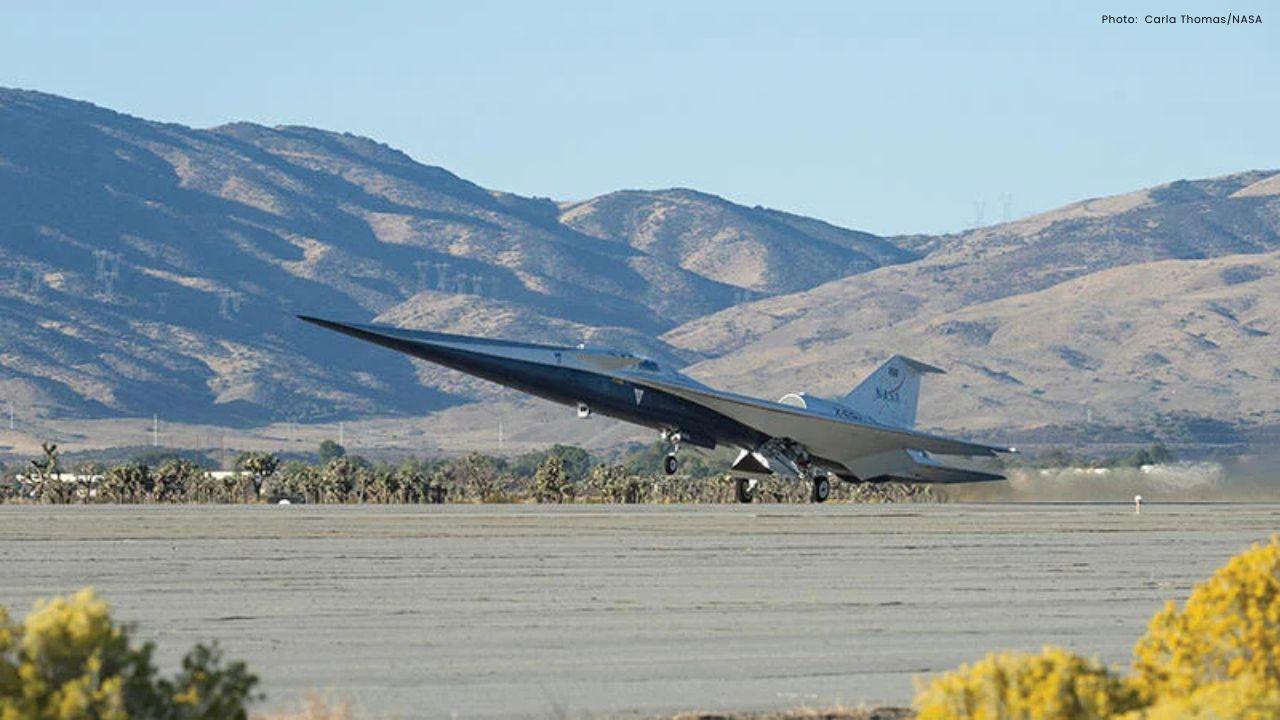
For decades, supersonic passenger travel has been limited by one major problem: the loud sonic boom created when aircraft break the sound barrier. These thunder-like sounds can disturb people and buildings on the ground, which is why many countries banned commercial supersonic flights over land in the 1970s. Today, however, a new experimental aircraft developed by NASA may change that rule. The aircraft is called the X-59, and it is designed to fly faster than the speed of sound while producing only a quiet “thump” instead of a loud boom.
The X-59 is part of NASA’s special research effort known as the Quiet SuperSonic Technology mission, often shortened to Quesst. The project aims to prove that supersonic aircraft can travel at high speeds without causing disturbing noise on the ground. If the technology works, regulators may reconsider the long-standing ban on overland supersonic flights, opening the door to a new era of faster commercial travel.
This unusual aircraft is being developed by NASA in partnership with Lockheed Martin at the company’s famous Skunk Works facility in Palmdale, California. The aircraft is not built to carry passengers. Instead, it is a research platform meant to test new technologies and gather important data about supersonic flight and sound levels.
The design of the X-59 looks very different from most aircraft flying today. It has a long, narrow nose that stretches far ahead of the cockpit. This extended shape is not just for appearance. Engineers created it to carefully control how shockwaves form around the aircraft when it travels faster than sound. Normally, these shockwaves combine and reach the ground as a loud sonic boom. The X-59’s design spreads them out so they arrive as softer sound pulses.
Another unusual feature of the aircraft is that the pilot cannot see directly out the front. Because the nose is so long, it blocks the forward view. To solve this problem, engineers installed an advanced external vision system. High-resolution cameras mounted outside the aircraft send live video images to screens inside the cockpit, allowing the pilot to see what lies ahead. This system represents an important innovation that may appear in future aircraft designs.
The X-59 is expected to fly at about 1.4 times the speed of sound, or roughly 925 miles per hour. It will cruise at high altitudes of around 55,000 feet. At this speed and height, the aircraft will be able to demonstrate how quiet supersonic flight might work in real conditions.
One of the key goals of the project is to collect real data from communities on the ground. After completing initial test flights, NASA plans to fly the aircraft over several cities in the United States. Residents will be asked to share their reactions to the sound they hear. Scientists will use this feedback to measure how people respond to the reduced sonic “thump.”
This information will be shared with aviation regulators in the United States and other countries. Agencies such as the Federal Aviation Administration will review the data to decide whether rules banning supersonic travel over land should be changed. If the rules are updated, aircraft manufacturers may begin developing a new generation of supersonic passenger jets.
The return of supersonic travel could dramatically shorten travel times between major cities. Flights that currently take six or seven hours might be reduced to half that time. For example, trips across large countries or continents could become much faster. This would benefit business travel, global trade, and emergency transportation.
However, experts also note that supersonic travel still faces several challenges. High fuel consumption, environmental concerns, and aircraft development costs must all be addressed before such aircraft become common. The X-59 project is only the first step toward solving the noise problem that has limited supersonic aviation for decades.
Despite these challenges, the X-59 represents one of the most exciting aerospace experiments in recent years. Its sleek shape, advanced technology, and ambitious mission highlight how modern engineering continues to push the limits of aviation.
If the aircraft succeeds in proving that quiet supersonic flight is possible, the skies of the future may look very different. Faster air travel could return in a new, quieter form, bringing distant cities closer together once again.
For now, the X-59 remains a test aircraft, but its impact could be enormous. The lessons learned from this project may guide the design of future passenger jets that travel faster than sound without disturbing the people living below their flight paths.
#trending #latest #NASA #X59 #SupersonicFlight #AviationTechnology #FutureOfAviation #AerospaceInnovation #QuietSupersonic #AircraftEngineering #HighSpeedTravel #armustnews










Advances in Aerospace Technology and Commercial Aviation Recovery
Insights into breakthrough aerospace technologies and commercial aviation’s recovery amid 2025 chall

Defense Modernization and Strategic Spending Trends
Explore key trends in global defense modernization and strategic military spending shaping 2025 secu

Tens of Thousands Protest in Serbia on Anniversary of Deadly Roof Collapse
Tens of thousands in Novi Sad mark a year since a deadly station roof collapse that killed 16, prote

Canada PM Carney Apologizes to Trump Over Controversial Reagan Anti-Tariff Ad
Canadian PM Mark Carney apologized to President Trump over an Ontario anti-tariff ad quoting Reagan,

The ad that stirred a hornets nest, and made Canadian PM Carney say sorry to Trump
Canadian PM Mark Carney apologizes to US President Trump after a tariff-related ad causes diplomatic

Bengaluru-Mumbai Superfast Train Approved After 30-Year Wait
Railways approves new superfast train connecting Bengaluru and Mumbai, ending a 30-year demand, easi



