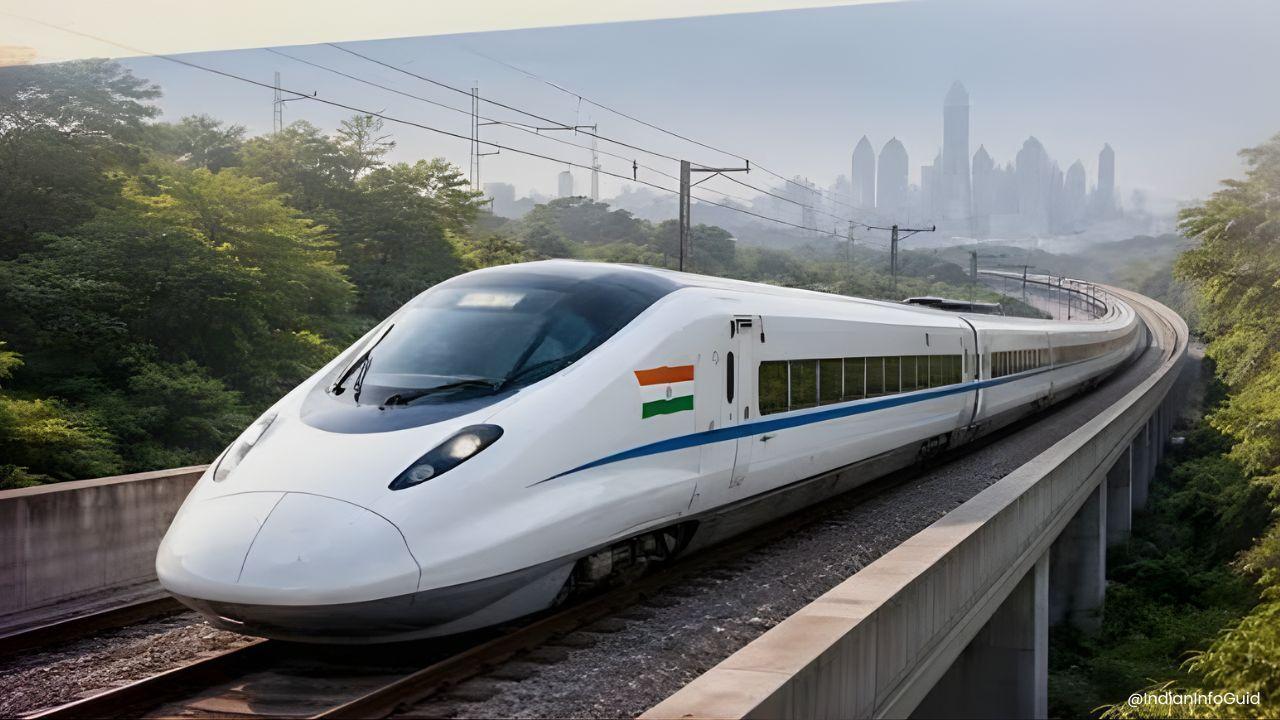
Post by : Avinab Raana
Photo : X / @IndianInfoGuid
India’s flagship Mumbai Ahmedabad Bullet Train project has entered a critical phase after a massive cost escalation of nearly ₹90,000 crore forced authorities to rethink the financial structure of the country’s first high-speed rail corridor. The central government has now stepped in to absorb the additional financial burden in order to ensure that construction continues without disruption.
The move reflects how strategically important the project has become for India’s long-term transportation vision. Designed to connect two of the country’s most powerful economic regions, the high-speed corridor promises to transform intercity mobility while introducing cutting-edge rail technology.
When the Mumbai Ahmedabad Bullet Train project was first planned, the estimated cost was significantly lower. However, several factors gradually contributed to the sharp cost escalation, including construction delays, rising material prices, complex engineering requirements, and extended timelines for land acquisition.
Large-scale infrastructure projects around the world frequently face such financial pressures, but the scale of this increase has drawn considerable attention. Despite the rising costs, authorities remain determined to move forward with the high-speed rail project, seeing it as a long-term investment in national infrastructure.
To prevent the Mumbai Ahmedabad Bullet Train from slowing down, the government has chosen to absorb the additional financial burden rather than delay construction. This decision ensures that work on bridges, tunnels, stations, and elevated tracks continues across the corridor.
The commitment also sends a strong signal that the country remains focused on completing its first high-speed railsystem. Officials believe halting or delaying the project now could increase costs even further and disrupt years of planning and engineering work.
The Mumbai Ahmedabad Bullet Train represents a historic technological shift for Indian railways. Once operational, the high-speed rail line is expected to run trains at speeds of more than 300 kilometers per hour, drastically reducing travel time between the two cities.
Passengers who currently spend several hours traveling by road or conventional trains could reach their destination in nearly half the time. The system will feature advanced safety technology, precision signaling, and modern station infrastructure designed to match global high-speed rail standards.
Supporters argue that despite the cost escalation, the Mumbai Ahmedabad Bullet Train could deliver major economic benefits. High-speed rail networks typically stimulate regional development, attract business investment, and improve connectivity between economic hubs.
Construction of the corridor has already generated thousands of jobs while driving demand for steel, concrete, engineering services, and advanced rail technology. Over time, the high-speed rail network could also inspire additional bullet train corridors across India.
As work continues along the route, the Mumbai Ahmedabad Bullet Train remains one of the most closely watched infrastructure projects in the country. The decision to absorb the cost escalation highlights how determined policymakers are to bring modern high-speed rail to India.
If completed successfully, the project will not only redefine travel between Mumbai and Ahmedabad but could also mark the beginning of a nationwide transformation in how Indians move between major cities.
Mumbai Ahmedabad Bullet Train, High-Speed Rail, Cost Escalation








Advances in Aerospace Technology and Commercial Aviation Recovery
Insights into breakthrough aerospace technologies and commercial aviation’s recovery amid 2025 chall

Defense Modernization and Strategic Spending Trends
Explore key trends in global defense modernization and strategic military spending shaping 2025 secu

Tens of Thousands Protest in Serbia on Anniversary of Deadly Roof Collapse
Tens of thousands in Novi Sad mark a year since a deadly station roof collapse that killed 16, prote

Canada PM Carney Apologizes to Trump Over Controversial Reagan Anti-Tariff Ad
Canadian PM Mark Carney apologized to President Trump over an Ontario anti-tariff ad quoting Reagan,

The ad that stirred a hornets nest, and made Canadian PM Carney say sorry to Trump
Canadian PM Mark Carney apologizes to US President Trump after a tariff-related ad causes diplomatic

Bengaluru-Mumbai Superfast Train Approved After 30-Year Wait
Railways approves new superfast train connecting Bengaluru and Mumbai, ending a 30-year demand, easi



