Post by : Meena Rani
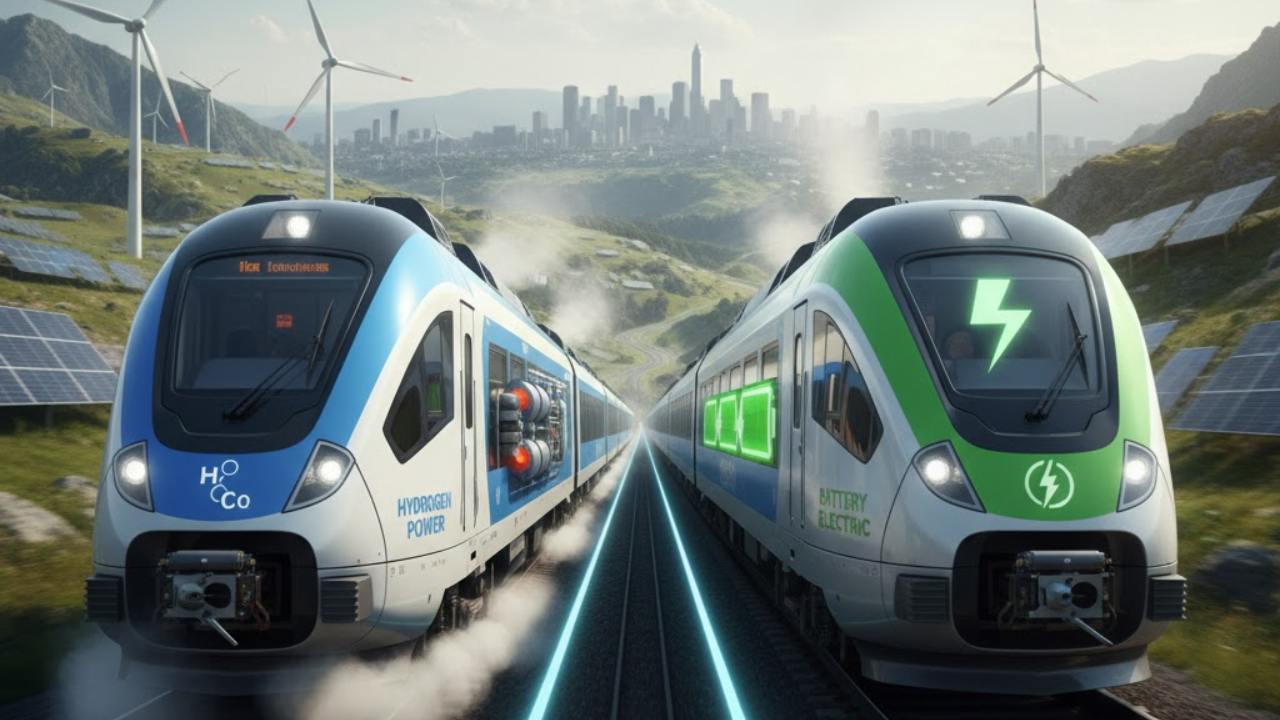
As nations race toward carbon neutrality, the rail sector — once dominated by diesel — is undergoing a major transformation. The push for zero-emission transport has given rise to two powerful technologies: hydrogen fuel cell trains and battery-electric trains. Both promise to eliminate exhaust emissions, cut operating costs, and make rail one of the greenest modes of transport on the planet. But which one will power the future of rail?
Rail transport already produces less pollution than cars, trucks, or planes, yet more than 40% of global rail lines are still non-electrified. In many regions, diesel locomotives remain the only viable option. To achieve net-zero targets by 2050, rail operators are rapidly transitioning to cleaner energy sources — and hydrogen and battery power are leading the charge.
Both options deliver cleaner operations and quieter journeys, but each comes with its own strengths, challenges, and best-use cases.
Hydrogen trains are powered by fuel cells that combine hydrogen gas with oxygen from the air, generating electricity to drive the motors. The process emits only water vapor, making hydrogen one of the most environmentally friendly fuels available.
Hydrogen-powered trains are especially suitable for long-distance and non-electrified routes where installing overhead wires is either expensive or impractical. These trains can cover up to 1,000 kilometers on a single refuel, offering a range that rivals diesel locomotives. Refueling takes just 10 to 20 minutes, much faster than recharging large batteries.
Another major advantage is consistent performance. Hydrogen trains perform well in cold climates and steep terrains, maintaining power output regardless of external conditions.
However, the biggest challenge is infrastructure. Producing and storing hydrogen requires specialized facilities, and the overall process is less energy-efficient than direct electric charging. If the hydrogen is produced using fossil fuels, it can also offset the environmental benefits. The future of hydrogen rail depends heavily on green hydrogen — produced from renewable energy sources such as wind or solar.
Countries like Germany, the UK, Japan, and India are leading the hydrogen train revolution. Alstom’s Coradia iLint, the world’s first operational hydrogen train, has already proven its reliability and sustainability, saving hundreds of tons of CO₂ emissions annually.
Battery-electric trains operate using high-capacity lithium-ion or solid-state batteries that store energy and power electric motors. They can be recharged via overhead lines, charging stations, or regenerative braking — where energy produced during braking is recovered and reused.
These trains are most efficient on short to medium routes, especially in urban and suburban networks. Since they use electricity directly rather than converting hydrogen into power, they deliver energy efficiency of up to 90%, making them one of the cleanest and most cost-effective options in public transport.
Battery-electric trains are also quieter and require less maintenance than hydrogen or diesel locomotives. With no complex fuel systems, they offer smoother acceleration, lower vibration, and reduced operational costs.
The main limitation is range. Most current battery trains can travel between 100 to 250 kilometers before needing a recharge, though this is improving with new solid-state and sodium-ion battery technologies. Charging time is another factor, as recharging large rail batteries can take an hour or more, depending on the infrastructure.
Several models are already running successfully. Siemens’ Mireo Plus B in Germany and Hitachi’s Masaccio in Italy are setting new standards for battery-powered regional rail. In Japan, JR Kyushu’s BEC819 series has been in operation since 2016, proving that battery trains are reliable, efficient, and ideal for intercity use.
Hydrogen trains excel on long regional and rural routes, where electrification is unfeasible and trains need extended range with minimal refueling stops. They are especially suited for countries with large rail networks and renewable hydrogen infrastructure.
Battery-electric trains, on the other hand, are best for shorter, frequent routes — such as metro, suburban, or commuter services. Their high energy efficiency, low maintenance, and quiet operation make them perfect for dense urban areas.
In simple terms, hydrogen is ideal for distance, and batteries are ideal for efficiency. Instead of competing, both technologies are likely to coexist and complement each other in the coming decades.
To overcome individual limitations, rail manufacturers are now developing hybrid models that combine hydrogen fuel cells with batteries. In these systems, hydrogen provides long-range energy, while batteries handle short bursts of acceleration and store regenerative energy.
This dual-mode approach increases flexibility, allowing trains to operate efficiently across various terrains and distances. Several prototypes are already in testing across Europe and Asia, signaling the next step toward fully sustainable rail mobility.
According to Allied Market Research, the global hydrogen train market is expected to reach $25 billion by 2035, while the battery-electric train market will likely exceed $45 billion. Governments are investing heavily in both technologies to meet decarbonization targets and reduce reliance on diesel.
Countries like France, Germany, China, India, and the U.S. are also offering incentives for rail operators to upgrade fleets with clean energy systems.
High-volume trending keywords dominating this space include:
hydrogen train 2025, battery-electric rail systems, green transportation, sustainable mobility, zero-emission trains, hydrogen fuel cell rail, electric train innovation, hybrid locomotives, renewable energy in rail.
The competition between hydrogen and battery power isn’t just a technological battle — it’s a sign of how railways are evolving into smarter, cleaner, and more sustainable ecosystems.
This article is for informational and educational purposes only. It summarizes current technology trends, research developments, and market insights related to rail decarbonization. The information should not be taken as investment, engineering, or policy advice.
hydrogen trains, battery-electric trains, zero-emission rail, green transport, hydrogen fuel cell, electric mobility, sustainable rail, decarbonized transport 2025, hybrid trains, rail innovation





Advances in Aerospace Technology and Commercial Aviation Recovery
Insights into breakthrough aerospace technologies and commercial aviation’s recovery amid 2025 chall

Defense Modernization and Strategic Spending Trends
Explore key trends in global defense modernization and strategic military spending shaping 2025 secu

Tens of Thousands Protest in Serbia on Anniversary of Deadly Roof Collapse
Tens of thousands in Novi Sad mark a year since a deadly station roof collapse that killed 16, prote

Canada PM Carney Apologizes to Trump Over Controversial Reagan Anti-Tariff Ad
Canadian PM Mark Carney apologized to President Trump over an Ontario anti-tariff ad quoting Reagan,

The ad that stirred a hornets nest, and made Canadian PM Carney say sorry to Trump
Canadian PM Mark Carney apologizes to US President Trump after a tariff-related ad causes diplomatic

Bengaluru-Mumbai Superfast Train Approved After 30-Year Wait
Railways approves new superfast train connecting Bengaluru and Mumbai, ending a 30-year demand, easi



