Post by : Avinab Raana
Photo : X / dukeflow_cars
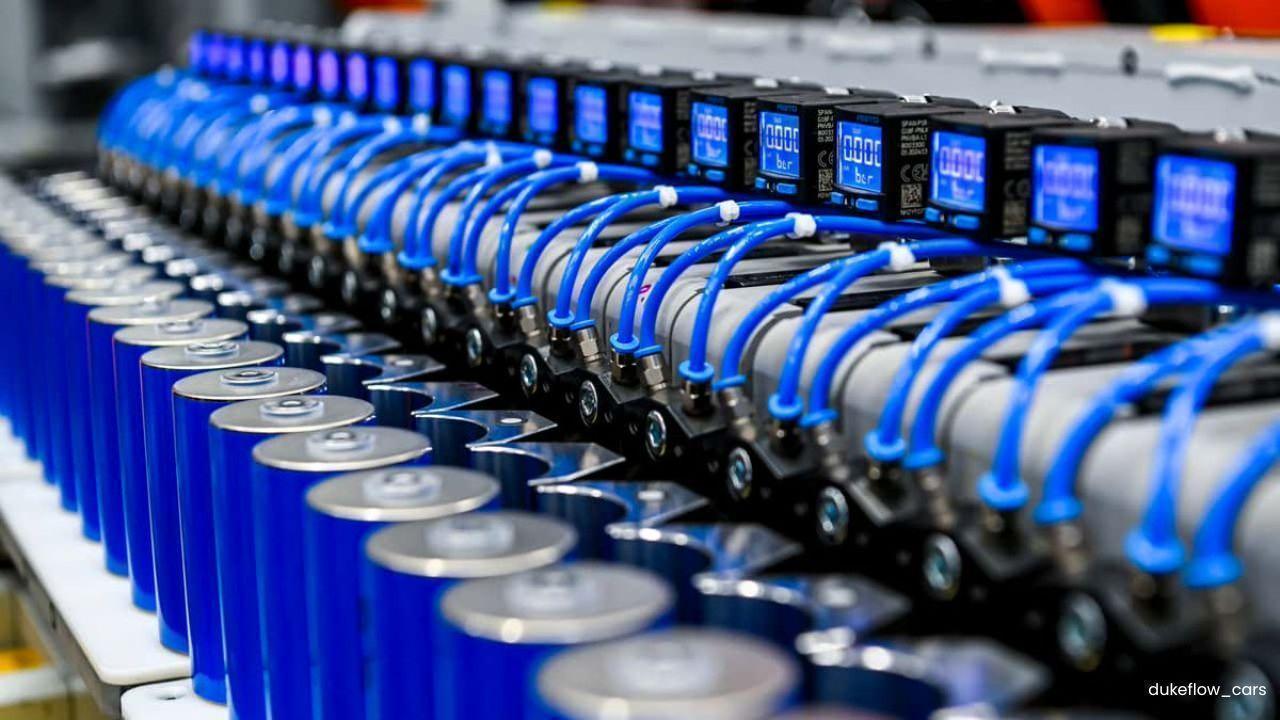
Europe’s aggressive push to build a leading EV battery production ecosystem once seen as a cornerstone of its clean mobility strategy faces an uncomfortable reality: scaling production at globally competitive cost and pace is proving far more difficult than policymakers and industry leaders anticipated. Despite substantial investment, preferential regulation and strong domestic demand for electric vehicles, structural supply chain limitations, raw material constraints and cost pressures are challenging Europe’s ability to meet its own electrification ambitions.
Until recently, Europe’s narrative on EV batteries was one of opportunity: government incentives coupled with industrial policy designed to reduce dependence on foreign supply, especially from Asia, and create a regional manufacturing powerhouse. However, recent performance indicators reveal that progress has not kept pace with ambitions, prompting fresh debate about strategy, competitiveness and industrial resilience.
One of the most visible issues in Europe’s EV battery landscape is the persistent supply chain bottleneck. While factories often referred to as “gigafactories” are being built across the continent, many still lack secure access to critical raw materials like lithium, nickel and cobalt. Unlike East Asian producers who have long-term, diversified supply contracts and strong upstream integration, European producers are scrambling to secure materials at competitive prices.
This gap is compounded by transportation, processing and refining bottlenecks. Localising upstream battery materials production has proven costly and slow, and Europe still relies heavily on imported precursors and active materials. The costs associated with refining and processing within Europe often to meet strict environmental standards further inflate production expenses relative to Asian competitors.
Europe’s lofty environmental and labour standards while essential for sustainable industrial practice inadvertently increase production costs for EV batteries. Energy costs in the region remain high compared to Asian markets, and complex regulatory requirements for land use, emissions reporting and worker protections add layers of expense and time to new factory builds.
The result is a manufacturing cost structure that, for many European producers, struggles to compete with counterparts in China, Japan and South Korea. Despite generous subsidies and EU industrial policy tools, European EV battery prices have not consistently reached the parity needed to attract large-scale consumer and OEM demand without significant incentives.
Faced with these headwinds, European leaders and battery manufacturers are revisiting policy frameworks and market strategies. Efforts are underway to streamline permitting processes for new facilities, create joint procurement vehicles for raw materials and enhance investment in battery recycling technologies to close supply loops. The European Battery Alliance and related mechanisms are also encouraging greater cross-border collaboration rather than fragmented national approaches.
However, industry insiders argue that policy agility must increase. Static incentives and protectionist measures alone won’t overcome the fundamental economic pressures that tilt cost advantages toward entrenched global competitors. Europe must balance sustainability goals with practical supply and cost considerations if it is to carve out a lasting position in the EV battery landscape.
The stakes of Europe’s EV battery production challenges extend far beyond industrial growth. Batteries are a strategic linchpin in the transition to zero-emission transport, energy storage solutions and broader decarbonisation goals. If Europe fails to build a robust, cost-effective battery industry, it risks ceding technological leadership to other regions, weakening its competitive position and slowing progress toward climate commitments.
Moreover, reliance on external suppliers for key components raises geopolitical vulnerabilities, especially as nations vie for control over critical minerals and processing technologies. Europe’s ambition to lead in sustainable mobility now hinges on reconciling high environmental standards with industrial competitiveness in a value chain dominated by global scale and cost leadership elsewhere.
Europe has set one of the most aggressive agendas for EV adoption in the world. Yet the journey from policy ambition to industrial reality is proving arduous. Overcoming material supply constraints, cost disadvantages, and fragmented production capacity will require sustained innovation, strategic public-private partnerships and a willingness to evolve beyond the current policy blueprint.
The Europe EV battery production challenge is a microcosm of broader tensions in the clean energy transition: sustainability goals meeting the hard economics of global competition. How Europe responds in the coming years will not only define its role in EV battery markets but also shape the future of electric mobility and industrial leadership in a decarbonising world.
Europe EV battery production, EV supply chain challenges, European battery industry risks






Advances in Aerospace Technology and Commercial Aviation Recovery
Insights into breakthrough aerospace technologies and commercial aviation’s recovery amid 2025 chall

Defense Modernization and Strategic Spending Trends
Explore key trends in global defense modernization and strategic military spending shaping 2025 secu

Tens of Thousands Protest in Serbia on Anniversary of Deadly Roof Collapse
Tens of thousands in Novi Sad mark a year since a deadly station roof collapse that killed 16, prote

Canada PM Carney Apologizes to Trump Over Controversial Reagan Anti-Tariff Ad
Canadian PM Mark Carney apologized to President Trump over an Ontario anti-tariff ad quoting Reagan,

The ad that stirred a hornets nest, and made Canadian PM Carney say sorry to Trump
Canadian PM Mark Carney apologizes to US President Trump after a tariff-related ad causes diplomatic

Bengaluru-Mumbai Superfast Train Approved After 30-Year Wait
Railways approves new superfast train connecting Bengaluru and Mumbai, ending a 30-year demand, easi



