Post by : Avinab Raana
Photo : X / Aviation A2z
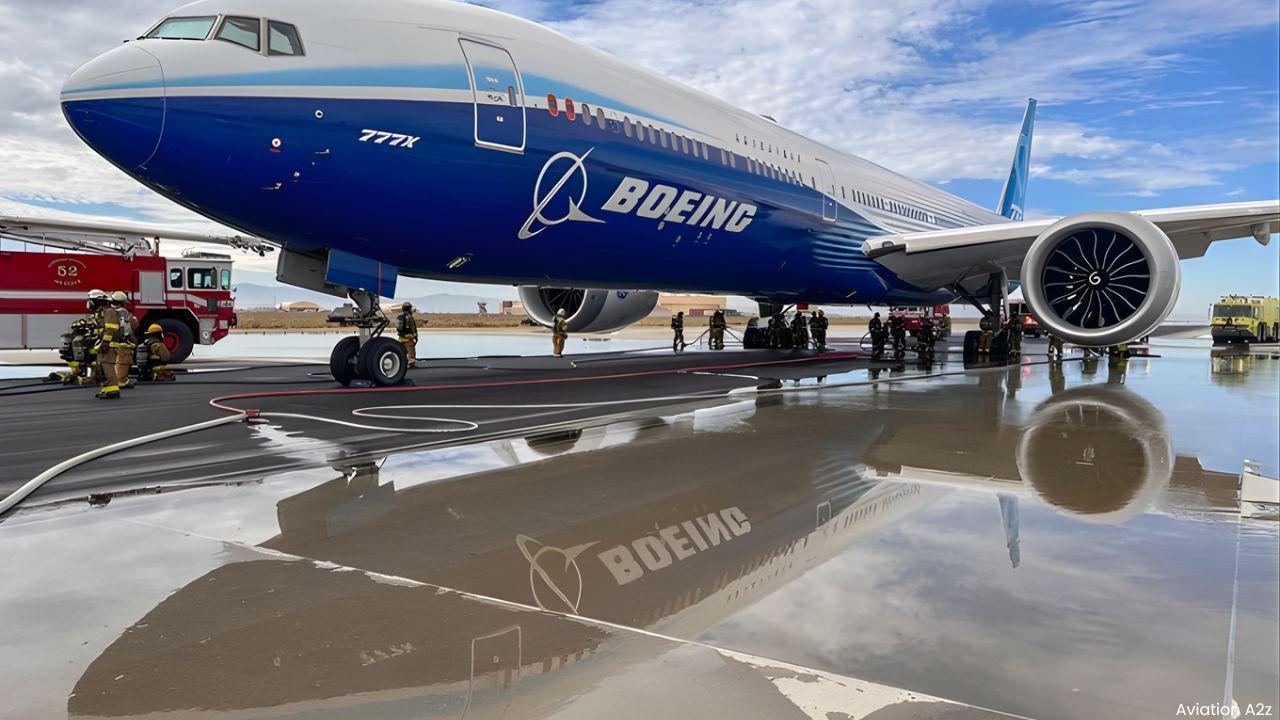
In a major step forward for one of the world’s most closely watched aviation programs, Boeing’s 777X has successfully completed an intense maximum-energy brake test, pushing its systems to temperatures exceeding 2,500°F. The achievement marks a crucial milestone in the aircraft’s long and closely scrutinized certification journey, reinforcing confidence in its operational safety under extreme conditions.
Conducted at high speed with the aircraft loaded to its maximum takeoff weight, the test simulated one of the most critical real-world emergencies—a rejected takeoff at peak performance. The ability of the aircraft to safely stop under such conditions is not just a regulatory requirement; it is a defining benchmark of engineering reliability in modern aviation.
The brake test is designed to replicate a worst-case operational scenario where pilots must abort takeoff at high speed without relying on thrust reversers. In this case, the entire stopping force is handled by the braking system alone, pushing it to its absolute limits.
During the trial, the 777X accelerated to approximately 190 knots before pilots initiated a full-stop maneuver. Engineers intentionally used worn-down brake components to simulate end-of-life conditions, ensuring the system could perform even under the most unfavorable circumstances.The result was a dramatic display of engineering endurance, as the brakes absorbed immense kinetic energy, generating temperatures high enough to cause visible heat glow.
What makes this test particularly significant is not just the heat levels, but the complexity of safety systems operating simultaneously. As temperatures soared, fuse plugs in the wheels melted as designed, allowing controlled tire deflation to prevent catastrophic failure or explosion.
Emergency response protocols were also tested in parallel. Fire crews remained on standby but delayed intervention to mimic real-world response timing, further validating the aircraft’s resilience under extended stress conditions.
Such multi-layered testing demonstrates how modern aircraft are engineered not just for performance, but for redundancy, fail-safe operations, and passenger safety even in extreme edge-case scenarios.
The 777X program has faced years of delays, heightened regulatory scrutiny, and evolving certification requirements. As Boeing’s next-generation widebody aircraft, it represents a significant leap in design, incorporating composite wings, advanced engines, and enhanced cabin efficiency.
Passing the maximum brake energy test signals that the aircraft is steadily progressing through one of the most demanding phases of certification. Each successful test brings the program closer to commercial entry, currently targeted around 2027, with global carriers closely watching its development. In an industry where safety standards are uncompromising, such milestones carry immense weight for both regulators and airline customers.
The successful completion of this high-stakes brake test is more than a technical achievement—it is a statement about the future of long-haul aviation. As airlines seek more efficient, high-capacity aircraft, the 777X is positioned to redefine performance standards in the widebody segment.
At a time when aviation is balancing innovation with heightened safety expectations, Boeing’s progress reflects a broader industry shift toward rigorous validation and resilience-driven design. The heat may have been extreme, but the message is clear: the next generation of aviation is being built to withstand the unimaginable.
#trending #latest,#Boeing777X #AviationSafety #AircraftCertification #AerospaceInnovation #WidebodyAircraft









Advances in Aerospace Technology and Commercial Aviation Recovery
Insights into breakthrough aerospace technologies and commercial aviation’s recovery amid 2025 chall

Defense Modernization and Strategic Spending Trends
Explore key trends in global defense modernization and strategic military spending shaping 2025 secu

Tens of Thousands Protest in Serbia on Anniversary of Deadly Roof Collapse
Tens of thousands in Novi Sad mark a year since a deadly station roof collapse that killed 16, prote

Canada PM Carney Apologizes to Trump Over Controversial Reagan Anti-Tariff Ad
Canadian PM Mark Carney apologized to President Trump over an Ontario anti-tariff ad quoting Reagan,

The ad that stirred a hornets nest, and made Canadian PM Carney say sorry to Trump
Canadian PM Mark Carney apologizes to US President Trump after a tariff-related ad causes diplomatic

Bengaluru-Mumbai Superfast Train Approved After 30-Year Wait
Railways approves new superfast train connecting Bengaluru and Mumbai, ending a 30-year demand, easi



