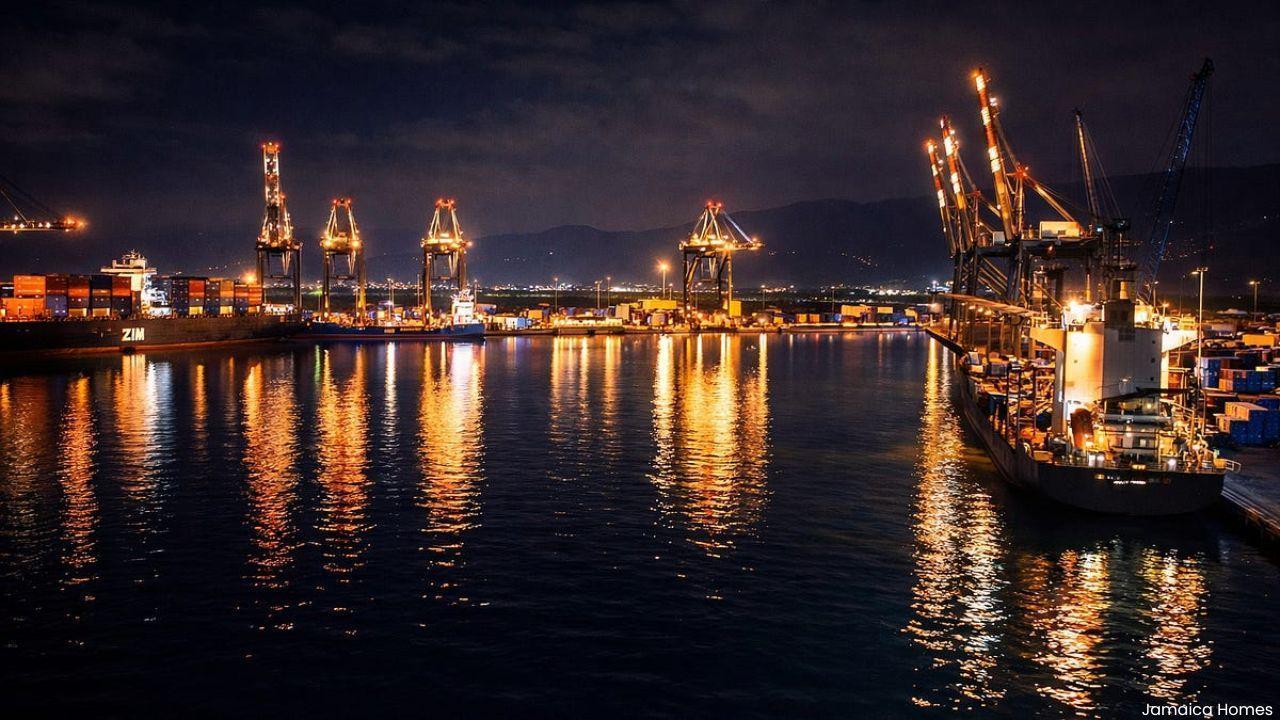
Post by : Avinab Raana
Photo : X / Jamaica Homes
At a time when global supply chains demand speed, precision, and resilience, Southern California’s ports are facing a growing challenge—automation delays driven by institutional hesitation. The ports of Los Angeles and Long Beach, which together form the busiest container gateway in the United States, are struggling to modernize their terminal operations despite long-standing approvals for automation rights.
This slowdown is not a technical limitation but a governance issue. Terminal operators, eager to implement automation technologies, are finding it increasingly difficult to secure approvals from port authorities, creating a disconnect between operational needs and administrative decision-making.
What makes the situation more complex is the fact that terminal operators have had the legal right to automate since 2008. Yet, nearly two decades later, progress remains limited. Projects that could significantly improve efficiency are facing prolonged approval processes, leaving operators in a state of uncertainty.
This hesitation has effectively stalled large-scale deployment of automated systems, even as global competitors move rapidly toward fully automated and semi-automated terminals. The gap between policy and execution is becoming increasingly visible, raising concerns about the long-term competitiveness of US West Coast ports.
Across Asia and Europe, port automation has accelerated dramatically over the past decade, with dozens of terminals adopting advanced systems to streamline cargo handling and reduce turnaround times. Automated stacking cranes, unmanned vehicles, and AI-driven logistics systems are redefining efficiency benchmarks worldwide.
In contrast, Southern California’s hesitation risks pushing cargo volumes toward more efficient ports elsewhere. As shipping lines prioritize reliability and speed, even minor inefficiencies can trigger shifts in routing decisions potentially eroding the region’s dominance in trans-Pacific trade.
Behind the slow pace of automation lies a complex intersection of labor concerns, political pressures, and economic considerations. Automation has long been a contentious issue, with labor unions raising concerns over job displacement and workforce impact.
Port authorities, caught between modernization demands and social responsibility, are proceeding cautiously. However, this cautious approach is increasingly being viewed as a strategic risk rather than a safeguard. In an industry where time is money, delays in adopting efficiency-enhancing technologies can translate directly into lost competitiveness.
The implications of stalled automation extend far beyond port operations. Inefficient cargo handling can lead to longer vessel turnaround times, increased congestion, and higher logistics costs across the supply chain. For importers, exporters, and logistics providers, these delays translate into real financial and operational challenges.
Southern California’s ports have already faced capacity pressures in recent years, with container backlogs and yard congestion highlighting the need for modernization. Without automation, scaling operations to meet future demand will become increasingly difficult, especially as global trade volumes continue to grow.
The hesitation surrounding automation in Southern California ports presents a defining moment for US maritime infrastructure. The choice is no longer between automation and tradition—it is between staying competitive or falling behind.
As global shipping networks evolve, ports that embrace technology will lead the next phase of logistics innovation. For Los Angeles and Long Beach, the path forward requires balancing labor considerations with operational urgency, ensuring that progress is not sacrificed at the cost of long-term relevance.The clock is ticking, and in the race for global trade dominance, delay may be the most expensive decision of all.
#trending #latest,#PortAutomation #SupplyChain #SmartPorts #LogisticsCrisis #MaritimeInnovation








Advances in Aerospace Technology and Commercial Aviation Recovery
Insights into breakthrough aerospace technologies and commercial aviation’s recovery amid 2025 chall

Defense Modernization and Strategic Spending Trends
Explore key trends in global defense modernization and strategic military spending shaping 2025 secu

Tens of Thousands Protest in Serbia on Anniversary of Deadly Roof Collapse
Tens of thousands in Novi Sad mark a year since a deadly station roof collapse that killed 16, prote

Canada PM Carney Apologizes to Trump Over Controversial Reagan Anti-Tariff Ad
Canadian PM Mark Carney apologized to President Trump over an Ontario anti-tariff ad quoting Reagan,

The ad that stirred a hornets nest, and made Canadian PM Carney say sorry to Trump
Canadian PM Mark Carney apologizes to US President Trump after a tariff-related ad causes diplomatic

Bengaluru-Mumbai Superfast Train Approved After 30-Year Wait
Railways approves new superfast train connecting Bengaluru and Mumbai, ending a 30-year demand, easi



