Post by : Amit
Strategic Reboot of a Vital Sector
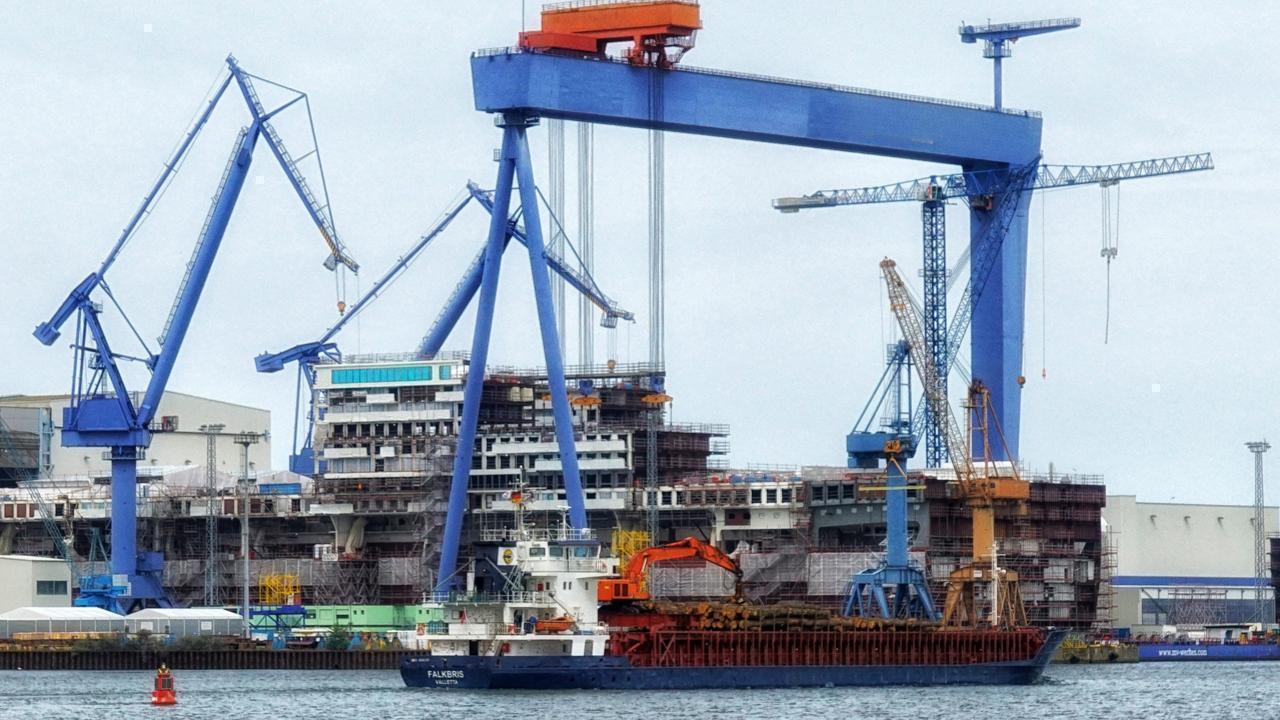
The U.S. shipbuilding industry is at a historic inflection point. For decades, it has struggled under the weight of foreign competition, aging infrastructure, inconsistent investment, and regulatory hurdles. But now, a growing consensus across government, military, and industry stakeholders suggests that revitalizing domestic shipbuilding is no longer a choice—it’s a necessity.
Following a series of national security reports, legislative reviews, and industry consultations, U.S. maritime authorities are outlining a comprehensive path forward. The objective is twofold: to reinvigorate the commercial shipbuilding sector while simultaneously scaling naval and coast guard production to meet 21st-century security demands.
The policy shift marks one of the most significant maritime repositionings since the Reagan-era buildup of the 1980s.
Growing Threats Demand Maritime Strength
At the core of this shipbuilding overhaul is concern over the U.S. Navy's shrinking fleet and the mounting assertiveness of naval powers like China. The Pentagon has warned that the U.S. industrial base lacks the capacity and resilience to rapidly produce warships in a high-end conflict scenario.
In response, the U.S. Navy has called for an expanded fleet of 355 ships—up from the current ~295—to maintain strategic deterrence. However, current production timelines and capacity limits have made that goal elusive.
Meanwhile, China continues to outpace the U.S. in commercial and military ship production. The Chinese shipbuilding industry, heavily subsidized and vertically integrated, now produces more gross tonnage annually than the U.S., Japan, and South Korea combined.
Without major reforms, experts warn that America risks becoming dangerously dependent on foreign builders for merchant vessels, supply ships, and potentially even repair work—undermining both economic security and wartime logistics.
National Maritime Strategy in Motion
In 2023, Congress directed the U.S. Maritime Administration (MARAD) and Department of Defense (DoD) to conduct a full industrial base assessment. Their findings, published in early 2025, triggered alarms across Washington.
The report highlighted that only a handful of major shipyards remain operational at full capacity. Critical suppliers, such as those producing naval-grade steel, turbines, or advanced electronic systems, are shrinking in number. Skilled labor shortages compound the issue, with many veteran shipbuilders nearing retirement and insufficient apprenticeship programs in place to replenish the workforce.
In response, MARAD has rolled out the initial framework of a National Maritime Strategy, focusing on five pillars:
Players Step Up
Major American shipbuilders, including Huntington Ingalls Industries (HII), General Dynamics NASSCO, and Philly Shipyard, have already begun aligning with the strategic vision. HII recently announced a $500 million modernization plan at its Pascagoula yard in Mississippi, aimed at incorporating AI-assisted welding and modular construction lines.
Meanwhile, Gulf Coast yards are expanding their workforce development programs in partnership with community colleges and maritime unions. The idea is to create a talent pipeline that can build everything from patrol boats to aircraft carriers.
Defense ship orders are also accelerating. The U.S. Navy’s Constellation-class frigate program, led by Fincantieri Marinette Marine, is a cornerstone of this resurgence. The shipyard in Wisconsin is undergoing a major expansion, with federal grants and workforce incentives helping to double its capacity.
Civilian Shipbuilding Gets a Lifeline
Although naval programs often dominate headlines, policymakers are equally focused on reviving the U.S. commercial fleet. Today, fewer than 100 large, ocean-going merchant ships fly the U.S. flag—a stark contrast to the hundreds sailing under flags of convenience for competitors like China and Panama.
To reverse that decline, the Maritime Administration is working with shipping companies to create incentive packages for building Jones Act-compliant tankers, cargo ships, and offshore wind installation vessels in U.S. yards.
Recent legislative efforts also aim to enforce “Buy American” mandates for federally subsidized maritime infrastructure, such as ships used for offshore energy, Arctic research, or coastal transport.
International Collaboration and Supply Chain Security
Even as the U.S. ramps up domestic production, cooperation with key allies remains critical. Canada, Japan, South Korea, and Australia are exploring joint ventures in naval design, sharing technologies like modular ship platforms and integrated combat systems.
South Korea’s shipbuilding sector, in particular, is being tapped as a model for scaling efficiency. The Biden administration has held discussions about potential technology transfer and skills exchange programs with Korean shipyards, aimed at leapfrogging inefficiencies in the U.S. system.
In parallel, MARAD is establishing a Maritime Supply Chain Council—bringing together Tier 1, Tier 2, and Tier 3 vendors—to map vulnerabilities and create inventory buffers for key inputs, including semiconductors, electric systems, and titanium parts.
Funding and Political Momentum
A key enabler of this transformation is funding. In FY2025, Congress allocated over $10 billion for shipbuilding programs, including fleet expansion, R&D for autonomous surface vessels, and industrial base revitalization grants. An additional $3.2 billion is earmarked in the Biden administration’s 2026 budget request for shipyard infrastructure upgrades alone.
This wave of funding has bipartisan support, especially as maritime security and economic independence gain urgency amid rising global tensions. Key lawmakers from coastal states—both Republican and Democrat—are pushing hard to ensure their districts benefit from the shipbuilding revival.
A Decade of Transformation
While progress is visible, stakeholders caution that this is a long-term mission. U.S. shipbuilding did not decline overnight—and it will not be reborn overnight either.
Real success will require continuity across administrations, steady funding, and deep coordination between the Navy, Coast Guard, commercial carriers, and industrial suppliers. Digital transformation, skilled labor, and ecosystem rebuilding are the watchwords for the decade ahead.
But the momentum is building. From small drydocks in Louisiana to naval yards in California, welders, designers, and engineers are once again sensing that shipbuilding is more than a job—it’s a patriotic calling.
If the U.S. can stay the course, the next ten years could mark not just the return of its shipbuilding capability, but a restoration of its maritime identity.
USA, Shipping








Advances in Aerospace Technology and Commercial Aviation Recovery
Insights into breakthrough aerospace technologies and commercial aviation’s recovery amid 2025 chall

Defense Modernization and Strategic Spending Trends
Explore key trends in global defense modernization and strategic military spending shaping 2025 secu

Tens of Thousands Protest in Serbia on Anniversary of Deadly Roof Collapse
Tens of thousands in Novi Sad mark a year since a deadly station roof collapse that killed 16, prote

Canada PM Carney Apologizes to Trump Over Controversial Reagan Anti-Tariff Ad
Canadian PM Mark Carney apologized to President Trump over an Ontario anti-tariff ad quoting Reagan,

The ad that stirred a hornets nest, and made Canadian PM Carney say sorry to Trump
Canadian PM Mark Carney apologizes to US President Trump after a tariff-related ad causes diplomatic

Bengaluru-Mumbai Superfast Train Approved After 30-Year Wait
Railways approves new superfast train connecting Bengaluru and Mumbai, ending a 30-year demand, easi



