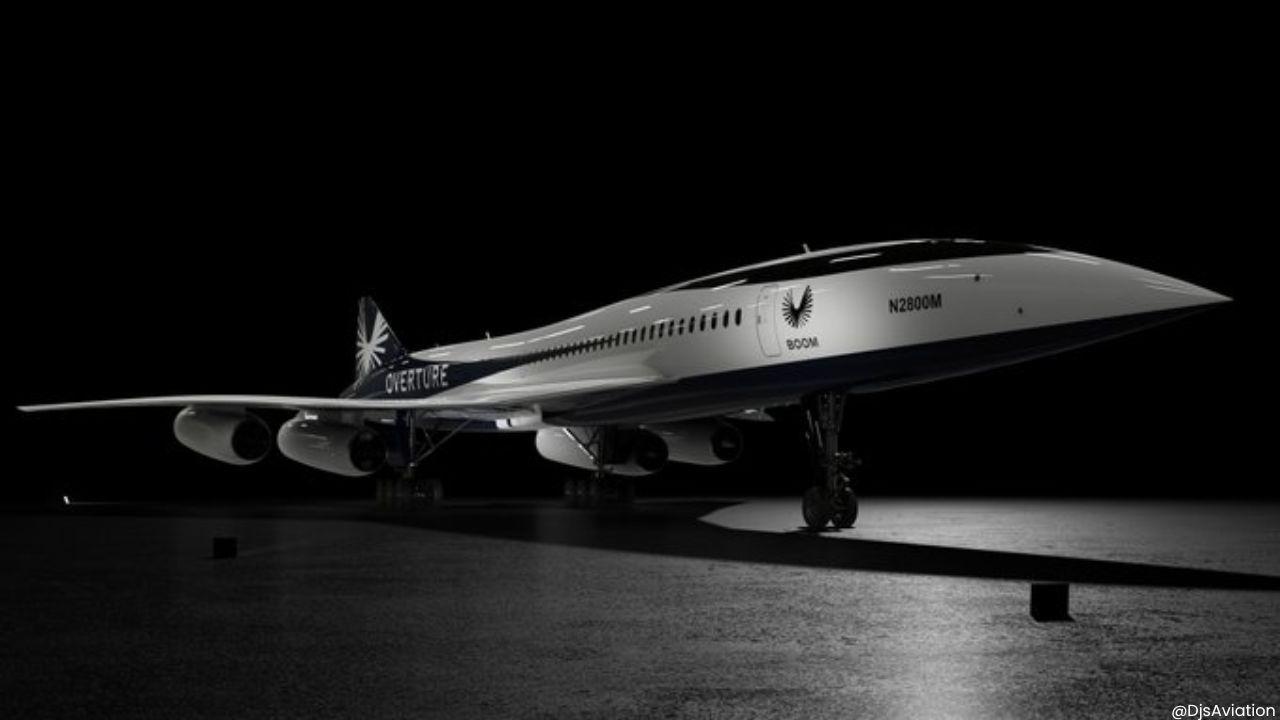
Post by : Avinab Raana
Photo : X / @DjsAviation
The United States is on the verge of a historic aviation transformation as the House of Representatives passes a bill aimed at enabling overland supersonic commercial flights. The legislation, known as the Supersonic Aviation Modernization Act, represents a decisive attempt to dismantle regulatory barriers that have restricted faster-than-sound travel for more than five decades. If fully enacted, the move could pave the way for a new era of high-speed aviation, fundamentally reshaping how people travel across the country.
Since 1973, civil supersonic flights over land have been effectively banned in the United States due to concerns over sonic boom noise and its impact on communities. The newly passed bill challenges this long-standing restriction by directing the Federal Aviation Administration to revise its regulations within a year. Crucially, the proposal allows supersonic travel only if aircraft can operate without producing disruptive sonic booms that reach the ground, reflecting advancements in quieter flight technologies.
The legislation is built on the premise that modern aerospace technology has evolved far beyond the limitations of earlier supersonic aircraft like Concorde. Innovations in “low-boom” or “boomless” flight are now making it possible to travel faster than the speed of sound without the disruptive noise traditionally associated with it. The bill mandates the creation of updated noise standards, ensuring that technological progress is matched by a robust regulatory framework that prioritizes safety and public acceptance.
The push for regulatory change comes at a time when aerospace companies are actively developing next-generation supersonic aircraft. With test programs already demonstrating quieter supersonic capabilities, the bill is expected to unlock significant investment and accelerate commercialization efforts. Airlines and manufacturers see this as a critical opportunity to revive high-speed passenger travel, potentially reducing coast-to-coast flight times dramatically and redefining long-haul aviation efficiency.
Beyond technological innovation, the legislation carries strong economic implications. Supporters argue that enabling supersonic travel will strengthen the United States’ position in the global aerospace industry, ensuring it remains competitive against emerging international players. Faster travel could also unlock new business opportunities, from premium passenger services to time-sensitive cargo operations, creating a ripple effect across the aviation and logistics sectors.
While the House vote marks a major milestone, the bill must still pass the Senate before becoming law. If approved, the responsibility will shift to the FAA to develop and implement new regulations, including certification standards and operational guidelines. This phase will be critical in determining how quickly supersonic travel can move from concept to reality, with timelines dependent on both regulatory readiness and technological maturity.
The passage of this bill signals a bold step toward reviving supersonic aviation in the United States. By aligning regulatory frameworks with modern technological capabilities, the country is opening the door to faster, more efficient air travel. While challenges remain, particularly in ensuring safety, sustainability, and public acceptance, the direction is clear supersonic flight is no longer a relic of the past but a defining feature of aviation’s future
supersonic flight bill US, overland supersonic travel, FAA regulation change 2026, Mach 1 commercial flights, aviation innovation US, supersonic aircraft future, Boom Supersonic








Advances in Aerospace Technology and Commercial Aviation Recovery
Insights into breakthrough aerospace technologies and commercial aviation’s recovery amid 2025 chall

Defense Modernization and Strategic Spending Trends
Explore key trends in global defense modernization and strategic military spending shaping 2025 secu

Tens of Thousands Protest in Serbia on Anniversary of Deadly Roof Collapse
Tens of thousands in Novi Sad mark a year since a deadly station roof collapse that killed 16, prote

Canada PM Carney Apologizes to Trump Over Controversial Reagan Anti-Tariff Ad
Canadian PM Mark Carney apologized to President Trump over an Ontario anti-tariff ad quoting Reagan,

The ad that stirred a hornets nest, and made Canadian PM Carney say sorry to Trump
Canadian PM Mark Carney apologizes to US President Trump after a tariff-related ad causes diplomatic

Bengaluru-Mumbai Superfast Train Approved After 30-Year Wait
Railways approves new superfast train connecting Bengaluru and Mumbai, ending a 30-year demand, easi



