Post by : Avinab Raana
Photo : X / MarineInsight
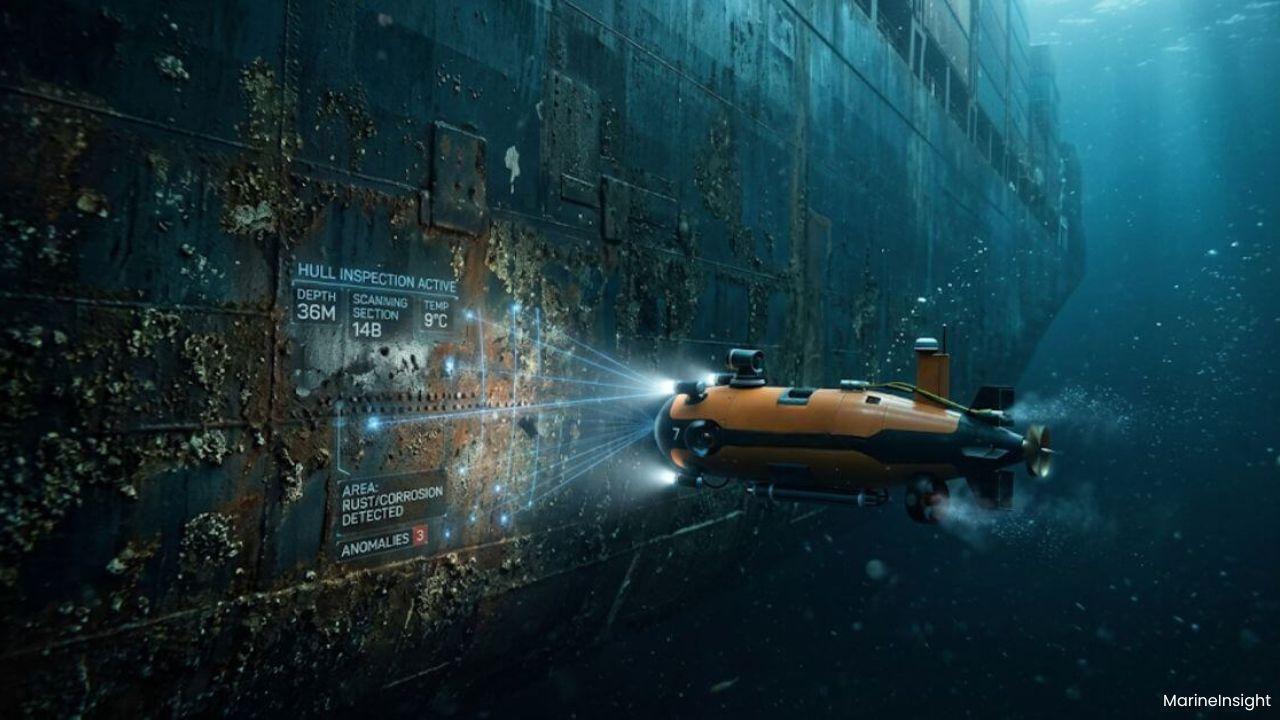
In a breakthrough that could redefine maritime maintenance, IQUA Robotics has successfully validated the use of Autonomous Underwater Vehicles (AUVs) for ship hull inspections eliminating the need for human divers in one of the industry’s most hazardous operations. The development marks a significant leap toward fully autonomous maritime operations, where underwater robots can perform complex inspection tasks with precision, consistency, and minimal human intervention. As global shipping increasingly embraces automation, this innovation signals a turning point in how vessels are monitored, maintained, and certified.
Traditionally, ship hull inspections have relied heavily on divers or remotely operated vehicles, both of which come with operational limitations, safety risks, and higher costs. The newly validated AUV system changes that equation entirely. Designed to operate independently without direct piloting, the vehicle can execute systematic scans of a vessel’s hull, capturing high-resolution data through advanced onboard sensors. This autonomous capability not only enhances inspection accuracy but also allows operations to be conducted more frequently and efficiently, reducing downtime for vessels.
At the core of this innovation is a sophisticated suite of sensors, including sonar, optical imaging, and navigation systems that enable the AUV to map hull surfaces in detail. These technologies allow the robot to detect structural anomalies, biofouling, or damage with a level of precision that rivals and in many cases exceeds manual inspections. By combining real-time data capture with intelligent navigation, the system ensures comprehensive coverage of the hull, even in complex underwater environments.
The implications for the shipping industry are profound. By removing the need for human divers, operators can significantly reduce safety risks associated with underwater inspections, including exposure to hazardous conditions and limited visibility. At the same time, AUVs can operate for extended periods, enabling faster turnaround times and more consistent inspection schedules. This shift not only improves operational efficiency but also aligns with the industry’s broader push toward automation and cost optimization.
The validation of AUV-based hull inspections comes at a time when the global market for autonomous underwater vehicles is rapidly expanding. With increasing demand for offshore inspections, naval surveillance, and underwater mapping, AUV technology is becoming a cornerstone of modern maritime operations. Industry projections indicate strong growth in adoption, driven by advancements in AI, sensor systems, and autonomous navigation capabilities that are enabling more complex and reliable underwater missions.
As IQUA Robotics pushes the boundaries of underwater automation, the success of this project offers a glimpse into a future where ships are maintained, monitored, and even repaired with minimal human intervention. The transition from diver-dependent inspections to fully autonomous systems is more than just a technological upgrade, it is a fundamental shift in maritime operations. For an industry constantly seeking safer, faster, and more efficient solutions, AUV-powered inspections could soon become the new global standard.
AUV ship inspection, IQUA Robotics, autonomous underwater vehicle, hull inspection technology







Advances in Aerospace Technology and Commercial Aviation Recovery
Insights into breakthrough aerospace technologies and commercial aviation’s recovery amid 2025 chall

Defense Modernization and Strategic Spending Trends
Explore key trends in global defense modernization and strategic military spending shaping 2025 secu

Tens of Thousands Protest in Serbia on Anniversary of Deadly Roof Collapse
Tens of thousands in Novi Sad mark a year since a deadly station roof collapse that killed 16, prote

Canada PM Carney Apologizes to Trump Over Controversial Reagan Anti-Tariff Ad
Canadian PM Mark Carney apologized to President Trump over an Ontario anti-tariff ad quoting Reagan,

The ad that stirred a hornets nest, and made Canadian PM Carney say sorry to Trump
Canadian PM Mark Carney apologizes to US President Trump after a tariff-related ad causes diplomatic

Bengaluru-Mumbai Superfast Train Approved After 30-Year Wait
Railways approves new superfast train connecting Bengaluru and Mumbai, ending a 30-year demand, easi



